Publications /
Book / Report

Back
Africa Economic Symposium (AES) 3nd edition - SUMMARY REPORT
Authors
General rapporteur Mahmoud Arbouch
September 2, 2025

The Africa Economic Symposium (AES) has firmly established itself as one of the flagship annual events of the Policy Center for the New South, alongside the Atlantic Dialogues and the African Peace and Security Annual Conference (APSACO). Now in its third edition, AES continues to provide a unique platform for economists, policymakers, and academics from across the continent and beyond to exchange perspectives on the pressing macroeconomic and structural challenges facing Africa. Its mission remains to foster rigorous, evidence-based debates that inform policymaking and support long-term strategies for Africa’s development in an era of uncertainty. 

The 2025 edition, convened under the theme “Bold Moves amid Global Shifts,” explored the difficult policy trade-offs confronting African governments as they navigate a volatile global environment. The continent’s recovery from COVID-19 has been uneven, while debt pressures, supply chain disruptions, and geopolitical tensions weigh heavily on fiscal and economic resilience. Structural challenges such as persistent unemployment, low productivity, and the exclusion of Africa’s youth continue to hinder inclusive growth, even as policymakers are called upon to adapt to deep systemic uncertainty. 

The symposium underscored that many African states are increasingly resorting to short-term stabilization measures—such as accumulating reserves and postponing reforms—that may provide immediate security but risk delaying the structural transformation urgently needed. Against this backdrop, AES 2025 called for a careful balance between fiscal prudence, social investment, and the pursuit of sustainable growth, placing emphasis on reforming governance, improving macroeconomic management, and accelerating structural change. 

The discussions highlighted the urgent need to rethink Africa’s economic strategies in a shifting global order. From debt sustainability and the role of central banks to the promise of financial innovation, digital inclusion, and new instruments such as central bank digital currencies, the symposium emphasized that policy choices must align with long-term transformation goals. The debates also explored the opportunities and challenges of regional integration, trade connectivity, and development finance, all of which are essential levers for Africa’s resilience and prosperity. 

As in previous editions, the Annual Report on African Economies was launched alongside the symposium, offering an in-depth analysis of the continent’s macroeconomic dynamics and structural transformation pathways. More than just a publication, the report reflects the collective intellectual effort of leading scholars and practitioners, providing evidence-based insights to guide decision- makers. Together, the symposium and the report reinforced the Policy Center for the New South’s commitment to fostering forward-looking economic thinking that moves beyond short-term headlines to tackle Africa’s enduring challenges.


RELATED CONTENT

  • November 30, 2023
    This Chapter was originally published on Cape Town Chronicles   The history of debt in Africa is a long and painful one. It began in the 1980s, when the public finances of most developing countries deteriorated following two episodes of oil shocks, leading to a "lost decade" of low growth, increased poverty, and political instability. The recovery from the debt crisis only became possible following initiatives in favour of heavily indebted poor countries (HIPC) and ...
  • November 29, 2023
    To emphasize the importance of addressing this issue and discuss the potential actions that need to be taken to ensure food security and sustainable development in these nations, the Policy Center for the New South is organizing a webinar titled “Rising Food Prices: Understanding the Im...
  • November 28, 2023
    This Working Paper was originally published on erf.org.eg Like many developing countries, Morocco faced a significant increase in public debt following the COVID-19 pandemic. In 2022, Central government debt reached 69.6% of GDP, up from 60.3% in 2019, highlighting the need for a thorough analysis of debt sustainability. This paper examines the main trends in the Moroccan economy over the past two decades, including growth performance, monetary policy and financial condit ...
  • November 24, 2023
    Debt in the Global South was a key point of discussion during the last annual meetings of the World Bank and International Monetary Fund which took place in Marrakesh on October 2023. Whi ...
  • November 22, 2023
    As part of the webinar series: “The Global Economy in Transition : Implications for Developing Countries”, the Policy Center for the New South is organizing a webinar titled: " The Future of Central Banks in Emerging Markets and Developing Countries” to contribute to the ...
  • Authors
    November 21, 2023
    Multiple shocks faced by the global economy over the past three years have apparently shaken the conventional wisdom on gains from economic integration, and have sparked widespread calls for protectionist and nationalist policies. Is there already evidence of some ‘deglobalization’, or do the factors that underlie globalization remain strong enough despite the shocks? So far, there are no signs of an overall reversal in the long-term trend of greater global trade integration. Howev ...
  • November 14, 2023
    This Policy brief was originally published on erf.org.eg Like many emerging and developing economies, Morocco has experienced a significant increase in public debt since the COVID-19 pandemic. Central government debt reached 69.6 percent of GDP in 2022, up from 60.3 percent in 2019, and overall public debt increased to 82.5 percent of GDP in 2022, well above the presumed critical threshold of 60 percent. Therefore, it becomes crucial to conduct a comprehensive debt sustainabil ...
  • Authors
    Touhami Abdelkhalek
    Dorothee Boccanfuso
    November 8, 2023
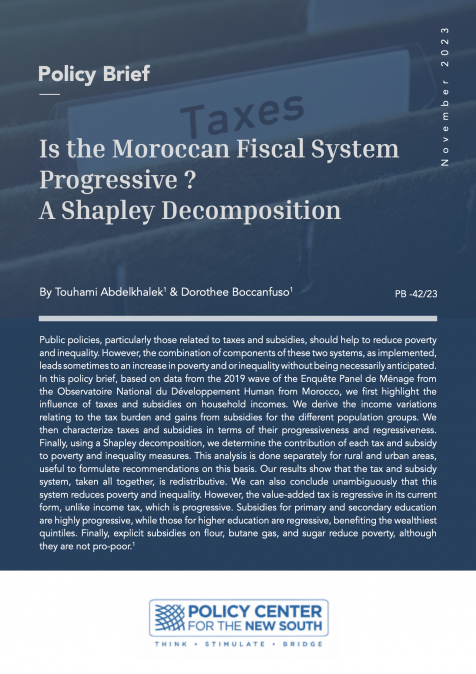
    Public policies, particularly those related to taxes and subsidies, should help to reduce poverty and inequality. However, the combination of components of these two systems, as implemented, leads sometimes to an increase in poverty and or inequality without being necessarily anticipated. In this policy brief, based on data from the 2019 wave of the Enquête Panel de Ménage from the Observatoire National du Développement Human from Morocco, we first highlight the influence of taxes ...