Publications /
Book / Report

Back
Africa Economic Symposium (AES) 3nd edition - SUMMARY REPORT
Authors
General rapporteur Mahmoud Arbouch
September 2, 2025

The Africa Economic Symposium (AES) has firmly established itself as one of the flagship annual events of the Policy Center for the New South, alongside the Atlantic Dialogues and the African Peace and Security Annual Conference (APSACO). Now in its third edition, AES continues to provide a unique platform for economists, policymakers, and academics from across the continent and beyond to exchange perspectives on the pressing macroeconomic and structural challenges facing Africa. Its mission remains to foster rigorous, evidence-based debates that inform policymaking and support long-term strategies for Africa’s development in an era of uncertainty. 

The 2025 edition, convened under the theme “Bold Moves amid Global Shifts,” explored the difficult policy trade-offs confronting African governments as they navigate a volatile global environment. The continent’s recovery from COVID-19 has been uneven, while debt pressures, supply chain disruptions, and geopolitical tensions weigh heavily on fiscal and economic resilience. Structural challenges such as persistent unemployment, low productivity, and the exclusion of Africa’s youth continue to hinder inclusive growth, even as policymakers are called upon to adapt to deep systemic uncertainty. 

The symposium underscored that many African states are increasingly resorting to short-term stabilization measures—such as accumulating reserves and postponing reforms—that may provide immediate security but risk delaying the structural transformation urgently needed. Against this backdrop, AES 2025 called for a careful balance between fiscal prudence, social investment, and the pursuit of sustainable growth, placing emphasis on reforming governance, improving macroeconomic management, and accelerating structural change. 

The discussions highlighted the urgent need to rethink Africa’s economic strategies in a shifting global order. From debt sustainability and the role of central banks to the promise of financial innovation, digital inclusion, and new instruments such as central bank digital currencies, the symposium emphasized that policy choices must align with long-term transformation goals. The debates also explored the opportunities and challenges of regional integration, trade connectivity, and development finance, all of which are essential levers for Africa’s resilience and prosperity. 

As in previous editions, the Annual Report on African Economies was launched alongside the symposium, offering an in-depth analysis of the continent’s macroeconomic dynamics and structural transformation pathways. More than just a publication, the report reflects the collective intellectual effort of leading scholars and practitioners, providing evidence-based insights to guide decision- makers. Together, the symposium and the report reinforced the Policy Center for the New South’s commitment to fostering forward-looking economic thinking that moves beyond short-term headlines to tackle Africa’s enduring challenges.
RELATED CONTENT

  • Authors
    Sandra Polónia Rios
    Pedro da Motta Veiga
    Eduardo Augusto Guimarães
    February 22, 2017
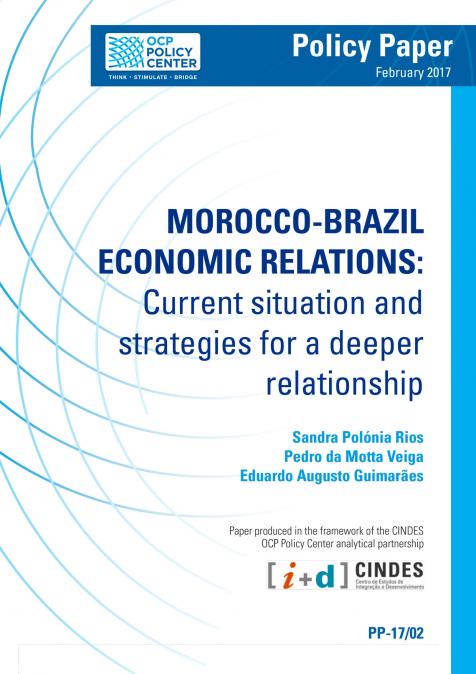
    Despite the sustained growth in the bilateral trade observed at the beginning of the Century, Moroccan – Brazilian economic relations are still going through what could be called the ‘shallow’ phase of relations between two middle-income countries. Trade is concentrated in a few products – those where both countries enjoy long lasting and natural comparative advantages – and face strong difficulties to diversify in terms of products and to upgrade towards more complex models of lin ...
  • Authors
    February 9, 2017
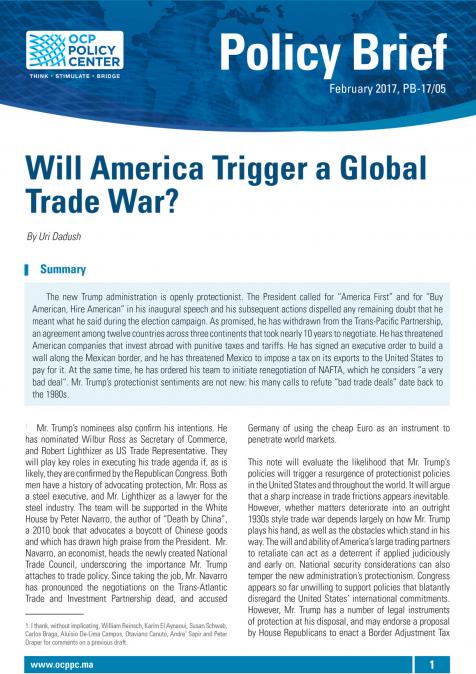
    The new Trump administration is openly protectionist. The President called for “America First” and for “Buy American, Hire American” in his inaugural speech and his subsequent actions dispelled any remaining doubt that he meant what he said during the election campaign. As promised, he has withdrawn from the Trans-Pacific Partnership, an agreement among twelve countries across three continents that took nearly 10 years to negotiate. He has threatened American companies that invest a ...
  • Authors
    Taoufik Abbad
    February 3, 2017
    La réflexion développée dans cet ouvrage part d’un constat alarmant et pressant. Le processus continu et renforcé de l’accumulation du capital, dans lequel s’est engagé le Maroc depuis les années 2000, a permis certes de préserver la stabilité des équilibres fondamentaux et d’amortir les différents chocs exogènes, aussi bien internes qu’externes, mais il n’a pas permis d’insuffler un accroissement plus important des gains de productivité et d’accélérer la transformation de la base p ...
  • Authors
    February 1, 2017
    L’analyse des relations commerciales entre le Maroc et l’Afrique subsaharienne fait ressortir un volume des échanges croissants, reflétant ainsi une dynamisation continue des leurs relations commerciales. Une tendance similaire est observée au niveau des investissements directs étrangers, qui ne cessent de croître au cours des dernières années, traduisant la volonté du Maroc à devenir un acteur majeur dans le développement du continent africain. Ce Policy Brief présente dans un prem ...
  • Authors
    February 1, 2017
    An analysis of trade relations between Morocco and sub-Saharan Africa indicates a growing volume of trade, reflecting a continuation of stimulated trade relations. A similar trend is observed in foreign direct investment (FDI), which has continued to grow in recent years, reflecting Morocco's determination to become a major player in the development of the African continent. This Policy Brief first presents trends in inter-regional trade between Morocco and sub-Saharan Africa, focus ...
  • Authors
    January 25, 2017
    In previous pieces, we have analyzed the run up to the still-ongoing Brazilian recession as a combination of factors. Given an “anemia” of productivity increases, an appetite for public spending without prioritization led to a condition of fiscal “obesity”. The external factors that provided for a boom in the new millennium, notwithstanding underlying vulnerabilities, have dissipated. The economic policy adopted as a response to the growth decline aggravated those vulnerabilities. O ...
  • Authors
    January 12, 2017
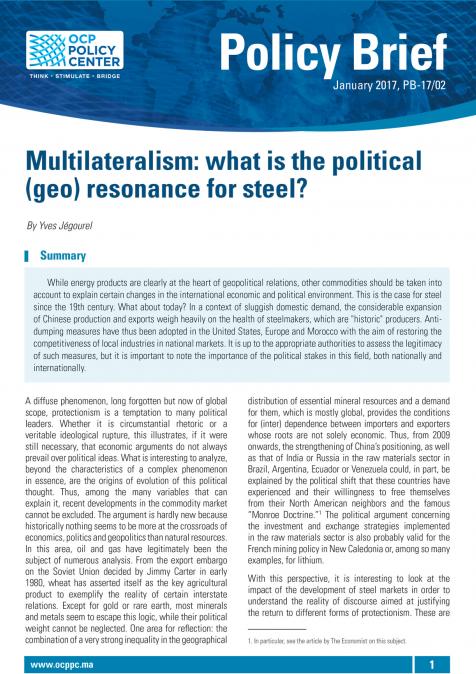
    While energy products are clearly at the heart of geopolitical relations, other commodities should be taken into account to explain certain changes in the international economic and political environment. This is the case for steel since the 19th century. What about today? In a context of sluggish domestic demand, the considerable expansion of Chinese production and exports weigh heavily on the health of steelmakers, which are "historic" producers. Antidumping measures have thus bee ...
  • Authors
    Thomas Awazu Pereira da Silva
    January 2, 2017
    This year, under the patronage of His Majesty King Mohammed VI, the OCP Policy Center (OCPPC) - in collaboration with the German Marshall Fund of the United States (GMFUS) - hosted and organized the fifth Atlantic Dialogues, gathering over 300 high-level international public- and private-sector leaders from the Atlantic Basin to discuss cross-regional issues ranging from economic and social development, security and trade, to migration, resources, and energy. This year’s e ...
  • December 30, 2016
    This podcast is presented by Pr. Eduardo Amaral Haddad. Specialist in regional economics, the professor deliver his thoughts about the relevance of developing a spatial tool in morocco, i ...
  • Authors
    Onasis Tharcisse A. Guedegbe
    December 23, 2016
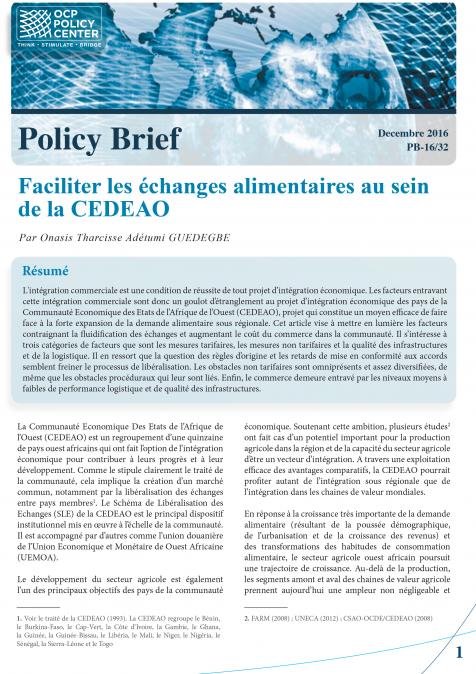
    L'intégration commerciale est une condition de réussite de tout projet d’intégration économique. Les facteurs entravant cette intégration commerciale sont donc un goulot d’étranglement au projet d’intégration économique des pays de la Communauté Economique des Etats de l’Afrique de l’Ouest (CEDEAO), projet qui constitue un moyen efficace de faire face à la forte expansion de la demande alimentaire sous régionale. Cet article vise à mettre en lumière les facteurs contraignant la flui ...