Publications /
Book / Report

Back
Africa Economic Symposium (AES) 3nd edition - SUMMARY REPORT
Authors
General rapporteur Mahmoud Arbouch
September 2, 2025

The Africa Economic Symposium (AES) has firmly established itself as one of the flagship annual events of the Policy Center for the New South, alongside the Atlantic Dialogues and the African Peace and Security Annual Conference (APSACO). Now in its third edition, AES continues to provide a unique platform for economists, policymakers, and academics from across the continent and beyond to exchange perspectives on the pressing macroeconomic and structural challenges facing Africa. Its mission remains to foster rigorous, evidence-based debates that inform policymaking and support long-term strategies for Africa’s development in an era of uncertainty. 

The 2025 edition, convened under the theme “Bold Moves amid Global Shifts,” explored the difficult policy trade-offs confronting African governments as they navigate a volatile global environment. The continent’s recovery from COVID-19 has been uneven, while debt pressures, supply chain disruptions, and geopolitical tensions weigh heavily on fiscal and economic resilience. Structural challenges such as persistent unemployment, low productivity, and the exclusion of Africa’s youth continue to hinder inclusive growth, even as policymakers are called upon to adapt to deep systemic uncertainty. 

The symposium underscored that many African states are increasingly resorting to short-term stabilization measures—such as accumulating reserves and postponing reforms—that may provide immediate security but risk delaying the structural transformation urgently needed. Against this backdrop, AES 2025 called for a careful balance between fiscal prudence, social investment, and the pursuit of sustainable growth, placing emphasis on reforming governance, improving macroeconomic management, and accelerating structural change. 

The discussions highlighted the urgent need to rethink Africa’s economic strategies in a shifting global order. From debt sustainability and the role of central banks to the promise of financial innovation, digital inclusion, and new instruments such as central bank digital currencies, the symposium emphasized that policy choices must align with long-term transformation goals. The debates also explored the opportunities and challenges of regional integration, trade connectivity, and development finance, all of which are essential levers for Africa’s resilience and prosperity. 

As in previous editions, the Annual Report on African Economies was launched alongside the symposium, offering an in-depth analysis of the continent’s macroeconomic dynamics and structural transformation pathways. More than just a publication, the report reflects the collective intellectual effort of leading scholars and practitioners, providing evidence-based insights to guide decision- makers. Together, the symposium and the report reinforced the Policy Center for the New South’s commitment to fostering forward-looking economic thinking that moves beyond short-term headlines to tackle Africa’s enduring challenges.
RELATED CONTENT

  • July 5, 2017
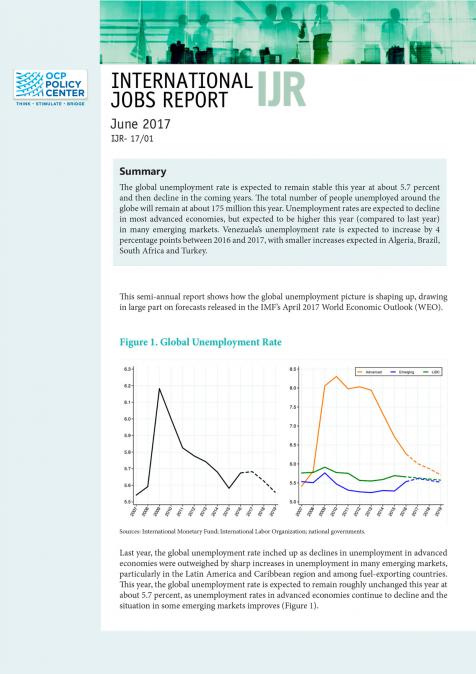
    The global unemployment rate is expected to remain stable this year at about 5.7 percent and then decline in the coming years. The total number of people unemployed around the globe will remain at about 175 million this year. Unemployment rates are expected to decline in most advanced economies, but expected to be higher this year (compared to last year) in many emerging markets. Venezuela’s unemployment rate is expected to increase by 4 percentage points between 2016 and 2017, with ...
  • Authors
    Taoufik Abbad
    July 5, 2017
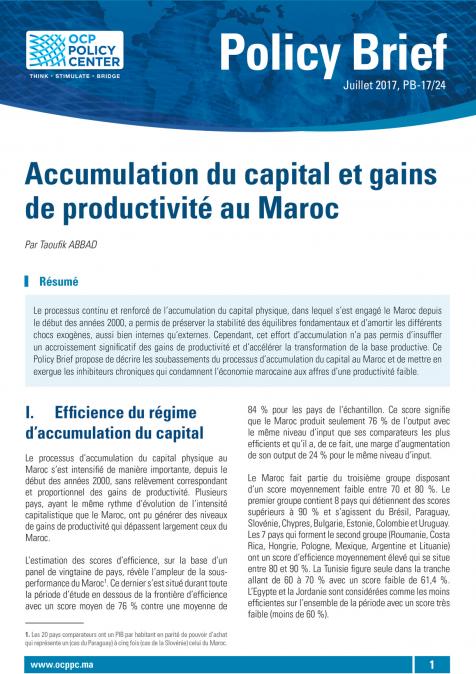
    Le processus continu et renforcé de l’accumulation du capital physique, dans lequel s’est engagé le Maroc depuis le début des années 2000, a permis de préserver la stabilité des équilibres fondamentaux et d’amortir les différents chocs exogènes, aussi bien internes qu’externes. Cependant, cet effort d’accumulation n’a pas permis d’insuffler un accroissement significatif des gains de productivité et d’accélérer la transformation de la base productive. Ce Policy Brief propose de décri ...
  • Authors
    Taoufik Abbad
    July 5, 2017
    The continuous and reinforced process of accumulating physical capital, in which Morocco has embarked since the early 2000s, has helped to preserve the stability of the fundamental equilibrium and cushion the economy from various external and exogenous shocks. However, these accumulation efforts have not led to a significant increase in productivity gains or to an accelerated transformation of the productive base. This Policy Brief aims to describe the underpinnings of the capital a ...
  • Authors
    Aleksandra Liaplina
    June 29, 2017
    The world economy – and emerging market and developing economies in particular – display a gap between infrastructure needs and its finance (Canuto, 2014). On the one hand, infrastructure investment has fallen far short of what would be necessary to support potential growth. On the other hand, abundant financial resources in world markets have been facing very low and decreasing interest rates, whereas opportunities of higher return from potential infrastructure assets are missed. H ...
  • June 21, 2017
    Ce podcast est présenté par Moubarack Lo. Il y analyse l’apport de l’adhésion marocaine à la CEDEAO suite à l’accord de principe donné par ses membres au 51e sommet de Monrovia le 4 juin ...
  • Authors
    Fernanda De Negri
    June 20, 2017
    Brazil’s labor and total-factor productivity (TFP) have featured anemic increases in the last decades (Canuto, 2016). As we illustrate here, contrary to common view, sector structures of the Brazilian GDP and employment cannot be singled out as major determinants of productivity performance. Horizontal, cross-sector factors hampering productivity increases seem to carry more weight. Brazil’s productivity performance has been dismal Since the end of the 1970s, the Brazilian la ...
  • Authors
    June 9, 2017
    In June 2017, the second Annual Report on Commodity Analytics and Dynamics In Africa (Arcadia report) was published, in collaboration between the OCP Policy Center and CyclOpe. Its aim is to annually report on the evolution of the economic, legal, financial and societal links between Africa and the world commodity markets, both with regard to the cyclical changes in the markets, and to the structural changes or failures that may have emerged. Focusing on 2016 and early 2017, the Arc ...
  • Authors
    Matheus Cavallari
    June 6, 2017
    One major policy issue in Brazil is how to boost productivity, while following a path of fiscal consolidation that will take at least a decade to bring the public-debt-to-GDP ratio back to 2000 levels (Canuto, 2016a). The productivityboosting agenda includes not only the implementation of a full range of structural reforms, but also recovering and upgrading the national infrastructure and other long-term investments. Given that fiscal consolidation has already been leading to less t ...
  • June 06, 2017
    Ce podcast est présenté par Mme. Clélie Nallet, chercheur au Programme Afrique subsaharienne de l’Ifri. La catégorie « classes moyennes africaines » est désormais largement mobilisée dans ...