Publications /
Book / Report

Back
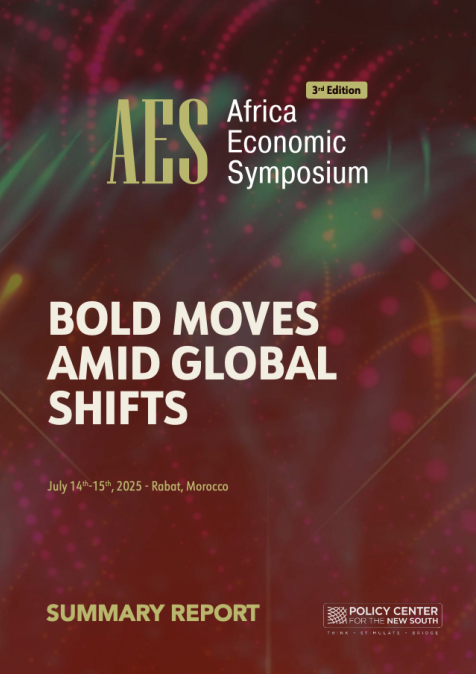
Africa Economic Symposium (AES) 3nd edition - SUMMARY REPORT
Authors
General rapporteur Mahmoud Arbouch
September 2, 2025

The Africa Economic Symposium (AES) has firmly established itself as one of the flagship annual events of the Policy Center for the New South, alongside the Atlantic Dialogues and the African Peace and Security Annual Conference (APSACO). Now in its third edition, AES continues to provide a unique platform for economists, policymakers, and academics from across the continent and beyond to exchange perspectives on the pressing macroeconomic and structural challenges facing Africa. Its mission remains to foster rigorous, evidence-based debates that inform policymaking and support long-term strategies for Africa’s development in an era of uncertainty. 

The 2025 edition, convened under the theme “Bold Moves amid Global Shifts,” explored the difficult policy trade-offs confronting African governments as they navigate a volatile global environment. The continent’s recovery from COVID-19 has been uneven, while debt pressures, supply chain disruptions, and geopolitical tensions weigh heavily on fiscal and economic resilience. Structural challenges such as persistent unemployment, low productivity, and the exclusion of Africa’s youth continue to hinder inclusive growth, even as policymakers are called upon to adapt to deep systemic uncertainty. 

The symposium underscored that many African states are increasingly resorting to short-term stabilization measures—such as accumulating reserves and postponing reforms—that may provide immediate security but risk delaying the structural transformation urgently needed. Against this backdrop, AES 2025 called for a careful balance between fiscal prudence, social investment, and the pursuit of sustainable growth, placing emphasis on reforming governance, improving macroeconomic management, and accelerating structural change. 

The discussions highlighted the urgent need to rethink Africa’s economic strategies in a shifting global order. From debt sustainability and the role of central banks to the promise of financial innovation, digital inclusion, and new instruments such as central bank digital currencies, the symposium emphasized that policy choices must align with long-term transformation goals. The debates also explored the opportunities and challenges of regional integration, trade connectivity, and development finance, all of which are essential levers for Africa’s resilience and prosperity. 

As in previous editions, the Annual Report on African Economies was launched alongside the symposium, offering an in-depth analysis of the continent’s macroeconomic dynamics and structural transformation pathways. More than just a publication, the report reflects the collective intellectual effort of leading scholars and practitioners, providing evidence-based insights to guide decision- makers. Together, the symposium and the report reinforced the Policy Center for the New South’s commitment to fostering forward-looking economic thinking that moves beyond short-term headlines to tackle Africa’s enduring challenges.

RELATED CONTENT

  • Authors
    Michael McKeon
    May 22, 2017
    The U.S. Senate voted to confirm Robert Lighthizer as United States Trade Representative last week, rounding out President Donald Trump’s cabinet and giving momentum to his trade agenda. At his swearing-in ceremony on May 15, Ambassador Lighthizer predicted that President Trump would permanently reverse “the dangerous trajectory of American trade,” and in turn make “U.S. farmers, ranchers and workers richer and the country safer.” This policy shift will begin in earnest in the comin ...
  • Authors
    May 22, 2017
    The best way I can describe my feelings about trade these days is as an unstable anxiety disorder. Following on November 8 2016, the date of the US election, my anxiety level rose markedly as the Trans-Pacific Partnership (TPP) was buried. Shortly thereafter it touched a maximum when a dangerous idea called the Border Adjustment Tax was gaining traction, and the North-American Free Trade Agreement seemed headed the way of TPP. Then I became a little less prone to panic attacks, as v ...
  • Authors
    May 22, 2017
    Despite the threat posed by right-wing nationalism, left wing populism, and protectionism, this is not the end of globalization. The most likely scenario is a continuation of globalization at a rate like that of the last ten years and perhaps even acceleration as the world catches up on lost time in the wake of the financial crisis and its many aftershocks. However, in recent years a formidable resistance to globalization has arisen, and the risk of a sharp and temporary slowdown in ...
  • Authors
    Eliot Pence
    May 19, 2017
    U.S. Africa policy has tended to shift over time and has lacked a clear overarching strategic vision. The Trump administration’s approach in Africa should articulate a limited set of principles that clarifies and solidifies a more sustainable framework that is better suited to address fundamental drivers of Africa’s future. These principles include prioritizing key countries and rationalizing resources, creating an “Investment- First” policy in Africa, and more clearly communicating ...
  • Authors
    May 8, 2017
    Despite fraught politics, the global outlook is strengthening. The next twelve months are likely to be characterized by moderate but steady growth across the world. However, the outlook becomes murkier as we move into the second half of 2018 and 2019. Significant upside in world economic growth is possible on account of building momentum against a background of low capacity utilization, but even greater downside is possible on account of inconsistent economic policy in the Unites St ...
  • April 25, 2017
    Chinese investors are increasingly interested in Africa. Some criticize them for privileging mining investments. A 2017 analysis of these investments shows that investments in mining have not been the only ones privileged by the Chinese operators. Many other sectors such as transport and energy have benefited from Chinese investments, much more so than the mining sector, for example. ...
  • April 24, 2017
    This podcast is performed by Mr. Otaviano Canuto. Central banks of large advanced and many emerging market economies have recently gone through a period of extraordinary expansion of bala ...