Publications /
Policy Brief

Back
Africa and global commodity markets: from cyclical realities to structural
Authors
June 9, 2017

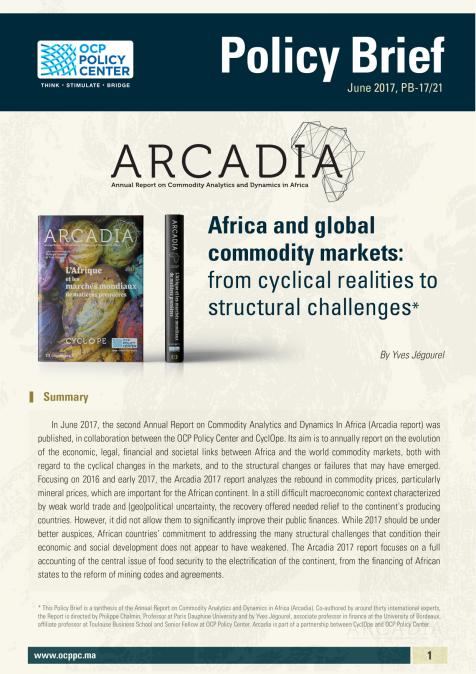
In June 2017, the second Annual Report on Commodity Analytics and Dynamics In Africa (Arcadia report) was published, in collaboration between the OCP Policy Center and CyclOpe. Its aim is to annually report on the evolution of the economic, legal, financial and societal links between Africa and the world commodity markets, both with regard to the cyclical changes in the markets, and to the structural changes or failures that may have emerged. Focusing on 2016 and early 2017, the Arcadia 2017 report analyzes the rebound in commodity prices, particularly mineral prices, which are important for the African continent. In a still difficult macroeconomic context characterized by weak world trade and (geo)political uncertainty, the recovery offered needed relief to the continent's producing countries. However, it did not allow them to significantly improve their public finances. While 2017 should be under better auspices, African countries’ commitment to addressing the many structural challenges that condition their economic and social development does not appear to have weakened. The Arcadia 2017 report focuses on a full accounting of the central issue of food security to the electrification of the continent, from the financing of African states to the reform of mining codes and agreements.

RELATED CONTENT

  • Authors
    Olalekan Samuel
    Mma Amara Ekeruche
    Adedeji Adeniran
    February 12, 2019
    This study was carried out within the framework of the Global Economic Governance Africa (GEGAfrica) funded by the UK Department for International Development. The GEGAfrica programme is a policy research and stakeholder engagement aimed at strengthening the influence of African coalitions at global economic governance forums and increase, inter alia, the visibility and the outreach of African views at the regional and worldwide levels. Policy Center for the New South was requested ...
  • January 1, 2019
    Morocco has moved towards a more flexible exchange rate system, by widening its currency fluctuation bands to +/- 2.5% around a central price. This transition will, in time, equip the Moroccan economy with a macroeconomic instrument acting as a shock absorber and facilitating rapid adjustment at lower costs. In the absence of such a mechanism, adjustment to macroeconomic shocks at times requires a contraction in demand and thereby a cyclical downturn in growth to restore external ba ...
  • Authors
    August 13, 2018
    Depuis la fin de l’année 2017, le président Donald Trump mène plusieurs batailles commerciales, contre différents partenaires, sous prétextes de sauver des emplois industriels américains et de réduire le déficit commercial des États-Unis. S’il est difficile de se prononcer sur les effets des combats commerciaux amorcés par le président Trump, l’importance des opposants et des échanges pour l’économie mondiale en fait une source de risque pour la croissance, les emplois et les prix à ...
  • December 14, 2017
    Moderator: André Caillé, Board Member, Junex - Eric Festa, Senior Vice President, LNG Business Development, Total - R. Andreas Kraemer, Founder & Chairman, Ecologic Institute - Thione Niang, Co-Founder of Akon Lighting Africa - Simone Tagliapietra, Research Fellow, Bruegel ...
  • Authors
    Taoufik Abbad
    July 5, 2017
    The continuous and reinforced process of accumulating physical capital, in which Morocco has embarked since the early 2000s, has helped to preserve the stability of the fundamental equilibrium and cushion the economy from various external and exogenous shocks. However, these accumulation efforts have not led to a significant increase in productivity gains or to an accelerated transformation of the productive base. This Policy Brief aims to describe the underpinnings of the capital a ...
  • Authors
    Taoufik Abbad
    July 5, 2017
    Le processus continu et renforcé de l’accumulation du capital physique, dans lequel s’est engagé le Maroc depuis le début des années 2000, a permis de préserver la stabilité des équilibres fondamentaux et d’amortir les différents chocs exogènes, aussi bien internes qu’externes. Cependant, cet effort d’accumulation n’a pas permis d’insuffler un accroissement significatif des gains de productivité et d’accélérer la transformation de la base productive. Ce Policy Brief propose de décri ...
  • June 21, 2017
    Ce podcast est présenté par Moubarack Lo. Il y analyse l’apport de l’adhésion marocaine à la CEDEAO suite à l’accord de principe donné par ses membres au 51e sommet de Monrovia le 4 juin ...