Podcasts

Back

Who Will Lead the UN Next? Transparency, Gender, and Geopolitics

17
April 2026
By Gabriela Keseberg Davalos & Chaima Jabbar

The 2026 UN Secretary-General election takes place amid rising conflicts, geopolitical fragmentation, and declining trust in multilateral institutions. These converging crises increase the stakes of leadership at the UN. The process is further shaped by regional dynamics, with Latin America seen as a strong contender, though shifting geopolitical interests—especially from major powers—are complicating the selection.
RELATED CONTENT

  • Authors
    November 28, 2025
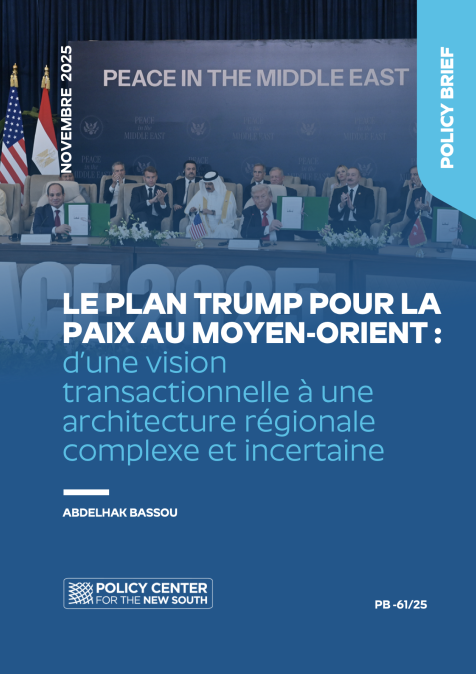
    On November 17, 2025, the United Nations (UN) Security Council adopted Resolution 2803, endorsing President Donald Trump's Comprehensive Plan to end the conflict in Gaza. Contrary to popular belief, the American initiative does not date from the Trump Administration's 2nd term. It was born during his first term.The plan endorsed by the UN Security Council resolution, dubbed the ''Deal of the Century'', is in fact the heir to the initial plan, which bore the name ''Peace to Prosperit ...
  • Authors
    November 28, 2025
    Le 17 novembre 2025, le Conseil de sécurité de l’Organisation des Nations Unies (ONU) a adopté la résolution 2803 par laquelle il fait sien le Plan d’ensemble du Président Donald Trump ayant pour objectif de mettre fin au conflit à Gaza. Contrairement à ce qu’on pourrait croire, l’initiative américaine ne date pas du 2ème mandat de l’Administration Trump. Elle a vu le jour durant son premier mandat.  Le Plan entériné par la résolution du Conseil de sécurité de l’ONU, surnommé ‘ ...
  • November 4, 2025
    Cette tribune a été initialement publiée sur telos-eu.comSi un domaine est supposé devoir échapper à la « démocratie d’opinion », c’est bien la politique étrangère, surtout dans la France de la Ve République. Elle se doit d’être articulée autour d’intérêts à long terme et de calculs savants, sans reculer devant la raison d’Etat. L’opinion des Français à son propos est rarement scrutée.Elle se révèle plus construite qu’on ne croit. Telle est la leçon du sondage Toluna-Louis ...
  • September 24, 2025
    Il y a presque deux ans, le Burkina Faso, le Mali et le Niger ont quitté la CEDEAO (Communauté économique des États de l’Afrique de l’Ouest) - Organisation régionale regroupant quinze pays- pour créer un nouveau groupement d’intégration: l’Alliance des États du Sahel (AES).  Les motivations des trois pays ne sont pas conjoncturelles. Elles reflètent les difficultés de l’Organisation régionale à accompagner les pays en question dans leur quête de sécurité et de développemen ...
  • Authors
    Bruno Saraiva
    July 21, 2025
    This article assesses the economic performance of the original BRICS economies, relative to the growth and currency appreciation projections presented in the papers that introduced the acronym, prior to the grouping becoming a diplomatic, political, and economic reality. It also discusses the BRICS agenda in the current challenging geopolitical context, in which economic fragmentation tends to raise costs for the global economy and presents considerable obstacles for emerging and de ...
  • Authors
    Pepe Zhang
    Fernando Straface
    June 13, 2025
    This Paper was originally published on cebri.org Within an ever-evolving system of multilateral development banks (MDB) currently reshaped by four structural geo-economic trends, the emergence of new MDBs like the Asian Infrastructure Investment Bank (AIIB) and the New Development Bank (NDB) carries great geopolitical significance. Yet the new MDBs, attuned to institutional and operational realities, have not upended the MDB system. Their relationship with long-e ...
  • Authors
    January 21, 2025
    According to the 2024 Secretary-General Report on Sahara (2024 Report), the biggest challenge may be the absence of progress in reaching a political solution to the Sahara Issue. Why has this conflict continued for half a century? In the 2024 Report, the Secretary-General has not attempted to give a stinging report on the resolution failure. The outline of the 2024 Report is largely as usual. Generally, to resolve a conflict, the proper parties should first be exactly identified. O ...
  • Authors
    December 24, 2024
    Over the past 50 years, international law relevant to the Sahara Issue has evolved significantly. Yet, even recent developments, such as a decision by the EU court and a proposal by the Secretary-General’s Personal Envoy to partition the Saharan provinces, have not adequately accounted for these advancements. Actions by a state that may not have been scrutinized in 1975 could now face condemnation under contemporary legal standards. Notably, the right to self-determination must not ...