Keynote Address and Closing Session

October 12, 2023

Keynote Address: The Role of Morocco in Africa’s Development

- Ryad Mezzour, Minister of Industry and Trade, Morocco


Closing Session

- Ryad Mezzour, Minister of Industry and Trade, Morocco


- Montek Singh Ahluwalia, Former Deputy Chairman, Planning Commission of India

Suma Chakrabarti, Chair of ODI Board

Karim El Aynaoui, Executive President, Policy Center for the New South (PCNS)

Enrique Garcia, Former President and CEO, CAF - Development Bank of Latin America

Indermit Gill, Chief Economist and Senior Vice President for Development Economics, World Bank Group

Nobumitsu Hayashi, Governor, Japan Bank for International Cooperation (JBIC)

Donald Kaberuka, Former President, African Development Bank (AfDB)

- Harinder Kohli, Founding Director and Chief Executive, Emerging Markets Forum (EMF

Hiroshi Watanabe, President of Institute for International Monetary Affairs

RELATED CONTENT

  • Authors
    April 30, 2026
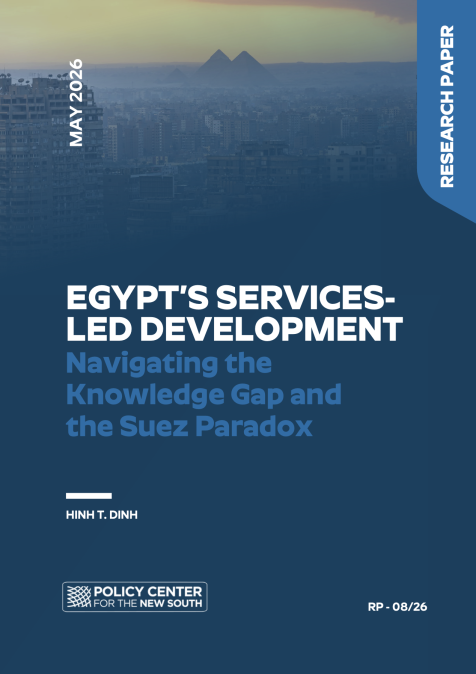
    This paper is the second in a series examining services-led development and global value chain (GVC) integration in the Global South. It applies a three-category analytical framework covering knowledge services (ICT and professional business services), enabling services (transport, logistics, and finance), and local services (retail, hospitality, health, and personal services), to OECD Trade in Value Added indicators. The paper thus  ...
  • April 30, 2026
    يشهد المغرب تحولًا سريعًا في صناعة السيارات الكهربائية، مدفوعًا باستثمارات كبيرة وطموح للانتقال من مجرد منصة تركيب إلى فاعل صناعي متكامل. وبين فرص بناء صناعة بطاريات محلية وخلق وظائف جديدة، تبرز أيضًا تحديات مرتبطة بنقل التكنولوجيا، والتشغيل، والاستدامة. في هذه الحلقة، نفكك هذا التحول و...
  • April 29, 2026
    Cet épisode revient sur la politique monétaire au Maroc, en soulignant sa capacité à maintenir une inflation faible et stable sur le long terme grâce à un cadre macroéconomique solide. Il met en avant le rôle central des réformes institutionnelles et de la Banque centrale dans le renfor...
  • April 29, 2026
    Cette chronique a été initialement publiée sur le site lesechos.fr Les économies en développement font face à un double défi : créer des emplois à grande échelle tout en soutenant la productivité. Quels types de services permettent cette convergence ? Les économistes Hinh T. Dinh et Karim El Aynaoui répondent dans la chronique du « Cercle des économistes ».Les services peuvent-ils se substituer à l'industrie manufacturière comme moteur du développement ...
  • Authors
    April 28, 2026
    Climate policy is increasingly reshaping the conditions under which firms participate in international markets. As some jurisdictions introduce carbon border adjustments, lifecycle emissions standards, and supply-chain traceability requirements, market access is starting to be made conditional on verifiable characteristics of production processes, such as carbon intensity, embedded emissions, and input sourcing, rather than solely on product characteristics or prices. This paper exa ...
  • April 27, 2026
    This episode examines firms’ access to finance in Morocco, highlighting its critical role in business creation and growth, especially for SMEs. It challenges common assumptions by showing that medium-sized firms, rather than small ones, face the most binding financial constraints. The d...
  • April 27, 2026
    This episode examines Morocco’s handicraft sector, highlighting its economic importance as a major source of employment and value creation, despite being often overlooked. It presents new empirical evidence showing the sector’s gradual shift toward more formalized SMEs, while exposing i...
  • Authors
    April 23, 2026
    The call for private finance mobilization received an answer in 2024, with private capital accounting for 66% of total flows in climate finance, while still reaching a record level. This flow of private finance represents a structural shift that can both be considered as a significant achievement and an underexamined governance risk. This paper argues that the growth of private climate finance, while real and consequential, does not always directly serve climate objectives. Pri ...