(FR) Moroccan Automotive and Aeronautics Industries

April 14, 2026

Cet épisode met en avant les industries automobile et aéronautique du Maroc en tant que moteurs de transformation industrielle, portées par le Pacte pour l’Émergence et le Plan d’Accélération Industrielle. Un écosystème solide composé de donneurs d’ordre, de fabricants internationaux et de sous-traitants a renforcé leur intégration dans les chaînes de valeur mondiales, stimulant les exportations et l’emploi qualifié. Ces résultats reposent sur la formation de la main-d’œuvre, des infrastructures de niveau international et des incitations stratégiques. Le prochain défi consiste à adopter des technologies vertes et à s’adapter à l’évolution des chaînes d’approvisionnement mondiales.

Speakers

Larabi Jaïdi
Senior Fellow
Larabi Jaïdi is a Senior Fellow at the Policy Center for the New South and an Affiliate Professor at Mohammed VI Polytechnic University. His areas of expertise include international economy, economic policies, international economic relations, regional economies, social development, international relations, and Mediterranean studies. He also served on the Special Commission on the New Development Model of Morocco, a consultative body created in November 2019 to formulate the country's new developmental guidelines. Jaïdi is a former Professor at Mohamed V University in Rabat-Agdal and a founding member of both the Centre Marocain de Conjoncture and the Groupement d’Etudes et de Recherches sur la Méditerranée.   Prof. Jaïdi previously served as Advisor to the Prime Minist ...

Sabrine Emran
Senior Economist
Sabrine Emran is a Senior Economist at the Policy Center for the New South (PCNS).At the PCNS, Sabrine Emran conducts research on the Energy Transition, Climate Finance, and Critical Minerals, focusing on the energy priorities of developing countries in the context of sustainable development, just energy transition, and global climate commitments.Before joining the PCNS in 2022, Sabrine Emran worked as a Commodities Analyst and Risk Management Consultant, specializing in agricultural and energy commodities as well as foreign exchange risk. She also held a position at Lyxor Asset Management as Request for Proposal and Product Specialist, where she focused on alternative investment asset classes and collaborated closely with institutional investors.Sabrine Emran holds a master’s ...


RELATED CONTENT

  • October 3, 2025
    In this episode, we explore Africa’s industrial challenges and opportunities, showing how AfCFTA-driven integration, green sectors, and inclusive policies for women, youth, and SMEs can foster sustainable growth, resilience, and domestic value capture. ...
  • September 23, 2025
    في هذا العدد من برنامجنا، نسلّط الضوء على موقع المغرب الاستراتيجي الذي يجعله حلقة وصل بين الأطلسي والمتوسط، ودوره المتصاعد في التجارة الدولية والاقتصاد البحري. نناقش التحديات والفرص التي تطرحها هذه الدينامية، من تطوير البنية التحتية وتأهيل الكفاءات، إلى استكشاف آفاق الاقتصاد الأزرق وضما...
  • August 22, 2025
    This episode explores the opportunities and challenges of achieving deeper economic integration under the African Continental Free Trade Area (AfCFTA). We discuss the potential for boosting intra-African trade, industrialization, and investment flows. The conversation highlights the nee...
  • Authors
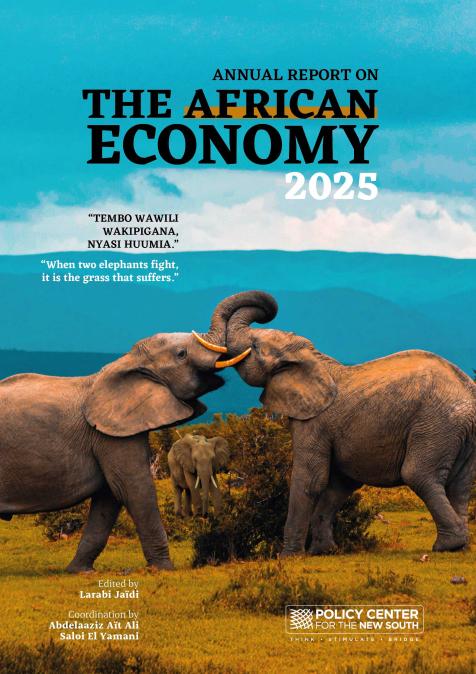
    Edited by
    July 14, 2025
    Available soon on livremoi. The 2025 edition of the African Economic Report continues in the spirit of previous versions. It presents a broad overview of the continent’s economic evolution and offers insights into Africa’s relationship with the rest of the world. In other words, it explores how Africa navigates the effects of global fragmentation within its regional spaces while pursuing its ambition of continental integration. ...
  • Authors
    Seydina Alioune NDIAYE
    July 8, 2025
    La stabilité apparente des taux directeurs de la BCEAO (Banque centrale des États de l'Afrique de l'Ouest) masque une réalité bien plus préoccupante : un resserrement monétaire non déclaré dans la zone UEMOA (Union économique et monétaire ouest-africaine) et une rareté accrue de la liquidité qui frappe tout le système. Nous proposons une analyse en profondeur des mécanismes de cette crise bancaire latente, ses manifestations concrètes sur le tissu économique et ses implications pour ...
  • Authors
    Aram Belhadj
    June 24, 2025
    Les politiques industrielles semblent marquer leur retour, aussi bien dans les grandes puissances économiques que dans les pays émergents et en voie de développement, notamment après la pandémie de la Covid-19, l’accroissement des tensions géopolitiques et commerciales et les effets du changement climatique.L’Afrique n’est pas en reste, surtout qu’une prise de conscience des enjeux liés à la position continentale dans un monde multipolaire est en train de naître. Même au niveau de l ...
  • Authors
    June 18, 2025
    In 2000, The Economist dismissed Africa as the “Hopeless Continent”—a label reflecting a broader system of marginalization rooted in colonial legacy and post-Cold War neglect. This essay offers a realist reappraisal, arguing that Africa’s growing strategic relevance is not the result of benevolence, but of structural necessity.Amid a fracturing global order and the rise of transactional geopolitics under Trump 2.0’s Bessent Doctrine, Africa has become indispensable: rich in critical ...
  • Authors
    Zakaria Elouaourti
    September 13, 2024
    This Paper was originally published on emerald.com   Purpose This paper examines the dynamics of structural transformation in Morocco since 1970 by analyzing input-output tables expressed in terms of employment and output levels across 24 sectors. Design/methodology/approach This study employs a twofold methodological approach. Firstly, it examines the evolution of sectoral employment shares over time using World Bank data. Secondly, it utilizes Input-Output analysis to ex ...