( EN ) Plenary VIII: Will the Rules-Based Trading System Survive?

December 14, 2019

Moderator John Yearwood, President and CEO, Yearwood Media Group Speakers Uri Dadush, Senior Fellow, Policy Center for the New South Matthias Fekl, Former Minister for Foreign Trade, France Renato Flôres, Director, International Intelligence Unit, Fundação Getulio Vargas

Speakers
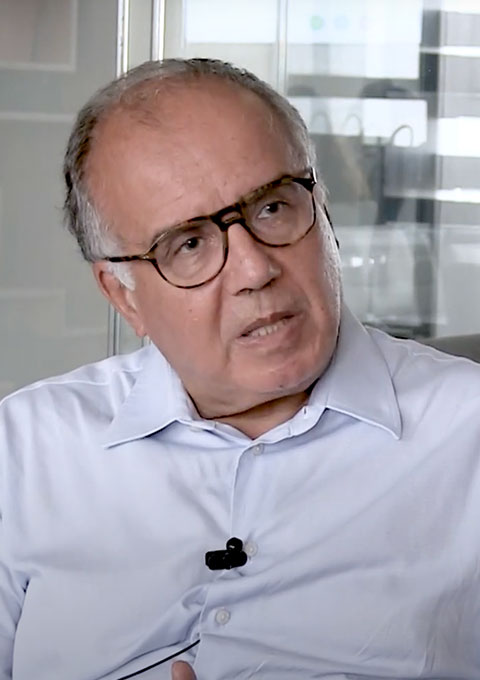
Uri Dadush
Non-Resident Senior Fellow
Uri Dadush is non-resident Senior Fellow at the Policy Center for the New South, where he served as Senior Fellow from its founding in 2014 until 2022. He is Research Professor at the School of Public Policy, University of Maryland and a non-resident scholar at Bruegel. He is based in Washington, DC, and is Principal of Economic Policy International, LLC, providing consulting services to the World Bank and to other international organizations as well as corporations. Previously, he served as Director of the International Economics Program at the Carnegie Endowment for International Peace and, at the World Bank, was Director of the International Trade, Economic Policy, and Development Prospects Departments. In the private sector before that he was President of the Economist Int ...
John Yearwood
President and CEO, Yearwood Media Group
An award-winning multimedia journalist, John Yearwood is President and CEO of Yearwood Media Group, a global consulting and content creation firm. In his role as President/CEO of Yearwood Media, he advises companies seeking to do business in emerging markets, with a particular focus on Africa and Asia. In 2019, he was appointed honorary chair of the the National Association of Black Journalists annual convention, which convened 4,100 black journalists in Miami. He sits on several boards, including the Austria-based International Press Institute, where he is the former chairman. Former world editor of the Miami Herald. The World Desk won numerous awards under his leadership, including two McClatchy Company President’s Awards and the Arthur Ross Award for best coverage of Latin ...

RELATED CONTENT

  • April 27, 2026
    This episode examines Morocco’s handicraft sector, highlighting its economic importance as a major source of employment and value creation, despite being often overlooked. It presents new empirical evidence showing the sector’s gradual shift toward more formalized SMEs, while exposing i...
  • April 14, 2026
    Cet épisode met en avant les industries automobile et aéronautique du Maroc en tant que moteurs de transformation industrielle, portées par le Pacte pour l’Émergence et le Plan d’Accélération Industrielle. Un écosystème solide composé de donneurs d’ordre, de fabricants internationaux et...
  • Authors
    April 6, 2026
    World trade was more resilient than expected during 2025. Its growth probably resulted from the way the rest of the world reacted to the U.S. tariffs. Other factors also had an impact, including moves by exporters to the U.S. in the first half of 2025 to get ahead of the tariffs, and the boom in global tech capital expenditures driven by investment in artificial intelligence (AI).The trade pattern observed in 2025 and early 2026 could point to a new architecture of world trade. Ther ...
  • April 6, 2026
    Trade agreements, in earlier eras, were instruments of exchange. In the present one, they have become instruments of order. The EU–Mercosur agreement, after more than two decades of negotiation, reaches a decisive moment—not merely as a framework for tariff reduction, but as a mechanism through which competing visions of economic organization are projected and contested. ...
  • Authors
    April 1, 2026
    We are now in the fifth week since the U.S. airstrike that killed top leaders of the Iranian regime, initiating a war involving the United States and Israel against the country. More than a month of mutual bombardments between Iran and Israel has ensued, extending to other Persian Gulf nations, U.S. military installations—and even Cyprus. From a global perspective, the impact has stemmed primarily from disruptions to regional production of goods and the blockade of the Strait of Hor ...
  • March 27, 2026
    This interview analyzes how tariff wars are transforming global power dynamics, disrupting trade systems, and redefining trade policy as a geopolitical tool, while examining the risks and opportunities for emerging economies and the Global South, the repositioning of regions like Latin ...
  • Authors
    Jonathan Berkshire Miller
    March 10, 2026
    At the Atlantic Dialogues in December 2025, I argued that a period was underway in which trade and security could no longer be analytically or practically separated. Assessments have solidified in recent months regarding the emergence of a geoeconomic world order. Geoeconomics was a gradual transition from a purely geopolitical focus on military force, to an emphasis on economics to gain competitive advantage. It is no longer a transitional phase, but an emerging structural componen ...
  • Authors
    March 3, 2026
    The February 20 United States Supreme Court decision against President Donald Trump’s use of the U.S. International Emergency Economic Powers Act (IEEPA) to establish tariffs has led him to resort to other legal instruments. So-called U.S. reciprocal tariffs on countries set out in April 2025 were based on IEEPA, as were tariffs that allegedly punished countries for allowing fentanyl into the U.S. Trump tried to evade the constraints presented by other legal instruments that could f ...
  • Authors
    Sofia Formigli
    February 13, 2026
    There is a story told by Václav Havel, the Czech dissident writer who later became president after the fall of communism. In his essay The Power of the Powerless, Havel describes a shopkeeper who, every morning, places a sign in his window reading: “Workers of the world, unite!” He does not believe in it. Nor do the people around him. Yet the sign remains. ...