#COVID-19 - Vers une nouvelle régulation de la mondialisation - Interview de Rachid Houdaigui

April 17, 2020

- Que pourraient être les effets du COVID-19 sur l’économie politique internationale ? - Comment se présente le débat international sur cette question ? - Que font les Etats pour se préparer à l’après COVID-19 ?

Speakers
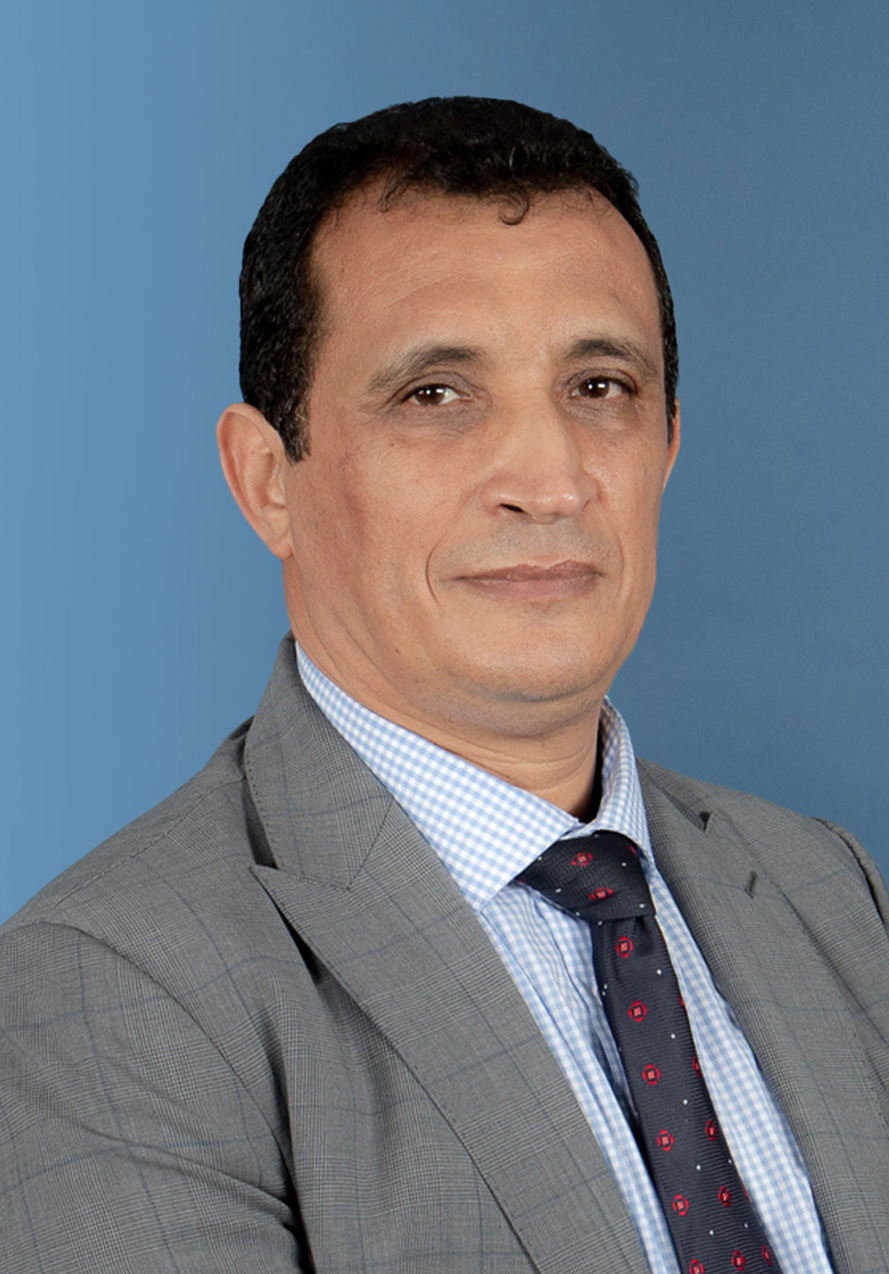
Rachid El Houdaigui
Senior Fellow
Rachid El Houdaïgui is a Senior Fellow at the Policy Center for the New South and an Affiliate Professor at Mohammed VI Polytechnic University. He also serves as a professor of International Relations at Abdelmalek Essaadi University's Law Faculty in Tangier. His expertise encompasses international relations, geopolitics, defense and security, focusing on the Mediterranean region, North Africa, and the Arab world. He also serves as a professor at the Royal College of Advanced Military Studies in Kenitra and is a visiting professor at Cergy-Pontoise University (Paris), Cadiz University (Spain), and La Sagesse University (Beirut, Lebanon).   He is the founder of the Moroccan-Spanish review "Peace and International Security" and oversees the Observatory of Mediterranean St ...


RELATED CONTENT

  • March 31, 2016
    In the context of the strategic partnership between OCP Policy Center and the German Marshall Fund of the United States, the Policy Center is a key partner for the Brussels Forum organized by GMF. - Dr. Karim El Aynaoui, Managing Director, OCP Policy Center - Amb. Masafumi Ishii, Amba...
  • March 14, 2016
    During the Lisbon Summit back in 2010, NATO adopted its third post-bipolar Strategic Concept acknowledging the structural and functional transformation process. In addition to its traditional mission of ensuring mutual defense, stabilizing its surroundings and global power projection capability now adds to the organization’s mission. As a matter of fact, the role of NATO could be shifting from a regional defense alliance to that of a global player. However, one can only wonder wheth ...
  • Authors
    February 23, 2016
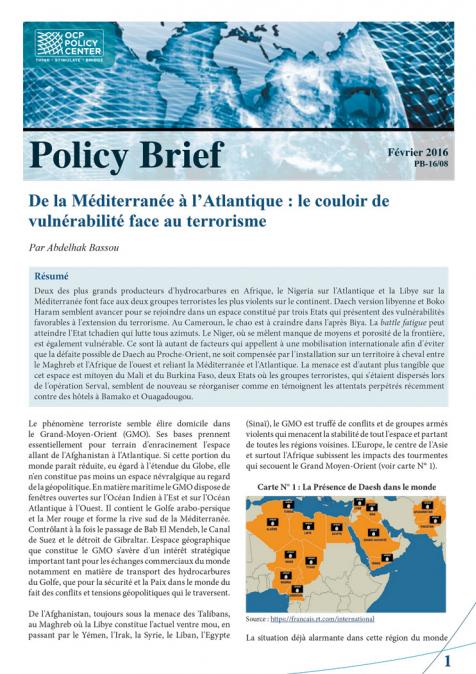
    Deux des plus grands producteurs d'hydrocarbures en Afrique, le Nigeria sur l'Atlantique et la Libye sur la Méditerranée font face aux deux groupes terroristes les plus violents sur le continent. Daech version libyenne et Boko Haram semblent avancer pour se rejoindre dans un espace constitué par trois Etats qui présentent des vulnérabilités favorables à l'extension du terrorisme. Au Cameroun, le chao est à craindre dans l'après Biya. La battle fatigue peut atteindre l'Etat tchadien ...
  • February 23, 2016
    This podcast is performed by Eduard Soler. This webinar will analyze the results of the 20D elections, drawing scenarios of potential impacts for Spanish foreign policy in terms of priori ...
  • Authors
    Jean-Yves Haine
    February 18, 2016
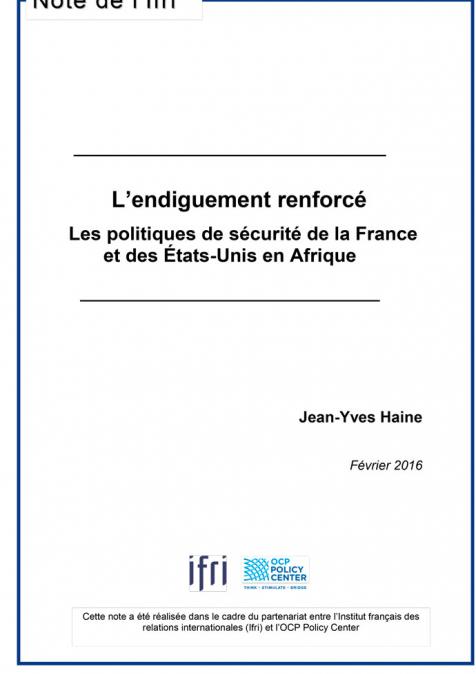
    Bien que les États-Unis soient moins présents en Afrique que la France, leurs politiques de sécurité sur le continent ont des objectifs souvent partagés et parfois poursuivis en commun. Si l’urgence des crises humanitaires a longtemps été au coeur des interventions étrangères, elle tend désormais à s’effacer au profit de la menace terroriste. L’émergence et l’expansion des groupes terroristes à caractère complexe, parfois rivaux les uns des autres, et se réclamant de l’islam radical ...
  • February 16, 2016
    Ce podcast est délivré par Tatiana Kastoueva-Jean. Les conflits extérieurs ont marginalisé la politique intérieure pendant plusieurs mois. Or, cette dernière est en train de « prendre sa ...
  • Authors
    Russel Dinh
    January 27, 2016
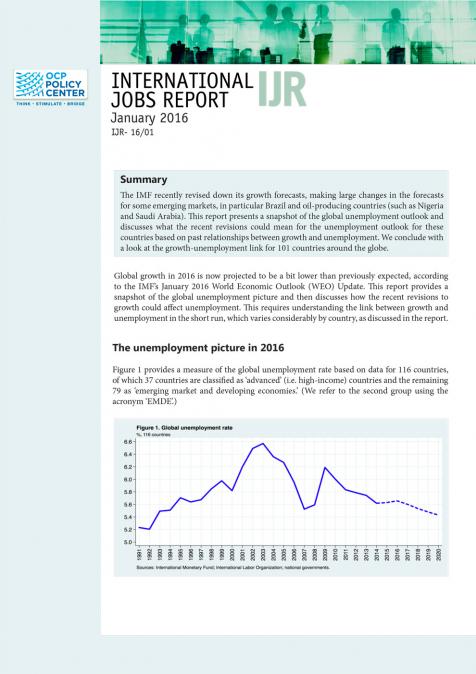
    The IMF recently revised down its growth forecasts, making large changes in the forecasts for some emerging markets, in particular Brazil and oil-producing countries (such as Nigeria and Saudi Arabia). This report presents a snapshot of the global unemployment outlook and discusses what the recent revisions could mean for the unemployment outlook for these countries based on past relationships between growth and unemployment. We conclude with a look at the growth-unemployment link f ...