Publications /
Policy Brief

Back
Pathways for Reconciling New Industrial Policy and International Cooperation for Global Goods
Authors
September 24, 2024


This paper was originally published on t20brasil.org

The resurgence of Neo protectionism as a reality is creating a pressing need to establish New Industrial Policies (NIPs) capable of striking a balance between Global Value Chains (GVC) managers' quest for efficiency and policy makers' need for more increasing resilience or national security in a turmoiled geopolitical landscape. Furthermore, although NIPs might pursue legitimate non-economic objectives, they are often captured by vested interests, resulting in protectionist measures. These policies produce negative spillovers, jeopardizing other countries’ development perspectives. This policy brief posits that countries embracing industrial policies with trade diversion components must allocate efforts to implement additional trade liberalization in sectors where the affected exporting countries have comparative advantages as compensation for the negative spillovers their unilateral domestic policies impose on third countries. This highlights the need to establish a structured system that penalizes protectionist countries for exceeding predetermined limits on subsidies and distortive measures. This policy brief also recommends that advanced economies implementing industrial policies with high amounts of embodied subsidies contribute to an international fund dedicated to financing developing economies' access to new green technologies. This approach acknowledges the undeniable push towards aggressive industrial policies, yet simultaneously strives to establish a framework to temper this emerging trend. This mechanism aligns with the principles of economic fairness and encourages nations to adopt less distortive behaviors in their pursuit of economic security or resilience to shocks.

RELATED CONTENT

  • Authors
    July 28, 2026
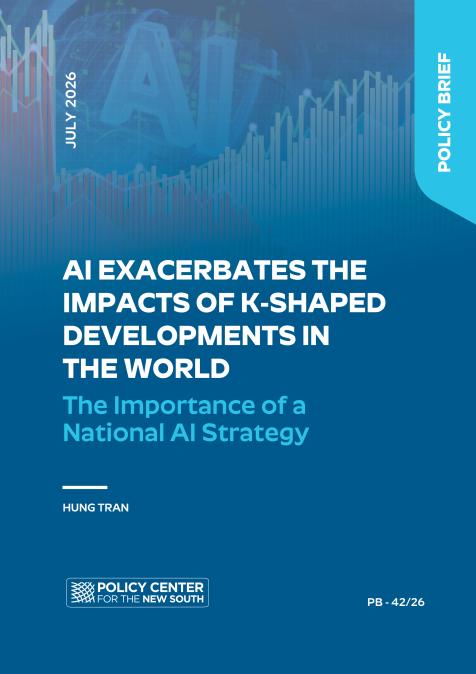
    The term “K-shaped recovery” was introduced to describe the economic recovery from the recession triggered by the Covid-19 pandemic. It refers to the uneven and divergent growth pattern between leading industries or sectors (the upper arm of the letter K—mainly the high-technology sector) and laggards, or the rest of the economy (the lower arm—the traditional industries). Since then the term has become popular in portraying divergent growth patterns within and between countries, esp ...
  • July 28, 2026
    تتناول هذه الحلقة اندماج المغرب في سلاسل القيمة العالمية، من خلال توضيح مفهومها واستعراض كيفية انخراط المغرب فيها عبر تطوير عدد من القطاعات الصناعية وجذب الاستثمارات الأجنبية. كما تسلط الضوء على أبرز المكاسب الاقتصادية والصناعية التي حققها هذا الاندماج، مقابل التحديات التي ما تزال تحدّ ...
  • Authors
    July 16, 2026
    Thanks to the AI investment boom, the U.S. economy has performed well at the macroeconomic level. However, it is on an unsustainable fiscal and debt path. Mr. Trump’s fiscal policy in his second term has aggravated this trajectory. In turn, Mr. Trump’s tariff-based trade policy has failed to address what he sees as U.S. economic problems associated with the trade balance. Besides explaining why this has been the case, and what its implications are for the U.S. economy and the r ...
  • Authors
    Edited by
    July 13, 2026
    Available soon on livremoi. The 2026 edition of the Annual Report on the African Economy examines the issue of the valorization of Africa’s natural resources, particularly its mineral wealth. While the continent holds some of the world’s largest known reserves of a wide range of minerals and metals, the objective is not merely to catalogue these resources, but rather to explore the conditions under which natural resource endowments can be transformed into drivers of Africa’s in ...
  • Authors
    July 13, 2026
    This paper provides a structural assessment of India’s services-led development trajectory, and its integration into global value chains (GVCs) between 2012 and 2022. Applying an analytical framework that categorizes services into knowledge (KS), enabling (ES), and local (LS) sectors, the study utilizes sixteen OECD indicators to move beyond the narrative of India as a ‘services champion’ and reveal a more complex economic reality. The analysis identifies three central structur ...
  • July 3, 2026
    Este Policy Paper también ha sido publicado en inglés y francés por Le Grand Continent La economía marroquí constituye un caso ilustrativo entre las economías de renta media, en un contexto marcado por una creciente fragmentación del entorno internacional, un crecimiento mundial anémico y una desaceleración de la convergencia. Desde 2022, su trayectoria se caracteriza por una relativa solidez, con un crecimiento superior a la media de las economías de la misma categoría. Superi ...
  • July 3, 2026
    Ce Policy Paper a également été publiée en anglais et en espagnol par Le Grand Continent Le Maroc offre un exemple éclairant parmi les pays à revenu intermédiaire, dans un contexte marqué par une fragmentation croissante de l’environnement international, une croissance mondiale atone et un ralentissement de la convergence. Depuis 2022, sa trajectoire se distingue par une certaine robustesse, avec un rythme d’expansion supérieur à celui des autres économies de même catégorie. Dé ...
  • July 3, 2026
    This Policy Paper has also been published in French and Spanish by Le Grand Continent Morocco offers a compelling example of how a middle-income economy can navigate a more fragmented global environment, characterized by weak growth and slower convergence. Since 2022, economic activity has remained relatively strong, with growth exceeding that of many comparable economies. Non-agricultural growth has averaged 4.4% since 2022, around 1.3 percentage points above its historical av ...
  • Authors
    June 8, 2026
    The energy shock caused by the war between the United States and Israel and Iran has highlighted the need for Africa to refine more of its own crude oil. Africa is a net hydrocarbon exporter, but remains stuck in the old colonial economic model: it mostly exports raw materials and imports refined products. Africa exports about 2.6 billion barrels of crude oil every year, and imports about 1.4 billion barrels of refined products. This is a problem for two reasons. First, Africa ...
  • May 29, 2026
    This Paper was originally published on tandfonline.com This paper examines how reductions in transportation costs reshape regional economic and environmental outcomes in Morocco. We simulate a reduction in delivered (purchasers’) costs via a transport-margin efficiency improvement – implemented as a margin-saving technical change in the transport sector – within a province-level Spatial Computable General Equilibrium (SCGE) framework. Simulating a 1% decline in transport costs, ...