حديث الثلاثاء: المغرب وسلاسل القيمة العالمية: أي موقع وأي آفاق؟

July 28, 2026

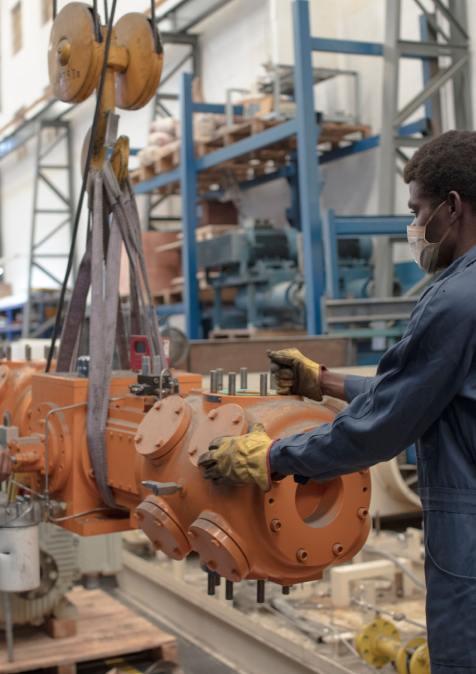
تتناول هذه الحلقة اندماج المغرب في سلاسل القيمة العالمية، من خلال توضيح مفهومها واستعراض كيفية انخراط المغرب فيها عبر تطوير عدد من القطاعات الصناعية وجذب الاستثمارات الأجنبية. كما تسلط الضوء على أبرز المكاسب الاقتصادية والصناعية التي حققها هذا الاندماج، مقابل التحديات التي ما تزال تحدّ من انتقال المغرب نحو أنشطة ذات قيمة مضافة أعلى، مع مناقشة السياسات والإصلاحات الضرورية لتعزيز موقعه والارتقاء بدوره داخل سلاسل القيمة العالمية.

Speakers
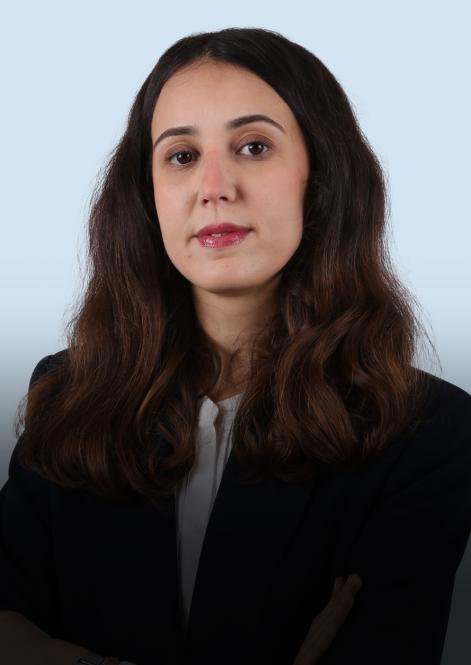
Fahd Azaroual
Economist
Fahd Azaroual is an Economist at the Policy Center for the New South. His research areas cover macroeconomics. He is currently working on themes related to Economic growth and business cycles. Fahd holds a master’s degree in applied economics and is currently a PhD student at Mohammed V University in Rabat. he joined the Policy Center for the New South in October 2019. ...

RELATED CONTENT

  • Authors
    July 28, 2026
    The term “K-shaped recovery” was introduced to describe the economic recovery from the recession triggered by the Covid-19 pandemic. It refers to the uneven and divergent growth pattern between leading industries or sectors (the upper arm of the letter K—mainly the high-technology sector) and laggards, or the rest of the economy (the lower arm—the traditional industries). Since then the term has become popular in portraying divergent growth patterns within and between countries, esp ...
  • July 28, 2026
    تتناول هذه الحلقة اندماج المغرب في سلاسل القيمة العالمية، من خلال توضيح مفهومها واستعراض كيفية انخراط المغرب فيها عبر تطوير عدد من القطاعات الصناعية وجذب الاستثمارات الأجنبية. كما تسلط الضوء على أبرز المكاسب الاقتصادية والصناعية التي حققها هذا الاندماج، مقابل التحديات التي ما تزال تحدّ ...
  • Authors
    July 16, 2026
    Thanks to the AI investment boom, the U.S. economy has performed well at the macroeconomic level. However, it is on an unsustainable fiscal and debt path. Mr. Trump’s fiscal policy in his second term has aggravated this trajectory. In turn, Mr. Trump’s tariff-based trade policy has failed to address what he sees as U.S. economic problems associated with the trade balance. Besides explaining why this has been the case, and what its implications are for the U.S. economy and the r ...
  • July 10, 2026
    For much of the post-war period, the Global South was framed as an object of history, defined by dependency, constrained by structural asymmetries, and confined to the margins of global decision-making. That narrative, once empirically grounded, is now no longer adequate. A profound yet uneven transformation is underway. The Global South is no longer only reacting; it is increasingly shaping rules, institutions, and narratives.This Policy Brief argues that the Global South is thus t ...
  • July 3, 2026
    This Policy Paper has also been published in French and Spanish by Le Grand Continent Morocco offers a compelling example of how a middle-income economy can navigate a more fragmented global environment, characterized by weak growth and slower convergence. Since 2022, economic activity has remained relatively strong, with growth exceeding that of many comparable economies. Non-agricultural growth has averaged 4.4% since 2022, around 1.3 percentage points above its historical av ...
  • Authors
    Mehran Haghirian
    June 15, 2026
    This article draws in part on perspectives shared by members of the Rihla Initiative for Green Economic Growth, whose regional insights helped inform the sections on how the costs of the war are being felt across the Global South. The war on Iran and in the Gulf has made it impossible to treat the Strait of Hormuz as a regional issue. The disruption around the Strait has moved through the world economy in concrete ways, from higher fuel bills and pressure on food and fertilizer ...
  • Authors
    June 12, 2026
    This essay argues that the current debate about the future of the international monetary system is not really about Gulf currencies, oil pricing, or de-dollarization in the narrow technical sense. It is about something deeper and more important: whether institutional trust can survive when geopolitical certainty is eroding.The Gulf monarchies—Saudi Arabia, the United Arab Emirates, Qatar, Kuwait, Bahrain, and Oman—increasingly exist in a world where the United States no longer looks ...
  • June 5, 2026
    Driven by its mission to reflect on and analyze the major geopolitical, economic, and societal transformations shaping the contemporary world, and with a view to contributing to knowledge-sharing and disseminating the main outcomes of its research program, the Policy Center for the New South regularly publishes collective volumes addressing issues of particular importance to Morocco, Africa, and the broader Global/New South. In this spirit, the Center has recently released two volum ...
  • Authors
    Sofia Formigli
    February 13, 2026
    There is a story told by Václav Havel, the Czech dissident writer who later became president after the fall of communism. In his essay The Power of the Powerless, Havel describes a shopkeeper who, every morning, places a sign in his window reading: “Workers of the world, unite!” He does not believe in it. Nor do the people around him. Yet the sign remains. ...