Publications /
Policy Brief
Migration from countries in the Middle East and North Africa (MENA) region is no longer limited to men, as increasing numbers of Arab and African women undertake this journey. Their motivations vary, ranging from economic opportunities and education to family reunification. This development has highlighted the complex intersection of work, gender, and migration.
This paper presents a comparative study of two distinct contexts: internal migrant women working in the Souss-Massa region and Moroccan migrant women working in Spain. Its objective is to address the challenges migrant women face in national and international labor markets.
Combining complementary theoretical frameworks, social role theory and intersectionality theory, the study examines how societal norms and gender expectations influence women’s experiences of labor mobility. It also considers possible measures to limit the abuse these women face and initiatives to strengthen their autonomy upon return.
Introduction
The feminization of migration did not emerge as a concept until the 1980s, as research had long been dominated by the idea that mobility was a male phenomenon, based on the assumption that migration was primarily motivated by economic reasons. Men were thus perceived as the economic agents of migration, unlike women, who were often seen as passive cultural actors following their male partners in the migration process (Khachani, 2019). Yet in quantitative terms, these assumptions proved limited. In 2020, female migrants were estimated at 135 million, representing almost half of the world's migrant population (48.1%), with a growing number of women migrating independently for professional reasons or as heads of household (Migration Data Portal, 2024).
In the specific case of Morocco, three main phases of female emigration can be distinguished. The first goes back to the 1960s and early 1970s, when very few women migrated, mainly for family reasons. The second phase, from the mid-1970s onwards, saw the departure of Moroccan women in the context of family reunification to countries such as France, Spain, Belgium and Italy. This process led to a gradual but sustained integration of Moroccan migrant women into the labor market of the host countries. Here again, a significant proportion of newly arrived women remained confined to an inherited gendered division of labor, with women looking after the home and children while men worked outside the home. Another proportion of Moroccan women entered the labor market in the host countries as domestic workers or as employees in other service sectors, often with no professional experience, either out of necessity or under the influence of the models they observed in the host societies. The third, more recent phase began in the second half of the 1980s, when women increasingly sought to emigrate to develop their economic autonomy through increasingly autonomous migration (Khachani, 2019, p. 50).
With autonomous female emigration, a significant set of challenges has emerged at the intersection of three main areas: work, gender, and migration. Through the presentation of a comparative analysis of migrant women working in two different contexts - internal migrant women employed in the agricultural sector in the Souss-Massa region of southern Morocco, and Moroccan migrant women working in Spain - the aim is to highlight the challenges and issues they face as migrant workers, both locally and abroad. Although their trajectories and motivations may differ, the juxtaposition of the two case studies reveals that discrimination and abuse are common gender-related patterns in female labor migration.
Beyond describing the difficulties encountered by migrant women, this paper aims to explore possible courses of action to limit the cases of abuse these women face, while also considering initiatives to empower them when they return to their countries of origin. The aim is to contribute to a better understanding of the complexities surrounding women's participation in the labor market, by combining two complementary theoretical frameworks: social role theory and intersectionality theory. The former explores how social expectations and norms play a significant role in influencing the behaviors and opportunities available as a function of perceived gender roles, while intersectionality theory adds a layer of analysis focused on social identities, examining how experiences and access to opportunities are shaped by factors such as nationality, migration status and gender. An analysis combining these two frameworks is essential to understanding how women find themselves in the majority among agricultural workers, both locally and abroad, and how gender influences their experience throughout their migratory journey.
In addition, this study - guided by a constructivist approach - presents the findings of field research we carried out in the Souss-Massa region. This research, based on qualitative interviews with 40 women from different Moroccan towns, settled in the province of Chtouka Ait Baha and working in the agricultural sector, enabled us to gather testimonies on the difficulties they encounter as women from disadvantaged social and economic backgrounds, several hundred kilometers away from their hometowns.
The emergence of a precarious female workforce in rural centers in Morocco
Historically, women in Morocco's "conservative regions" were mainly confined to domestic work, although they had a long tradition of contributing to local agriculture for subsistence. However, due to deep-rooted taboos and social norms, women were not integrated into paid agricultural work until the 1980s (Pascon & Ennaji, 1986). Later, with the modernization of society and women's access to the labor market, it became common to see women working in the agricultural sector, mainly in roles not requiring high qualifications, reflecting women's growing role in household finances. Furthermore, women in rural areas have proved to be more active than their urban counterparts. In 2017, the labor force participation rate among rural women reached 29.6%, compared with 18.4% for urban women and 22.4% at national level.
With this gradual evolution of cultural norms and gender dynamics, a subtle division of roles has emerged. The work performed by women in agriculture followed lines similar to their usual activities in the family context. Thus, for a long time, women were mainly responsible for weeding, harvesting, and storing food crops, as well as assisting with transplanting, irrigation, and soil fertilization (FAO).
Today, although the participation of rural women in paid agricultural work has become common practice, these workers continue to suffer from stigmatization due to the social images associated with women working on farms. This stigmatization is due in part to their generally disadvantaged social and economic backgrounds, but also to harassment and abuse practices in the sector. In truth, only a minority of women farm workers benefit from formal contracts entitling them to social protection, while the majority work in the informal sector, placing them in a vulnerable position in the production chain.
As a result, career advancement opportunities for female farm workers remain considerably limited compared to men. Male workers often benefit from years of experience acquired through early access to the labor market, which accelerates their ascent to positions such as "cabran" (a supervisor of agricultural workers) or machine operator. On the other hand, women's access to such specialized roles is much more difficult, many being confined to back-breaking work on farms, either as direct employees of the farmers, or through informal recruitment in places like the "moquef" (informal labor market) where women turn up very early in the morning, at around 4 a.m. to offer their labor. If they are not selected by 7 a.m., they are without work for the day. In addition, the conditions in which these women travel to and from work expose them to a high risk of accidents, as most of the vehicles used are unsuitable for carrying passengers.
Data from the latest report on Moroccan international migration, published by the Haut-Commissariat au Plan (HCP, 2019), revealed a growing trend towards the feminization of international migration, despite the historical predominance of male mobility. According to the data provided, current migration trends show a gender structure marked by a clear male predominance, with more than two-thirds of current migrants (68.3%) being men, while women account for an estimated 31.7% of migrants, with a peak among young people aged 15 to 29 (38.4%) and lower rates among people over 60 (23.7%). This persistent gender disparity is largely due to the history of male emigration, which was dominant until the mid-1970s, following a traditional division of roles inspired by the family breadwinner model, where men worked for pay while women were confined to household chores. Over the decades, however, there has been an increasing feminization of Moroccan migration abroad, initially through family reunification and increasingly through autonomous female migration. Economists consider that the recent autonomous female emigration is primarily driven by economic factors; it is rooted in the crisis that hit the Moroccan economy from the late 1970s and led to dysfunctions that intensified from the early 1980s, fueled by the impact of structural adjustment programs that proved financially beneficial but had negative effects on unemployment rates for both men and women (Khachani, 2019). Women, especially those from poor backgrounds, with limited education and often from peri-urban areas, found themselves looking for paid jobs to support their households. In this context, sectors such as services in urban areas and agriculture in rural areas emerged as the main options, due to the significant growth they experienced, offering a large supply of temporary, flexible and generally low-skilled work.
This change in female migration patterns underlines a significant transformation in Morocco's social and economic landscape, with women becoming increasingly active and contributing to household expenditure. At local level, most Moroccan women in rural areas are active in the agricultural sector (HCP, 2020). Analysis of the structure of employed women according to the main occupational groups reveals that over a third (36%) of women in rural areas work in the agricultural or fishing sectors.
Discrimination against migrant women working abroad
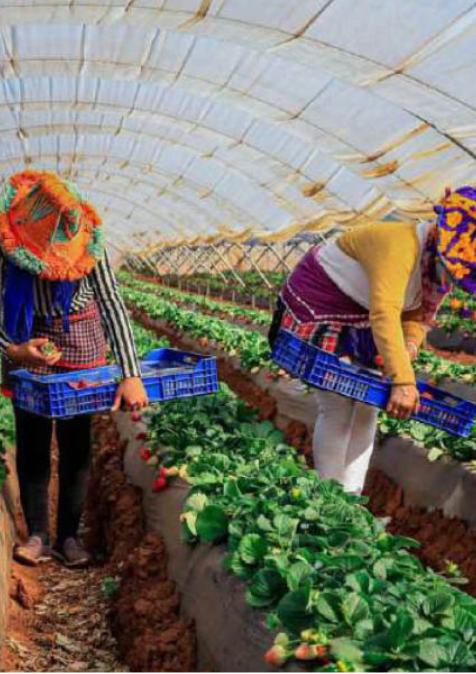
In southern Spain, thousands of Moroccan migrant women are employed to harvest soft fruit in Huelva and process horticultural produce in the canning warehouses of Almería, a tradition that has its roots in the early 2000s, when Spanish farmers sought to make up for labor shortages in the agricultural sector. The Spanish authorities therefore sought to develop this form of immigration, regulated since 2001 by international seasonal employment contracts (contratos en origen). These agreements enable Spain to negotiate and sign contracts with labor-exporting countries by pre-selecting workers directly in their countries of origin for the duration of the season (on average 8 to 10 months), while ensuring the compulsory return of these migrants to their respective countries once the contract period is over. This policy of selective sorting is commonly referred to as circular mobility, and consists of selecting, recruiting, transporting, placing and repatriating labor according to the economic needs of the host and home countries (Mésini, 2009).
Once they arrive at their workplaces in Spain, Moroccan migrant women face challenges similar to those experienced in their own countries. They are offered lower wages than their male counterparts and suffer abuse and harassment. These women work in difficult conditions and are often exploited, as their work is seasonal, often involving fruit-picking, physically exhausting tasks with no job security. The fact that they suffer from language barriers, illiteracy and geographical isolation from their families accentuates their difficulties, limiting their ability to defend their rights or access support services.
When it comes to selection criteria, an ethical dilemma arises. The women selected to take part in the migration program must meet specific criteria: they must be mothers of young children and come from rural areas. These criteria are designed to minimize the likelihood of visa overstays, as women are expected to return home to care for their children. They are therefore perceived as less likely to have support networks that could facilitate their irregular stay in Spain. According to an official from ANAPEC (Agence nationale pour la promotion de l'emploi et des compétences) in the province of Chtouka Ait Baha - who wished to remain anonymous - selection criteria often go beyond restrictions linked to marital status to include physical considerations, with candidates being assessed on the condition of their hands to gauge their familiarity with agricultural work. During the COVID-19 pandemic, Spanish recruitment agencies opted for online selection processes, resulting in a significant number of applicants from urban areas intending to settle permanently in Spain, explains the same source. As a result, it was decided to recruit exclusively in rural areas, with the help of ANAPEC.
The fact that migrant women are selected primarily based on their marital status raises several questions. In Middle Eastern and North African societies, women play an essential role in childcare and household management. As a result, women spend a considerable amount of time on unpaid household tasks. When Moroccan migrant mothers leave to work in Spain, the whole family structure is disrupted. Interviews with social agents working on behalf of ANAPEC highlighted several impacts of female migration on households, including a drop in children's school performance, the discovery of extramarital relationships of spouses and, above all, financial exploitation, as many of these women send money to their husbands in compensation for their care duties during the seasonal work period. All these problems have an impact on families, especially women and children. The ANAPEC source noted that only a few Moroccan migrant women manage to achieve economic independence, underlining the vital importance of supporting these women to help them break the cycle of vulnerability.
Conclusion and recommendations
In both cases of Moroccan female migration, whether internal or international, there is an intersection of vulnerabilities. In addition to structural discrimination linked to the very nature of work, the lives of women migrant workers are marked by inequalities, making them particularly vulnerable. These forms of discrimination do not manifest themselves simply as an addition of vulnerabilities arising from each axis of inequality - gender, migratory status, etc. - but converge and reinforce each other, resulting in interlocking experiences of discrimination. In the case of migrant women working in the agricultural sector, three axes most strongly influence their experiences: gender, origin and social class. Indeed, migrant women's work in this sector carries a social stigma and is often associated with belonging to vulnerable socio-economic groups.
Additionally, these women are expected to meet complex gender-role expectations, which may conflict with traditional norms, which mainly expect women to be present and actively manage the home, including household chores and child-rearing. Yet these women farm workers also find themselves called upon to take on the role of income providers for their families, calling into question the traditional social norms mentioned above. The pressure of balancing these responsibilities, particularly regarding motherhood, can lead to emotional and psychological stress, as they strive to meet the demands of both work and family. In the workplace, these women are exposed to gender-based violence and harassment, compounded by a lack of institutional support and awareness. In Spain, power dynamics in the workplace are particularly problematic, especially for resident workers or those with irregular administrative status, creating environments where it is difficult to report abuse for fear of reprisals, such as job loss or expulsion.
However, the socio-economic benefits of economic migration for Moroccan women working in the agricultural sector should not be overlooked, especially those who manage to work in Spain. Indeed, despite the challenges mentioned, when we interviewed local women workers in the Souss region, they declared that they would still be willing to seize the opportunity to go to Spain, given the significant wage differentials. While they are paid 70 DH (around 6.5 euros) a day in Morocco, the average wage for Moroccan women agricultural workers in Spain is around 7.63 euros an hour, almost eight times their remuneration in Morocco. It is also important to remember that, for many migrant women, participation in paid employment represents an opportunity for emancipation and a break with the constraints imposed by the family. Income from their work enables them to achieve a degree of autonomy and improve their family's standard of living.
Consequently, the solution to the issues raised does not necessarily lie in stopping these types of arrangements, which have proved financially beneficial to many of these women, but rather in implementing measures to improve their working conditions. This could involve several actions, such as eliminating selection criteria that run counter to human rights, such as childcare-related requirements or assessments based on candidates' physical condition. It would also be necessary to improve contractual clauses to better integrate the social and economic rights of migrant women, including a clear list of what is expected of them and the corresponding remuneration.
Experts we met during our interviews in the Souss-Massa region confirmed that negotiations are underway to grant longer-term work permits to experienced migrant women, in order to simplify renewal procedures. This would be beneficial for these women, enabling them to plan their careers and, consequently, better manage their income. Other actions could include setting up outreach services available to both internal migrant women in Morocco and Moroccan women workers in Spain, to make them aware of their rights and the support services they can access if needed. Finally, it is essential to support and fund the activities of agencies such as ANAPEC that provide guidance, training, and project financing to women returning to Morocco, in order to support their financial autonomy.
References
Ait Ben Lmadani, F. (2012). Femmes et émigration marocaine : Entre invisibilisation et survisibilisation : pour une approche postcoloniale. Hommes et Migrations, pp. 96–103.
Arab, C. (2010). Emergence de circulations migratoires féminines des Marocaines vers de nouvelles destinations – l’Espagne et les Émirats Arabes Unis. NAQD, 28, 179–200. https://doi.org/10.3917/naqd.028.0179
Bossenbroek, L. (2019). Les ouvrières agricoles dans le Saïss au Maroc, actrices de changements sociaux ? Alternatives Rurales, 7. https://alternatives-rurales.org/les-ouvrieres-agricoles-dans-le-saiss-au-maroc-actrices-de-changements-sociaux/
Bossenbroek, L., & Ftouhi, H. (2021). The plight of female agricultural wageworkers in Morocco during the COVID-19 pandemic. Cahiers Agricultures, 30, Article 40. https://doi.org/10.1051/cagri/2021027
Eagly, A. (2009). Social Role Theory. In J. J. Jost & B. Major (Eds.), The Handbook of Social Psychology (5th ed., pp. 797–824).
Haut-Commissariat au Plan. (2019). Enquête nationale sur la migration internationale.
Haut-Commissariat au Plan. (2020). La femme marocaine en chiffres : évolution des caractéristiques démographiques et socioprofessionnelles.
International Organization for Migration. (2019). Middle East and North Africa Migrant Profiles Infographic, p. 2.
Jehouani, R., & Naji, M. (2023). Female Farm Workers in Morocco: Between Laborious Working Conditions and Environmental Challenges. Hassan II University.
Khachani, M. (2019). La Question Migratoire au Maroc.
Mésini, B. (2009). Enjeux des mobilités circulaires de main-d’œuvre : l’exemple des saisonniers étrangers dans l’agriculture méditerranéenne.
Migration Data Portal. (2024). Gender and migration. https://www.migrationdataportal.org/themes/gender-and-migration
Mongui Monsalv, M., et al. (2022). Libro Blanco sobre la situación de las mujeres inmigrantes en el sector del trabajo del hogar y los cuidados en España. Instituto de la Mujer, pp. 17–27.
Moreno Nieto, J. (2009). Los contratos en origen de temporada: Mujeres marroquíes en la agricultura onubense. Revista de Estudios Internacionales Mediterráneo (REIM), pp. 58–78.
Ouali, N. (2003). Les Marocaines en Europe : diversification des profils migratoires. Hommes et Migrations, pp. 71–82. https://www.persee.fr/doc/homig_1142-852x_2003_num_1242_1_3975
Pascon, P., & Ennaji, M. (1986). Les paysans sans terre au Maroc. Casablanca: Les Éditions Toubkal.
Plaza Del Pino, F. J., Muñoz Lucena, L., Azougagh, N., Gómez Haro, A., Álvarez Puga, B., Navarro-Prado, S., & Cabezón-Fernández, M. J. (2023). Migrant Women in Shantytowns in Southern Spain: A Qualitative Study. International Journal of Environmental Research and Public Health.
Sabatar, L. (2020). Gender, Culture and Sustainability in the Mediterranean. IUCN, Washington, DC, United States.