Publications /
Book / Report

Back
Africa Economic Symposium (AES) 3nd edition - SUMMARY REPORT
Authors
General rapporteur Mahmoud Arbouch
September 2, 2025

The Africa Economic Symposium (AES) has firmly established itself as one of the flagship annual events of the Policy Center for the New South, alongside the Atlantic Dialogues and the African Peace and Security Annual Conference (APSACO). Now in its third edition, AES continues to provide a unique platform for economists, policymakers, and academics from across the continent and beyond to exchange perspectives on the pressing macroeconomic and structural challenges facing Africa. Its mission remains to foster rigorous, evidence-based debates that inform policymaking and support long-term strategies for Africa’s development in an era of uncertainty. 

The 2025 edition, convened under the theme “Bold Moves amid Global Shifts,” explored the difficult policy trade-offs confronting African governments as they navigate a volatile global environment. The continent’s recovery from COVID-19 has been uneven, while debt pressures, supply chain disruptions, and geopolitical tensions weigh heavily on fiscal and economic resilience. Structural challenges such as persistent unemployment, low productivity, and the exclusion of Africa’s youth continue to hinder inclusive growth, even as policymakers are called upon to adapt to deep systemic uncertainty. 

The symposium underscored that many African states are increasingly resorting to short-term stabilization measures—such as accumulating reserves and postponing reforms—that may provide immediate security but risk delaying the structural transformation urgently needed. Against this backdrop, AES 2025 called for a careful balance between fiscal prudence, social investment, and the pursuit of sustainable growth, placing emphasis on reforming governance, improving macroeconomic management, and accelerating structural change. 

The discussions highlighted the urgent need to rethink Africa’s economic strategies in a shifting global order. From debt sustainability and the role of central banks to the promise of financial innovation, digital inclusion, and new instruments such as central bank digital currencies, the symposium emphasized that policy choices must align with long-term transformation goals. The debates also explored the opportunities and challenges of regional integration, trade connectivity, and development finance, all of which are essential levers for Africa’s resilience and prosperity. 

As in previous editions, the Annual Report on African Economies was launched alongside the symposium, offering an in-depth analysis of the continent’s macroeconomic dynamics and structural transformation pathways. More than just a publication, the report reflects the collective intellectual effort of leading scholars and practitioners, providing evidence-based insights to guide decision- makers. Together, the symposium and the report reinforced the Policy Center for the New South’s commitment to fostering forward-looking economic thinking that moves beyond short-term headlines to tackle Africa’s enduring challenges.
RELATED CONTENT

  • Authors
    October 26, 2017
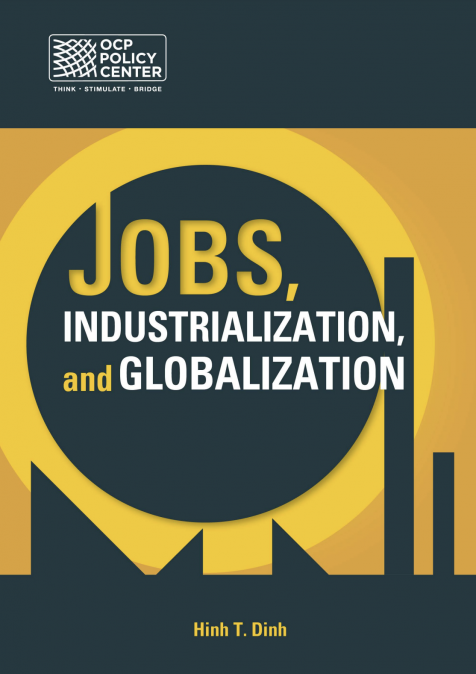
    After many decades of expansion, incomes and standards of living have never been better in many parts of the world. Yet, in the developed economies, there is anxiety over the loss of manufacturing jobs that once absorbed a large share of the labor force and created a middle class that formed the core of democracy. The vast majority of middle- income countries have not yet been able to make the transition to the high-income group despite decades of growth. Progress among low-income c ...
  • October 24, 2017
    Input-output tables provide a rich source of information about the structure of economies that is not available from other frameworks. In addition to providing key information for the analysis of linkages between activities (and regions), the tables also provide the underlying core database used in a range of economic models. If used appropriately, these more sophisticated models can meaningfully assess the impact of economic change, at the national and regional levels. They can als ...
  • Authors
    October 23, 2017
    The rise of protectionism, economic nationalism and nativism in the United States can be attributed inter alia to the nation’s wage stagnation and rising inequality. Other countries are responding by reevaluating their reliance on the American hegemon. But this is not enough. Policy-makers also need to ask what lessons they can draw for their domestic policies from the United States’ success in creating wealth while, at the same time, failing to distribute it equitably and to reduce ...
  • Authors
    Ana Maria Bonomi Barufi 
    October 21, 2017
    Location decisions of firms and workers shape the spatial distribution of economic activity between and within cities. On one hand, the interaction between cities is widely investigated in the literature of regional and urban economics, which tries to assess the extent to which urban scale affects the local concentration of different skills, sectors, etc., apart from defining each city's role in the regional system. On the other hand, within-city dynamics and internal heterogeneity ...
  • Authors
    Jesús P. Mena-Chalco
    Otávio Sidone
    October 11, 2017
    Este artigo apresenta os resultados de um estudo sobre as potencialidades da utilização dos dados curriculares derivados das informações da Plataforma Lattes como ferramentas para avaliação do desempenho científico de pesquisadores. Um novo indicador, denominado "Índice Multidimensional de Desempenho Científico" (IMDC), é proposto considerando um amplo conjunto de indicadores bibliométricos que buscam captar diferentes formas da produção acadêmica dos atuais pesquisadores vinculados ...
  • Authors
    Yassine Msadfa
    September 21, 2017
    Les chaînes de valeur mondiales offrent de nouvelles opportunités de transformation structurelle pour les pays en développement. Aujourd’hui la vision des chaînes de valeur mondiales se limitant à l’analyse des flux commerciaux et des IDE à l’échelle globale n’est plus suffisante pour répondre aux questions clés du positionnement et de la remontée dans ces chaînes de valeur, de la dynamique de la capture de la valeur et de sa pérennisation. La réponse à ces questions appelle un écla ...
  • Authors
    Lahcen Oulhaj
    September 20, 2017
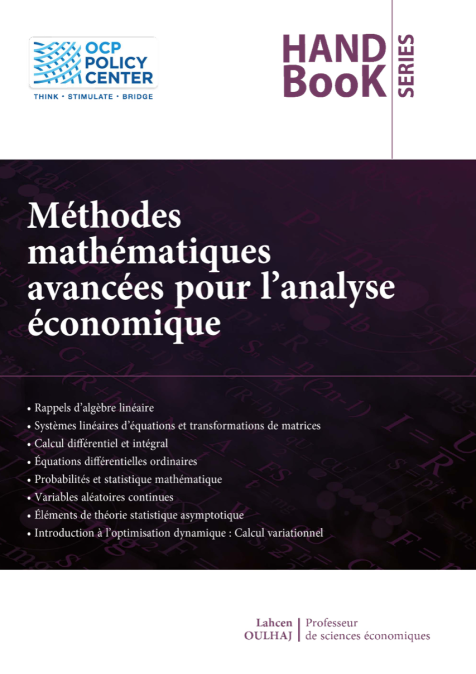
    Le présent livre présente un ensemble d’outils et de notions mathématiques communément utilisés en économie appliquée. Il commence par rappeler les notions d’algèbre matricielle, et enchaîne avec l’étude des systèmes linéaires d’équations et les transformations de matrices, pour traiter de la décomposition des matrices, devenue un outil couramment utilisé en économétrie des séries chronologiques et des données de panel. Le calcul différentiel et intégral, de plus en plus utilisé en ...
  • Authors
    Dina N. Elshahawany
    Michael L. Lahr
    September 18, 2017
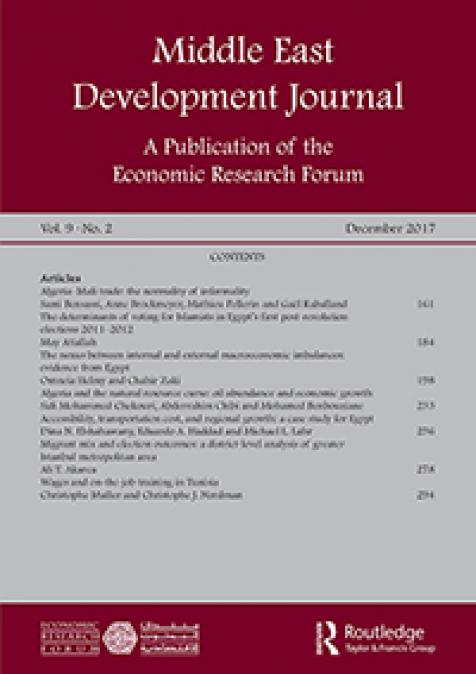
    This paper focuses on a proposed development corridor in Egypt, a main component of which is a desert-based expansion of the current highway network. The main beneficial features of this proposed transport investment are travel time reductions and improved accessibility. We use a spatial computable general equilibrium (SCGE) model to estimate the economic impacts of changes in transportation costs from this new roadway. To effect this, we integrate the model with a stylized geo-code ...
  • September 17, 2017
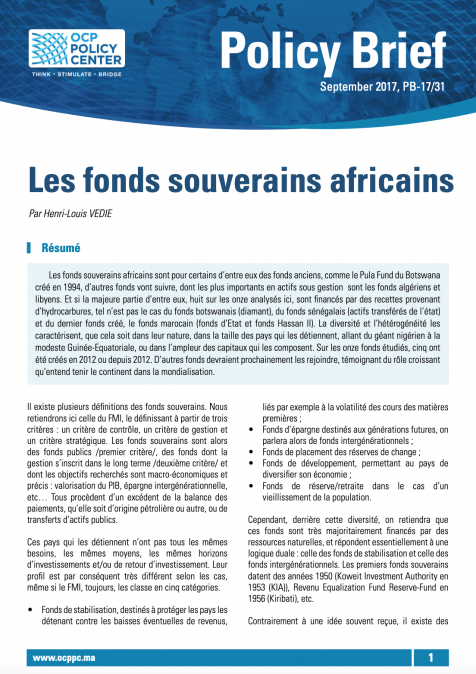
    Les fonds souverains africains sont pour certains d’entre eux des fonds anciens, comme le Pula Fund du Botswana créé en 1994, d’autres fonds vont suivre, dont les plus importants en actifs sous gestion sont les fonds algériens et libyens. Et si la majeure partie d’entre eux, huit sur les onze analysés ici, sont financés par des recettes provenant d’hydrocarbures, tel n’est pas le cas du fonds botswanais (diamant), du fonds sénégalais (actifs transférés de l’état) et du der ...