Publications /
Book / Report

Back
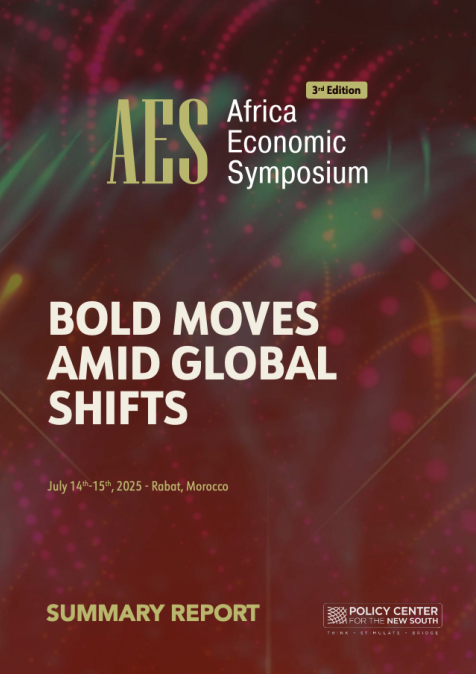
Africa Economic Symposium (AES) 3nd edition - SUMMARY REPORT
Authors
General rapporteur Mahmoud Arbouch
September 2, 2025

The Africa Economic Symposium (AES) has firmly established itself as one of the flagship annual events of the Policy Center for the New South, alongside the Atlantic Dialogues and the African Peace and Security Annual Conference (APSACO). Now in its third edition, AES continues to provide a unique platform for economists, policymakers, and academics from across the continent and beyond to exchange perspectives on the pressing macroeconomic and structural challenges facing Africa. Its mission remains to foster rigorous, evidence-based debates that inform policymaking and support long-term strategies for Africa’s development in an era of uncertainty. 

The 2025 edition, convened under the theme “Bold Moves amid Global Shifts,” explored the difficult policy trade-offs confronting African governments as they navigate a volatile global environment. The continent’s recovery from COVID-19 has been uneven, while debt pressures, supply chain disruptions, and geopolitical tensions weigh heavily on fiscal and economic resilience. Structural challenges such as persistent unemployment, low productivity, and the exclusion of Africa’s youth continue to hinder inclusive growth, even as policymakers are called upon to adapt to deep systemic uncertainty. 

The symposium underscored that many African states are increasingly resorting to short-term stabilization measures—such as accumulating reserves and postponing reforms—that may provide immediate security but risk delaying the structural transformation urgently needed. Against this backdrop, AES 2025 called for a careful balance between fiscal prudence, social investment, and the pursuit of sustainable growth, placing emphasis on reforming governance, improving macroeconomic management, and accelerating structural change. 

The discussions highlighted the urgent need to rethink Africa’s economic strategies in a shifting global order. From debt sustainability and the role of central banks to the promise of financial innovation, digital inclusion, and new instruments such as central bank digital currencies, the symposium emphasized that policy choices must align with long-term transformation goals. The debates also explored the opportunities and challenges of regional integration, trade connectivity, and development finance, all of which are essential levers for Africa’s resilience and prosperity. 

As in previous editions, the Annual Report on African Economies was launched alongside the symposium, offering an in-depth analysis of the continent’s macroeconomic dynamics and structural transformation pathways. More than just a publication, the report reflects the collective intellectual effort of leading scholars and practitioners, providing evidence-based insights to guide decision- makers. Together, the symposium and the report reinforced the Policy Center for the New South’s commitment to fostering forward-looking economic thinking that moves beyond short-term headlines to tackle Africa’s enduring challenges.

RELATED CONTENT

  • Authors
    September 15, 2017
    After a strong rising tide starting in the 1990s, financial globalization seems to have reached a plateau since the global financial crisis. However, that apparent stability has taken place along a deep reshaping of cross-border financial flows, featuring de-banking and an increasing weight of non-banking financial cross-border transactions. Sources of potential instability and long-term funding challenges have morphed accordingly.      Financial globalization is mor ...
  • Authors
    September 8, 2017
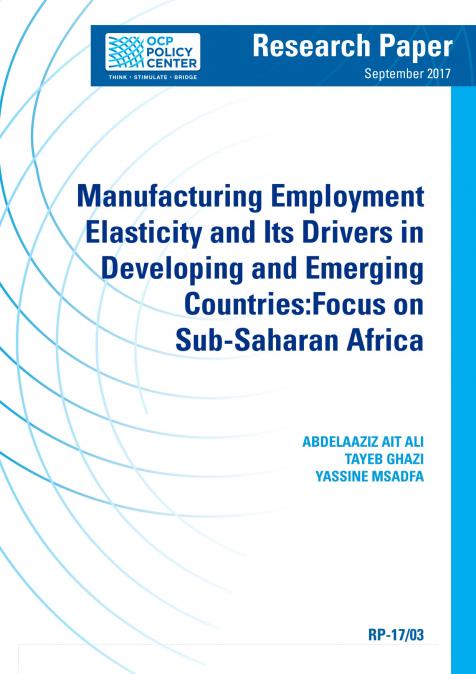
    The aim of this work is to contribute to the empirical literature on employment-GDP elasticities in four main ways. First, it provides a set of employment-GDP elasticities for a sample of emerging and developing economies, including 11 sub-Saharan countries, based on the GGDC 10-sectors database. Second, it assesses the extent to which manufacturing activities are inclusive compared to the rest of the economy, in terms of employment creation. Third, it explores the determinants of c ...
  • Authors
    Simone Tagliapieta
    Marion Jansen
    Yassine Msadfa
    Mario Filadoro
    August 28, 2017
    Endowed with half of the world’s known oil and gas reserves, the Middle East and North Africa (MENA) region became – particularly during the second half of the twentieth century – a cornerstone of the global energy architecture (Yergin, 1991, 2011; Maugeri, 2006). This architecture is currently undergoing a structural transformation, prompted by two different forces: decarbonisation policies and technological developments. The adoption and quick entry into force of the Paris Agreem ...
  • Authors
    Abdelkhalek El Bikam
    Afang Ndong Zita
    Kourouma Oumar
    August 25, 2017
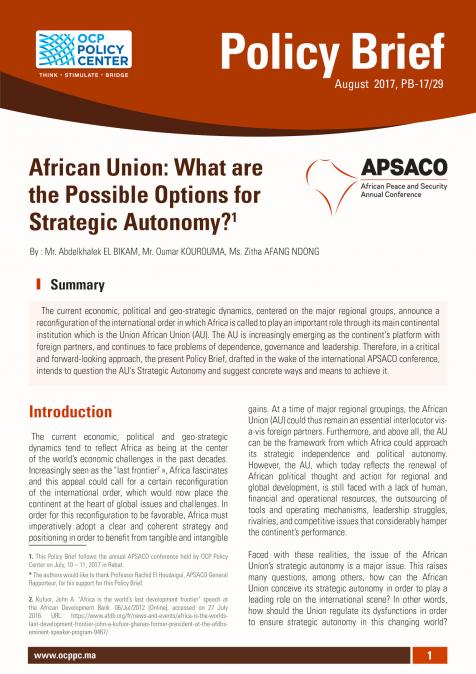
    The current economic, political and geo-strategic dynamics, centered on the major regional groups, announce a reconfiguration of the international order in which Africa is called to play an important role through its main continental institution which is the Union African Union (AU). The AU is increasingly emerging as the continent's platform with foreign partners, and continues to face problems of dependence, governance and leadership. Therefore, in a critical and forward-looking a ...
  • Authors
    Abdelkhalek El Bikam
    Afang Ndong Zita
    Kourouma Oumar
    August 25, 2017
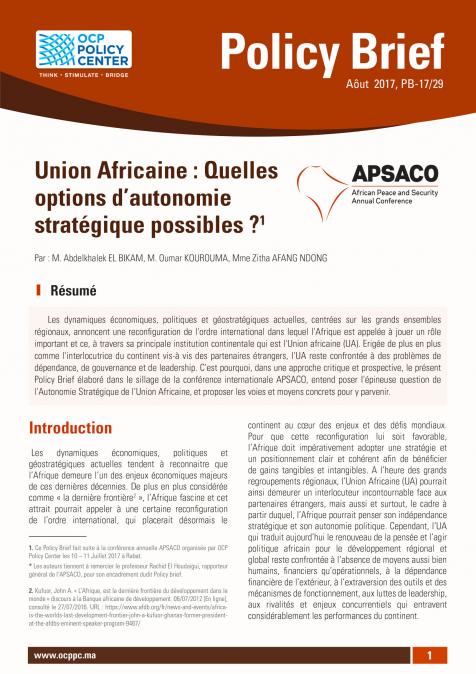
    Les dynamiques économiques, politiques et géostratégiques actuelles, centrées sur les grands ensembles régionaux, annoncent une reconfiguration de l'ordre international dans lequel l'Afrique est appelée à jouer un rôle important et ce, à travers sa principale institution continentale qui est l'Union africaine (UA). Erigée de plus en plus comme l'interlocutrice du continent vis-à vis des partenaires étrangers, l'UA reste confrontée à des problèmes de dépendance, de gouvernance et de ...
  • Authors
    August 9, 2017
    This paper reports on the recent developments in the construction of an interregional input-output matrix for Morocco (IIOM-MOR). As part of an ongoing project that aims to specify and calibrate an interregional CGE (ICGE) model for the country, a fully specified interregional input-output database was developed under conditions of limited information. Such database is needed for future calibration of the ICGE model. We conduct an analysis of the intraregional and interregional shar ...
  • July 14, 2017
    Thinking creatively the bilateral relationship of Brazil and Morocco is quintessential for enhancing its reach and possibilities. The world is currently facing enormous changes whose outcomes are unpredictable. From a revival in the cold war realist dispute of power between the United States and Russia, the collapse of International Law in relation to Ukraine, Crimea and the South China Sea, BREXIT and the imponderable results that may impact the European Union and to the possible d ...
  • July 5, 2017
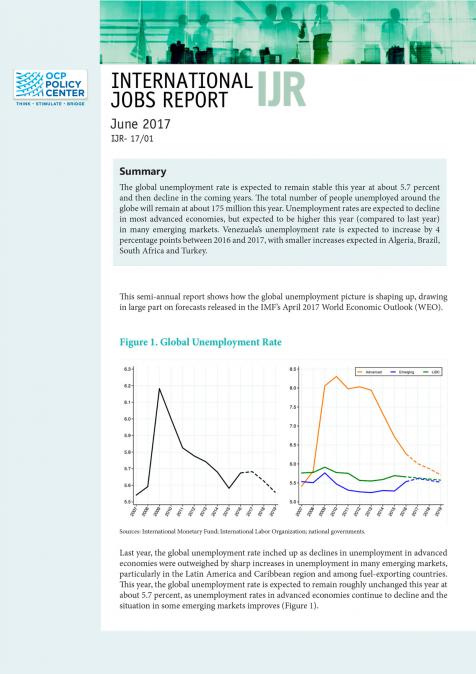
    The global unemployment rate is expected to remain stable this year at about 5.7 percent and then decline in the coming years. The total number of people unemployed around the globe will remain at about 175 million this year. Unemployment rates are expected to decline in most advanced economies, but expected to be higher this year (compared to last year) in many emerging markets. Venezuela’s unemployment rate is expected to increase by 4 percentage points between 2016 and 2017, with ...
  • Authors
    Taoufik Abbad
    July 5, 2017
    Le processus continu et renforcé de l’accumulation du capital physique, dans lequel s’est engagé le Maroc depuis le début des années 2000, a permis de préserver la stabilité des équilibres fondamentaux et d’amortir les différents chocs exogènes, aussi bien internes qu’externes. Cependant, cet effort d’accumulation n’a pas permis d’insuffler un accroissement significatif des gains de productivité et d’accélérer la transformation de la base productive. Ce Policy Brief propose de décri ...
  • Authors
    Taoufik Abbad
    July 5, 2017
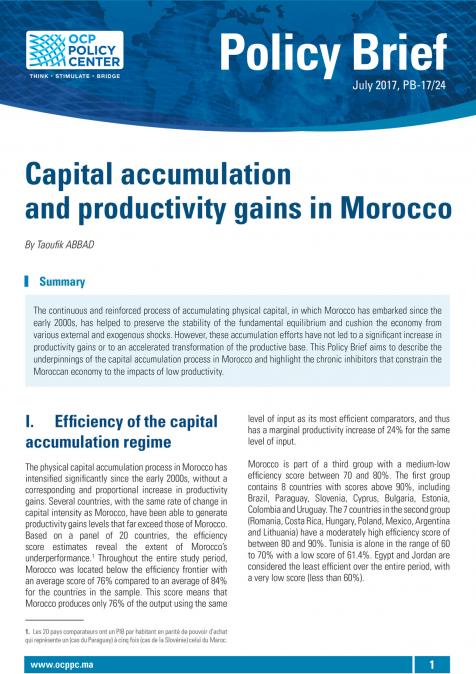
    The continuous and reinforced process of accumulating physical capital, in which Morocco has embarked since the early 2000s, has helped to preserve the stability of the fundamental equilibrium and cushion the economy from various external and exogenous shocks. However, these accumulation efforts have not led to a significant increase in productivity gains or to an accelerated transformation of the productive base. This Policy Brief aims to describe the underpinnings of the capital a ...