Publications /
Book / Report

Back
Africa Economic Symposium (AES) 3nd edition - SUMMARY REPORT
Authors
General rapporteur Mahmoud Arbouch
September 2, 2025

The Africa Economic Symposium (AES) has firmly established itself as one of the flagship annual events of the Policy Center for the New South, alongside the Atlantic Dialogues and the African Peace and Security Annual Conference (APSACO). Now in its third edition, AES continues to provide a unique platform for economists, policymakers, and academics from across the continent and beyond to exchange perspectives on the pressing macroeconomic and structural challenges facing Africa. Its mission remains to foster rigorous, evidence-based debates that inform policymaking and support long-term strategies for Africa’s development in an era of uncertainty. 

The 2025 edition, convened under the theme “Bold Moves amid Global Shifts,” explored the difficult policy trade-offs confronting African governments as they navigate a volatile global environment. The continent’s recovery from COVID-19 has been uneven, while debt pressures, supply chain disruptions, and geopolitical tensions weigh heavily on fiscal and economic resilience. Structural challenges such as persistent unemployment, low productivity, and the exclusion of Africa’s youth continue to hinder inclusive growth, even as policymakers are called upon to adapt to deep systemic uncertainty. 

The symposium underscored that many African states are increasingly resorting to short-term stabilization measures—such as accumulating reserves and postponing reforms—that may provide immediate security but risk delaying the structural transformation urgently needed. Against this backdrop, AES 2025 called for a careful balance between fiscal prudence, social investment, and the pursuit of sustainable growth, placing emphasis on reforming governance, improving macroeconomic management, and accelerating structural change. 

The discussions highlighted the urgent need to rethink Africa’s economic strategies in a shifting global order. From debt sustainability and the role of central banks to the promise of financial innovation, digital inclusion, and new instruments such as central bank digital currencies, the symposium emphasized that policy choices must align with long-term transformation goals. The debates also explored the opportunities and challenges of regional integration, trade connectivity, and development finance, all of which are essential levers for Africa’s resilience and prosperity. 

As in previous editions, the Annual Report on African Economies was launched alongside the symposium, offering an in-depth analysis of the continent’s macroeconomic dynamics and structural transformation pathways. More than just a publication, the report reflects the collective intellectual effort of leading scholars and practitioners, providing evidence-based insights to guide decision- makers. Together, the symposium and the report reinforced the Policy Center for the New South’s commitment to fostering forward-looking economic thinking that moves beyond short-term headlines to tackle Africa’s enduring challenges.

RELATED CONTENT

  • Authors
    April 3, 2017
    Turkey has been approaching a crossroads for some time now. Soon enough it will have to choose a direction. On April 16, 2017 Turks will vote in a referendum on President Recep Tayyip Erdogan’s proposed constitutional amendment that would shift the country’s power center from a parliamentary system to a presidential one.  If successful, not only would this further consolidate power in the executive’s hands—in this case Erdogan himself—but it would also pave the way for him to ...
  • Authors
    March 29, 2017
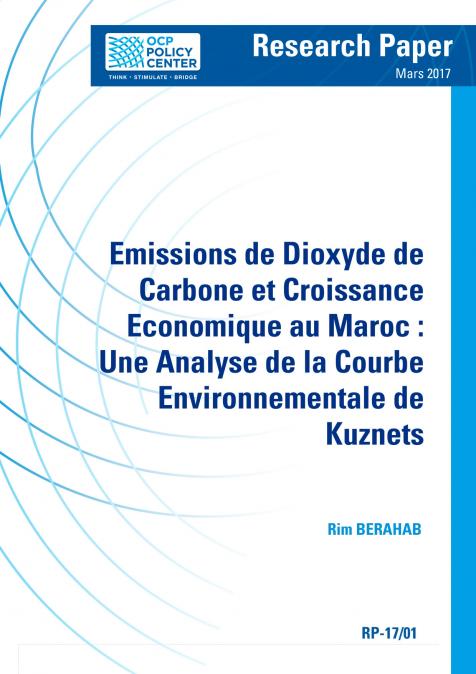
    Dans un contexte mondial de plus en plus préoccupé par les aléas climatiques, comprendre l’impact de la croissance économique sur l’environnement devient crucial, notamment pour les pays en voie de développement. Ce papier aborde cette problématique sous le prisme des émissions de dioxyde de carbone (CO2) et examine comment la croissance économique se répercute sur l’environnement. L’objectif de cette étude est de tester la validité de la courbe environnementale de Kuznets (CEK) pou ...
  • Authors
    Françoise Nicolas
    March 24, 2017
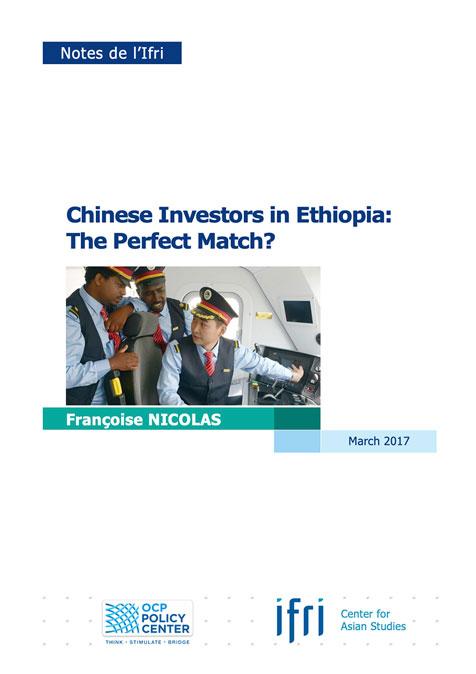
    Since the fall of the Derg regime in 1991, cordial relations have developed between China and Ethiopia, forming a positive political backdrop in front of which the two countries’ interests have increasingly converged. On the one hand, Ethiopia seeks to replicate the experience of East Asian countries such as Taiwan, Malaysia, or China and to attract foreign direct investment (FDI) in order to accelerate the development of its manufacturing capacities (in particular through an ambit ...
  • Authors
    Diana Quintero
    March 23, 2017
    Colombia is a country of incredible contrast: known to be one of the places on earth where people feel happiest, it is also one of the most unequal and for many decades, a country immersed in a protracted conflict. Despite the latter - and here is the starkest contrast - Colombia has recently succeeded in reducing poverty and building the foundations for sustainable growth and prosperity. The Santos administration has delivered on two of its main promises: sign a peace agreement wi ...
  • Authors
    Coordonné par
    Zineb Bouba
    Appui technique: Pierre-Richard Agénor
    March 9, 2017
    Dans le sillage des débats actuels sur la contribution de la femme à la création de richesses, le présent ouvrage s’essaye d’y contribuer moyennant des approches méthodologiques innovantes couvrant plusieurs champs d’analyse conciliant l’égalité de genre, les politiques publiques et la croissance économique au Maroc. Il offre, ainsi, un diagnostic exhaustif de l’évolution des inégalités de genre en termes, notamment, d'accès à l'emploi, à l'éducation, à la santé, à l'infrastructure, ...
  • Authors
    March 7, 2017
    During his run for President of the United States, Mr. Trump called the North American Free Trade Agreement (NAFTA), “the worst trade deal ever approved by this country”. His target is Mexico, which runs a $ 50 billion surplus of trade in goods and services with the United States. Trade with Canada, the third NAFTA party, is essentially balanced. However, NAFTA’s provisions cannot be changed without affecting Canada and without Canada’s consent, and the Foreign Ministers of Canada a ...
  • Authors
    Matheus Cavallari
    February 23, 2017
    Central banks of large advanced and many emerging market economies have recently gone through a period of extraordinary expansion of balance sheets and are all now possibly facing a transition to less abnormal times. However, the fact that one group is comprised by global reserve issuers and the other by bystanders receiving impacts of the former’s policies carries substantively different implications. Furthermore, using Brazil and the U.S. as examples, we also illustrate how the re ...
  • Authors
    Sandra Polónia Rios
    Pedro da Motta Veiga
    Eduardo Augusto Guimarães
    February 22, 2017
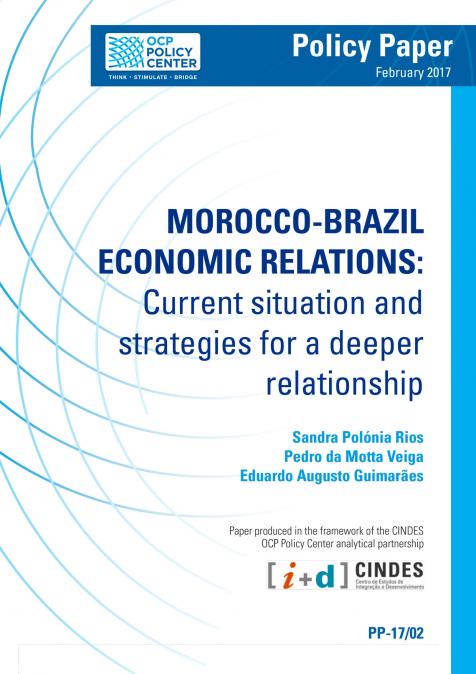
    Despite the sustained growth in the bilateral trade observed at the beginning of the Century, Moroccan – Brazilian economic relations are still going through what could be called the ‘shallow’ phase of relations between two middle-income countries. Trade is concentrated in a few products – those where both countries enjoy long lasting and natural comparative advantages – and face strong difficulties to diversify in terms of products and to upgrade towards more complex models of lin ...
  • Authors
    February 9, 2017
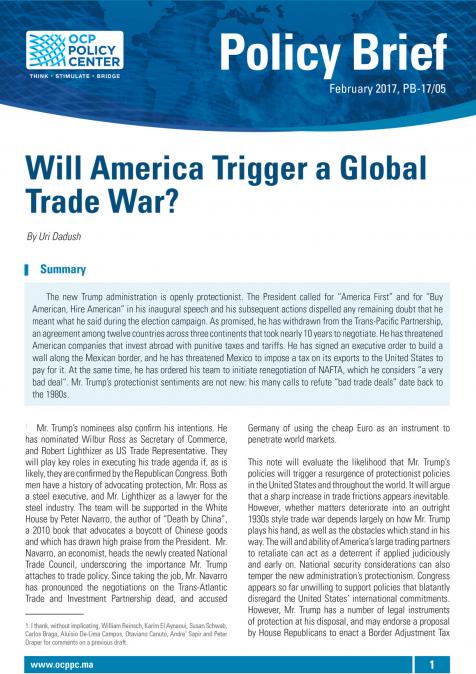
    The new Trump administration is openly protectionist. The President called for “America First” and for “Buy American, Hire American” in his inaugural speech and his subsequent actions dispelled any remaining doubt that he meant what he said during the election campaign. As promised, he has withdrawn from the Trans-Pacific Partnership, an agreement among twelve countries across three continents that took nearly 10 years to negotiate. He has threatened American companies that invest a ...
  • Authors
    Taoufik Abbad
    February 3, 2017
    La réflexion développée dans cet ouvrage part d’un constat alarmant et pressant. Le processus continu et renforcé de l’accumulation du capital, dans lequel s’est engagé le Maroc depuis les années 2000, a permis certes de préserver la stabilité des équilibres fondamentaux et d’amortir les différents chocs exogènes, aussi bien internes qu’externes, mais il n’a pas permis d’insuffler un accroissement plus important des gains de productivité et d’accélérer la transformation de la base p ...