Publications /
Opinion

Back
Why Regionalism Matters More Than Ever for Non-G20 Developing Countries
Authors
Bambang Brodjonegoro
November 12, 2026

This Opinion was originally published in asiapathways-adbi.org


When G20 leaders meet in Miami next month, the discussions are expected to focus on how to sustain growth in a world marked by economic fragmentation, supply chain disruptions, fiscal pressures, and geopolitical uncertainty. Yet the global economy’s success depends not only on G20 members, but also on the many developing countries outside the group. Strengthening regional cooperation is a practical way to bridge this gap.

Many non-G20 developing economies rely heavily on neighboring G20 members for exports, FDI, remittances, and development finance. Consequently, their fortunes are closely tied to regional economic conditions.

This reality has intensified as global fragmentation accelerates. Trade restrictions have increased sharply, official development assistance has declined, and developing countries continue to face a massive financing gap in achieving the Sustainable Development Goals. For many economies, the challenge is how to preserve growth opportunities when global cooperation falters.

In this context, regionalism offers a vital part of the solution. Regional cooperation is not a retreat from globalization; rather, it provides a practical mechanism to strengthen resilience, deepen integration, and create new growth opportunities. Crucially, it advances core G20 objectives, including robust supply chains, effective development finance, and economic stability.

Asia’s experience demonstrates what sustained regional cooperation can achieve. Over decades, regional institutions, trade agreements, and production networks—such as ASEAN, the Regional Comprehensive Economic Partnership (RCEP), and the Chiang Mai Initiative Multilateralisation (CMIM), first established in response to the Asian financial crisis of 1997/98—have fostered a deeply interconnected economic region. Today, intra-Asian trade accounts for over half of the region’s merchandise trade, proving that regional integration sustains growth amid global uncertainty.

Other regions are pursuing their own pathways. In Africa, high trade costs, infrastructure gaps, and fragmented markets constrain regional commerce. While initiatives like the African Continental Free Trade Area seek to address these barriers, success depends on connecting businesses, logistics, and financial systems across borders.

Connector economies can contribute to this process. These are countries with the industrial capabilities and logistics infrastructure to link neighbors to wider markets. Morocco, for instance, combines these capabilities with its geographic position and a substantial network of trade agreements, creating opportunities for African producers to access wider markets and integrate into global value chains. Realizing this potential requires supportive policies and targeted infrastructure investment.

To support sustainable growth, three priorities for G20 members stand out:

First, greater investment is needed by G20 countries in regional public goods, via regional platforms and MDBs. Transport corridors, power grids, broadband networks, digital payment systems, and disease surveillance generate cross-border benefits. Because these benefits are shared, such projects often face underinvestment. As discussions continue on enhancing development finance, greater emphasis on regional public goods, especially digital infrastructure, could deliver substantial returns for both G20 and non-G20 economies.

Second, regional trade arrangements must remain open and inclusive. The most successful agreements create opportunities not only for existing members but also for neighboring economies to join value chains. Through trade facilitation, standards support, and access to trade finance, open regional trade strengthens the multilateral trading system rather than restricting it.

Third, the G20 should strengthen regional financial safety nets that are essential to manage future shocks. Regional financing arrangements, including swap lines between central banks, can complement global institutions by providing additional layers of protection, improving crisis preparedness and strengthening confidence across regions.

As G20 leaders prepare for their summit in December, regionalism offers a practical way to translate the group’s growth agenda into tangible benefits for a wider community of nations. At a time when development finance is under pressure and global cooperation faces headwinds, strengthening regional partnerships represents a strategic investment in a resilient and interconnected global economy.

RELATED CONTENT

  • April 18, 2018
    The recently signed African Continental Free Trade Agreement represents a countercurrent to protectionist tendencies across the Atlantic and the Pacific, and may well move the economic integration of the African continent forward. Translating the vision into action, however, will call upon signatories to undertake deeper domestic reforms and to confront specific challenges related to the agreement itself. This brief explains why the agreement is important for Africa and identifies p ...
  • Authors
    Mouhamadou Moustapha Ly
    March 28, 2018
    Ce mardi 21 Mars 2018, quarante-quatre chefs d’Etat et de gouvernement réunis à Kigali (Rwanda) signaient l’accord de création de la zone de libre échange continentale (Continental Free Trade Area, CFTA). Cet accord historique marque la volonté des Etats africains d’aller vers la mise en place à l’échelle du continent d’un marché commun où les échanges de biens et de services seraient libres et la circulation des capitaux et des personnes sans contraintes. Tels que précisés dans la ...
  • Authors
    November 27, 2017
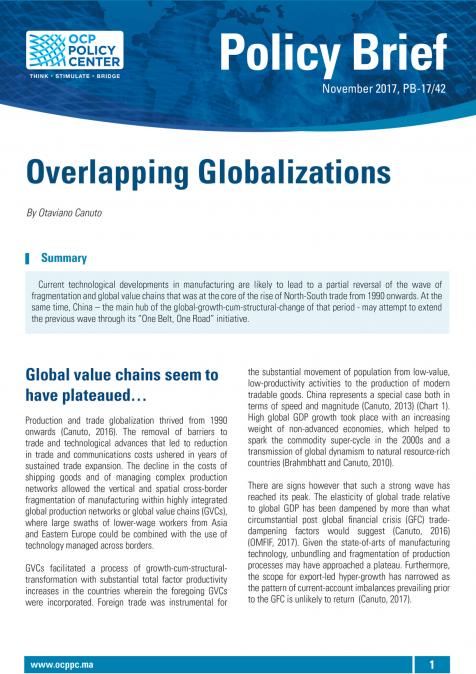
    Current technological developments in manufacturing are likely to lead to a partial reversal of the wave of fragmentation and global value chains that was at the core of the rise of North-South trade from 1990 onwards. At the same time, China – the main hub of the global-growth-cum-structural-change of that period - may attempt to extend the previous wave through its “One Belt, One Road” initiative. ...
  • Authors
    Thomas Awazu Pereira da Silva
    January 2, 2017
    This year, under the patronage of His Majesty King Mohammed VI, the OCP Policy Center (OCPPC) - in collaboration with the German Marshall Fund of the United States (GMFUS) - hosted and organized the fifth Atlantic Dialogues, gathering over 300 high-level international public- and private-sector leaders from the Atlantic Basin to discuss cross-regional issues ranging from economic and social development, security and trade, to migration, resources, and energy. This year’s e ...
  • Authors
    Vera Songwe
    December 23, 2016
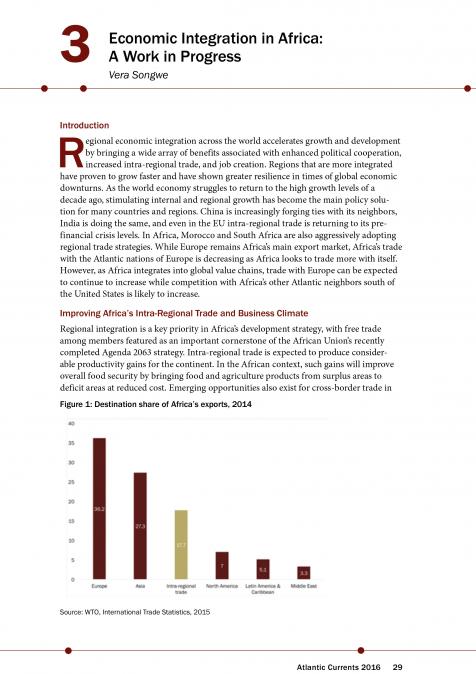
    Regional economic integration across the world accelerates growth and development by bringing a wide array of benefits associated with enhanced political cooperation, increased intra-regional trade, and job creation. Regions that are more integrated have proven to grow faster and have shown greater resilience in times of global economic downturns. As the world economy struggles to return to the high growth levels of a decade ago, stimulating internal and regional growth has become t ...
  • Authors
    Vera Songwe
    December 23, 2016
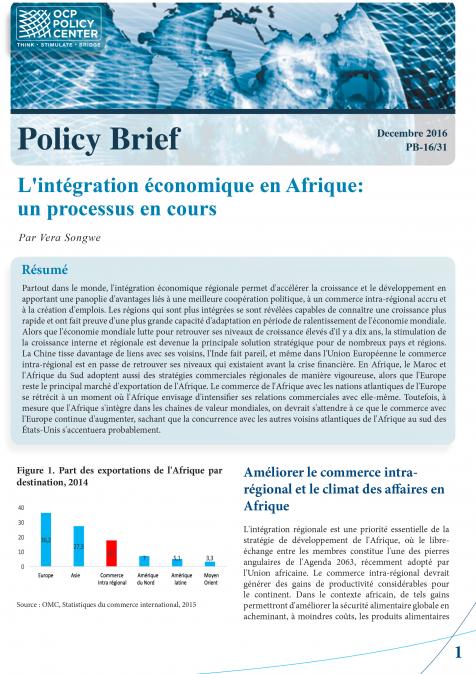
    Partout dans le monde, l'intégration économique régionale permet d'accélérer la croissance et le développement en apportant une panoplie d'avantages liés à une meilleure coopération politique, à un commerce intra-régional accru et à la création d'emplois. Les régions qui sont plus intégrées se sont révélées capables de connaître une croissance plus rapide et ont fait preuve d'une plus grande capacité d'adaptation en période de ralentissement de l'économie mondiale. Alors que l'écono ...
  • Authors
    May 25, 2016
    This paper will take stock of the economic performance of Europe and the Arab world, examining how they can do better by working together. The paper pays special attention to the trade, investment, migration and energy linkages between the two regions, as well as those among the Arab countries, as well as how they can be improved to achieve better development. Whereas we present a southern perspective, with Arab countries as main focus, the purpose is to understand the constraints f ...
  • Authors
    Pierre-Richard Agénor
    January 24, 2015
    OCP Policy Center est ravi de recueillir vos commentaires et d’engager la discussion autour de la publication de son dernier livre sur la stratégie de croissance du Maroc à l’horizon 2025 dans un environnement international en mutation, co-écrit par Pierre Richard Agénor et Karim El Aynaoui. L’économie marocaine fait actuellement face au risque de se retrouver « prise en tenaille », entre, d’un côté les pays à faible revenu en croissance rapide, bénéficiant d’une main-d’œuvre abond ...
  • Authors
    Mohamed Mouline
    January 1, 2014
    L’Afrique du Sud est une république fédérale, fondée sur une démocratie parlementaire. Avec une superficie de 1,2 million de km² et une population de 50 millions d’habitants, elle est la première puissance économique du continent africain, représentant, à elle seule, 30 % du PIB de l’Afrique Subsaharienne et 66 % de celui de l’Afrique Australe. Son PIB est de 420 milliards de dollars et son PIB par habitant est de 5 860 dollars. Ce pays est parvenu à réinsérer son économie dans les ...
  • Authors
    Mihoub Mezouaghi
    November 1, 2013
    Le discours sur la « colocalisation » est chargé de bonnes intentions à l’attention des pays du sud de la Méditerranée qui, depuis quelques années, réclament avec insistance une contrepartie à l’accès à leur marché (notamment en matière de transfert de technologie pour permettre d’accélérer leur industrialisation). La « colocalisation » est alors présentée comme une « forme avancée de la délocalisation ». Mais, ce discours s’adresse en même temps à l’opinion publique française lorsq ...