Publications /
Paper in Academic Journals
Back
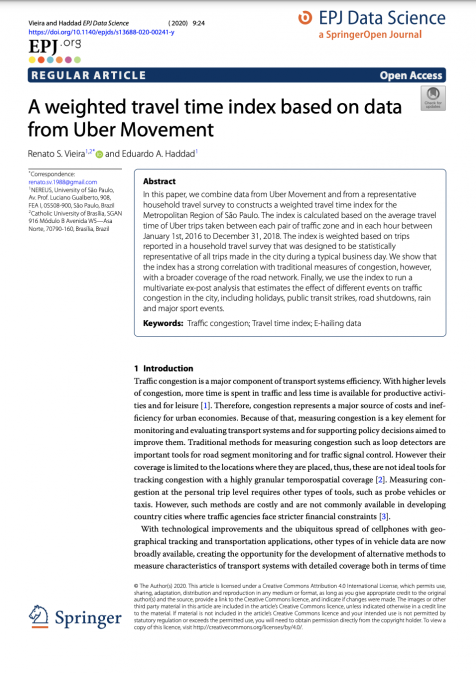
A weighted travel time index based on data from Uber Movement
Authors
Renato S. Vieira
August 8, 2020

In this paper, we combine data from Uber Movement and from a representative household travel survey to constructs a weighted travel time index for the Metropolitan Region of São Paulo. The index is calculated based on the average travel time of Uber trips taken between each pair of traffic zone and in each hour between January 1st, 2016 to December 31, 2018. The index is weighted based on trips reported in a household travel survey that was designed to be statistically representative of all trips made in the city during a typical business day. We show that the index has a strong correlation with traditional measures of congestion, however, with a broader coverage of the road network. Finally, we use the index to run a multivariate ex-post analysis that estimates the effect of different events on traffic congestion in the city, including holidays, public transit strikes, road shutdowns, rain and major sport events.

RELATED CONTENT

  • Authors
    Jonathan Berkshire Miller
    March 10, 2026
    At the Atlantic Dialogues in December 2025, I argued that a period was underway in which trade and security could no longer be analytically or practically separated. Assessments have solidified in recent months regarding the emergence of a geoeconomic world order. Geoeconomics was a gradual transition from a purely geopolitical focus on military force, to an emphasis on economics to gain competitive advantage. It is no longer a transitional phase, but an emerging structural componen ...
  • Authors
    Inácio F. Araújo
    Geoffrey J.D. Hewings
    March 6, 2026
    By mapping Iraq’s economic structure in detail, the Multiregional Social Accounting Matrix (MRSAM) sheds light on regional interdependencies and distributional dynamics, offering a critical foundation for evidence-based policy design. Key MessagesIraq is dependent on oil, but this dependence is felt unevenly. In 2013, oil accounted for nearly half of GDP, over 90% of exports, and almost all fiscal revenues, but less than 2% of jobs; benefits from oil were concentrated in Basra ...
  • Authors
    March 3, 2026
    The February 20 United States Supreme Court decision against President Donald Trump’s use of the U.S. International Emergency Economic Powers Act (IEEPA) to establish tariffs has led him to resort to other legal instruments. So-called U.S. reciprocal tariffs on countries set out in April 2025 were based on IEEPA, as were tariffs that allegedly punished countries for allowing fentanyl into the U.S. Trump tried to evade the constraints presented by other legal instruments that could f ...
  • Authors
    February 24, 2026
    This Paper was originally published on sciencedirect.com This paper assesses the national and regional impacts of the Marrakech–Fès highway project in Morocco using a Spatial Computable General Equilibrium (SCGE) model combined with GIS-based road network data. The analysis captures how improved connectivity alters economic performance and emissions patterns across space and time. Results show that while overall economic gains are modest, the benefits are unevenly distributed—f ...
  • February 20, 2026
    تناول هذا البودكاست، المنظم على هامش الدورة الرابعة عشرة من منتدى الحوارات الأطلسية، الدور الاستراتيجي للممرات البحرية باعتبارها رافعة للتنمية ومحركاً لإدماج اقتصادات الجنوب في التجارة ال ...
  • Authors
    Sofia Formigli
    February 13, 2026
    There is a story told by Václav Havel, the Czech dissident writer who later became president after the fall of communism. In his essay The Power of the Powerless, Havel describes a shopkeeper who, every morning, places a sign in his window reading: “Workers of the world, unite!” He does not believe in it. Nor do the people around him. Yet the sign remains. ...