Publications /
Opinion

The author of this piece, Carolina Novac, is a 2023 alumna of the Atlantic Dialogues Emerging Leaders program. Learn more about her here.
This year, I had the honor to participate for the first time in the World Economic Forum (WEF), as a member of the delegation of Moldovan Prime Minister Dorin Recean. WEF has always been a melting pot of innovative ideas, and a place where world leaders, business giants, and thought leaders can bring suitable, joint solutions to the main challenges we all face today. Two wars are already shaking 2024, and now the global community faces some huge technological challenges with artificial intelligence (AI) being at the point of full take-off.
I wanted to share some humble reflections gathered during and after WEF 2024 (which took place in Davos from January 15-19) on the role AI can have in energy-system transformation. More than 140 countries, including the biggest polluters, have net-zero targets to be achieved by 2050, and the global energy system as a whole is currently undergoing a massive transformation, in the context of electricity demand expected to more than double by 2050. In the decades ahead, the net-zero goal requires billions of euros of investment channeled annually at high speed, to further more decentralization with higher renewables (RES) penetration and digitalization at the heart of it.
AI has tremendous potential to accelerate and support the global energy transition, but also make it more resilient. Although AI has little to do with production, transportation, or consumption of both electrons and molecules, it can optimize all these processes interlinked in the energy system.
At WEF 2024, I particularly found insightful the session on ‘AI for the Energy Transition’ with Remi Eriksen, DNV’s CEO, and Lauren Woodman, CEO of the NGO DataKind as key speakers.
As I cover energy decarbonization at the Ministry of Energy, in the Republic of Moldova, below are some key takeaways from the Forum, showing where AI could play a significant role in the energy sector:
1- Utilizing AI for efficient electricity management and its distribution, while securing broad efficiency improvements. With more RES integration—meaning more variable energy, expansion of electrification, increased numbers of electric vehicles, and decarbonization of heating and cooling systems—a focal point will be distributed energy resources, as more autonomous systems operate within horizontally integrated energy sources, which can enable certain communities to operate more independently. The role of AI here can be a close-to-real-time matching of generation of RES vs consumption per community, while storing excess electricity and minimizing costs for consumers and shifting to more autonomous decisions of prosumers.
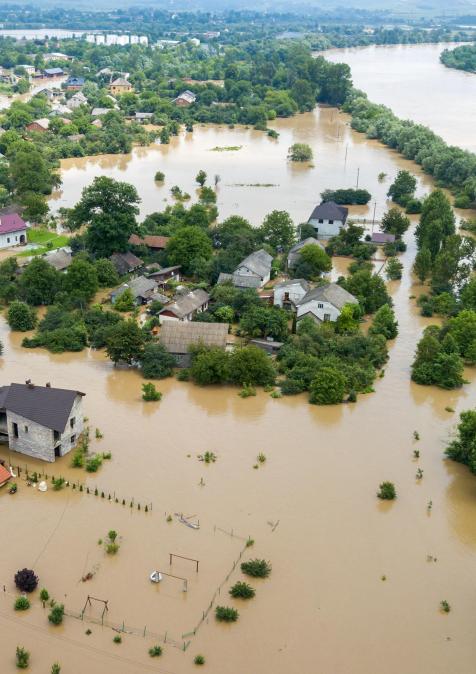
2- Alerting operators to possible grid congestion, especially in times of bad weather. During storms and/or low temperatures, electricity distribution grids can be impacted significantly, especially if they rely on overhead power lines, which can be damaged or severed more often than underground cables. Such a situation arose in Moldova on January 7, 2024, when it took three days for full restoration of the power supply to 80 000 household consumers in the country, in the wake of a bad winter storm. AI can offer some solutions in terms of assessing the need for changes to grid components which would suffer damage in such storms, identifying deterioration, and highlighting high congestion at certain parts of the grid. AI can also play a role in maintenance and operation of conventional power plants when it has certain operational problems, and can notify operators of faults in due time.
3- More accurate RES trading on Day-Ahead and Intra-Day platforms thanks to AI integrated into weather forecasting software. More green-power procurement can be achieved with cross-cutting efficiency in terms of optimization of production, distribution, and consumption, and provision of a better matching of generation and consumption—specifically, in terms of forecasting energy production, balancing the grid, reducing possible losses, and securing energy savings.
4- Using data science to better tackle inequity and energy vulnerability. How can we use it for an equitable transition given also the last two years of energy crises across Europe and high energy price volatility? Lauren Woodman, CEO of the NGO DataKind, referred to a fantastic project deployed by her NGO, in the US which targeted vulnerable energy consumers in a community in which resources/compensation could be better allocated. Application of AI software with better datasets has resulted in better allocation of limited resources per each final consumer.
5- Augmenting AI tools by training staff in an appropriate way, bringing online new skills and building on human capital development. In this context, state institutions should look at reallocating their resources to facilitate this, by retraining employees on use of these tools. The private sector is already deploying AI tools, minimizing their costs and maximizing the benefits and further reducing possible risks.
6- Accelerating innovation and enhancing a new set of solutions in terms of processes, services, and products, such as: 1) improving current technologies, and 2) discovering new materials and solutions. AI is set to amplify that set of new technologies or ‘unknown knowns’, meaning products and solutions which we know are on the way to be discovered or commercialized, and which will further get us closer to the net-zero goal.
The main challenge of the energy transition is to build in an optimal fashion a more sustainable, affordable, and secure energy system. This can be done, despite its complexity, with the deployment of AI tools, which can help improve efficiency and up-scale new innovative products and accelerate the energy transition.