Publications /
Policy Brief
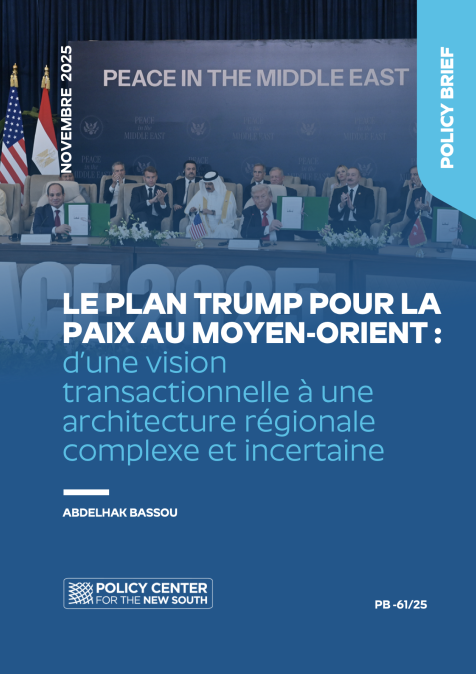
On November 17, 2025, the United Nations (UN) Security Council adopted Resolution 2803, endorsing President Donald Trump's Comprehensive Plan to end the conflict in Gaza. Contrary to popular belief, the American initiative does not date from the Trump Administration's 2nd term. It was born during his first term.
The plan endorsed by the UN Security Council resolution, dubbed the ''Deal of the Century'', is in fact the heir to the initial plan, which bore the name ''Peace to Prosperity''. The version of the plan enshrined in Resolution 2803 can be seen as both a continuation of and a break with the initial plan: a continuation, insofar as it focuses on peace, and a break, insofar as it speaks of a peace established by force rather than by the lure of prosperity.
The meeting with Arab and Muslim leaders on the sidelines of the United Nations General Assembly seems to have convinced President Trump that any peace in the Middle East must involve politics and security, rather than an economic or financial transaction.
So the original plan hasn't disappeared, and the new one isn't a creation.
Trump has been forced to adapt his conception of peace to safeguard his Middle East policy.
INTRODUCTION
On the afternoon of November 17, 2025, the United Nations Security Council adopted Resolution 2803, by 13 votes in favor and 2 abstentions (Russian Federation and China), endorsing President Donald Trump's Comprehensive Plan to end the conflict in Gaza.
The American President's ideas on the Middle East do not date from his second term in office and cannot, therefore, be reduced to the Plan signed at Sharm Al Sheikh in Egypt, on October 13, 2025, and which has just been endorsed by the Security Council.
During his first term in office, President Trump had already presented a so-called "Deal of the Century" plan which, according to its promoters, was to usher in a new era of peace between Israelis, Arabs and Palestinians.
Intended to resolve a conflict that had lasted more than seventy years, the "Deal of the Century" above all marked a lasting shift in American policy in the Middle East: from diplomacy based on political legitimacy and international law to diplomacy based on transactions, normalization and economic power.
The Plan, which was part of the "Peace to Prosperity" project1 , was conceived by the President's son-in-law, Jared Kushner. It promised to transform the Middle East into a zone of shared prosperity, but the peace Kushner proposed, which was to lead to prosperity, turned out to be achievable only at the price of concessions deemed painful by the Palestinians and virtually unacceptable to the Arabs and Muslims. It was denounced by the Palestinian Authority as a manoeuvre designed to institutionalize the Israeli occupation under the guise of peace. Mahmoud Abbas dismisses the Plan out of hand: "Jerusalem is not for sale, and our rights are not up for negotiation "2.
The Plan was based on a philosophy typical of the American President's style of thinking: peace as a transaction, not a political process. Far from restoring historical fairness, the Plan aimed to transform the balance of power into a win-win deal, conditional on the acceptance of Israel's primacy as a regional stabilizing power and the indefinite postponement of any idea of a Palestinian state.
Some thought that this Plan would be buried after Trump's defeat in 2020; they were belied by the facts. The conceptual foundations of Trump's thinking on the Middle East have survived. The Biden administration had, in fact, only been a parenthesis in the life of the Plan. While displaying a more multilateral posture, and putting the economic aspects of the Plan on the back burner, the Democrats reactivated several of its pillars, notably the priority given to the pacification of Gaza (where war broke out in 2023), the consolidation of the Abraham Accords (without putting much enthusiasm into it) and the expansion of the regional anti-Iranian coalition (without succeeding). When Donald Trump returned to the White House in 2025, he was still holding out for his deal of the century. He had tried everything to convince people that prosperity could bring peace (making Gaza the Singapore or Rivera of the Middle East); but then he had to bend over backwards to transform his project into an approach that was still transactional, but that took into account political fairness, historical and legal acumen, and an international public opinion that gives little or no credence to economic concerns and prosperity when it comes to Palestinian rights.
Indeed, the situation in the Middle East and around the world has changed. The war in Gaza, which broke out in October 2023, has transformed the situation. Israel, the central subject of Donald Trump's project, responded disproportionately to the attacks of October 7, and its image has deteriorated in international public opinion, moving from that of victim to that of executioner. The priority now is to stop the war before seeking wealth. Trump is thus obliged to adapt his conception of peace to safeguard his Middle East policy, while at the same time restoring the image of Israel, whose isolation is increasingly marked, especially after the failed attack on the Hamas delegation in Qatar. His meeting with Arab and Muslim leaders on the sidelines of the United Nations General Assembly has convinced him that any peace in the Middle East requires political and security measures, rather than economic or financial transactions.
As nothing is lost, nothing is created, everything is transformed, President Trump's old plan has not disappeared, and the new one is not a creation. Indeed, Resolution 2803 of 2025, which sets out the new Plan, does not fail to refer, in paragraph 2, to the convictions expressed on this subject by President Trump in 2020.3
Indeed, the idea of 2019 has only been transformed into a matrix of geopolitical and security action, first, in the hope of becoming geo-economic, second. Prosperity, which must create peace, must have peace as a prerequisite. Peace must first be imposed by force and diplomacy, before embarking on the transactions that are supposed to bring prosperity.
The Trump Administration's 2025 Plan is therefore nothing new. It is part of the President's amended doctrine and is called "Peace through strength", combining bilateral pressure, economic incentives and personal diplomacy. It is the heir to the "Peace to Prosperity" project initiated by the American president during his first term. It is both a continuation and a break with it. It is a continuation in that it focuses on peace; and it is a break in that it is a peace established by force, not by the lure of prosperity.
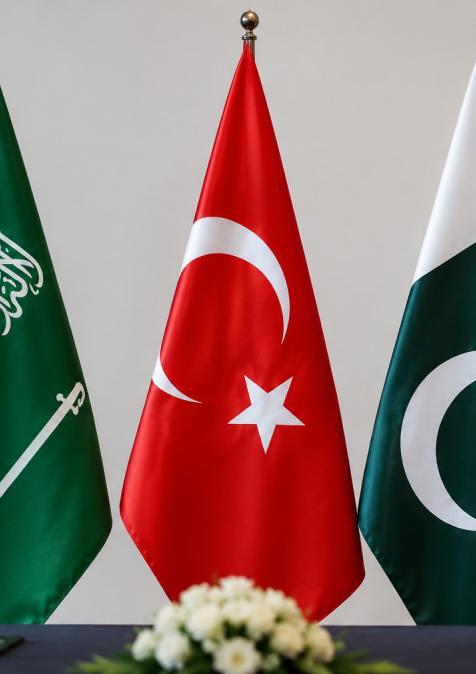
In Sharm Al Sheikh, Trump imposed peace by pressuring Israel and threatening Hamas. He even claims that it was the Israeli-American strikes on Iran that facilitated the ceasefire in Gaza. He signs, and gets Egypt, Qatar and Turkey to sign, a plan that seems to forget the deal of the century, but in reality only prepares the ground for it. Peace was signed in the absence of the belligerents; Hamas and Israel were condemned, in absentia, to cease hostilities.
The plan signed in Sharm Al Sheikh aims to bring about an imposed compromise capable of facilitating peace and potentially prosperity.
The plan seems to have three objectives, supposedly to prepare the Middle East for an era of cooperation and prosperity:
- an immediate step: the pacification of the Gaza Strip;
- a possible but uncertain prospect: resolving the conflict between Palestinians and Israelis ;
- to crown the efforts of the first mandate: to broaden peace by extending the Abraham Accords.
These three objectives form the backbone of this Policy Brief.
AN IMMEDIATE STEP: PACIFICATION OF THE GAZA STRIP
At the heart of President Trump's original plan was the idea that prosperity is a prerequisite for peace. Jared Kushner, his son-in-law and principal advisor, saw peace not as a political compromise, but as a collective investment. At the Manama conference (Bahrain, June 2019), he presented a $50 billion economic plan to finance infrastructure, trade and innovation in the Palestinian territories and neighboring countries (Egypt, Jordan, Lebanon).
However, this approach overlooked the political dimension of the conflict. The implicit assumption was that a population better integrated into the global economy would become more amenable to stability, even without full sovereignty.
When the Gaza war broke out in October 2023, and Donald Trump returned to power in January 2025, this logic was reactivated in another form. Washington sees the end of the war as the second floor of a new regional edifice, and the prerequisite for any effort at prosperity-generating economic cooperation. The ceasefire becomes not the conclusion of an agreement, but the starting point for political recomposition, a sine qua non for any move towards economic normalization.
Post-war Gaza: a governance issue first and foremost
Since the end of 2023, when it became clear to everyone that Hamas could never rule Gaza after the war, discussions on the territory's future have oscillated between three models:
a supervised return of the Palestinian Authority under Arab supervision (Egypt, Saudi Arabia, Qatar, Emirates);
an interim international administration, possibly steered by the UN, with a humanitarian and security mandate (which is what the Security Council finally decided on);
indirect management by Israel, via buffer zones and increased military surveillance.
But Tel Aviv rejects any Palestinian Authority presence. Prime Minister Benyamin Netanyahu declared in January 2024: "Israel will not allow a Hamas 2.0 or a Palestinian Authority 1.0 in Gaza."
This intransigence makes any political settlement difficult. For Israel, the objective is the total neutralization of Hamas, not a democratic transition. The United States, on the other hand, is seeking a pragmatic balance: avoiding a power vacuum in Gaza without rehabilitating a discredited Hamas.
Regional players: between caution and calculation
Egypt plays a pivotal role, but fears the destabilization of Sinai. President Abdel Fattah Al-Sissi warned as early as November 2023: "We will not allow the Palestinian cause to be resolved at the expense of Egypt's security."
Qatar, for its part, positions itself as mediator and financier, but also as protector of Hamas cadres. Jordan, for its part, maintains its line of defending the status quo in Jerusalem. Finally, Saudi Arabia remains on the sidelines, making any involvement conditional on a serious political perspective. The UN and the European Union reiterate that any lasting solution must be anchored in international law, in particular Security Council resolutions 242 and 338.
The end of the war in Gaza is thus a common objective, but with divergent motivations:
Israel's objective is security. For Tel Aviv, peace means a strategic situation in which its deterrent capacity is felt and internalized by all its neighbors;
through peace, the United States aims to achieve a situation in which the countries of the region abandon all belligerence in favor of greater cooperation and stable cohabitation. Normalization between the Arab-Muslim states of the region and Israel constitutes a bulwark against Iran's strategies of nuisance, which could lead the latter to revise its doctrine;
Arab countries give priority to legitimacy under international law. They are using all their capacities to recover what they consider to be a legitimate right; that of the Palestinians to be masters of their own destiny. This solution would pull the rug from under the feet of Iran, which is using the Palestinian question to consolidate its influence in the region.
RESOLVING THE CONFLICT BETWEEN PALESTINIANS AND ISRAELIS: A POSSIBLE BUT UNCERTAIN PROSPECT
The Trump Plan: an ambiguous formula for a Palestinian state under trusteeship
The initial plan put forward during President Trump's first term proposed a form of demilitarized Palestinian state, fragmented and made up of enclaves linked by roads and tunnels, with a capital at Abu-Dis (a new city near Jerusalem). Jerusalem would remain Israel's "indivisible" capital. In exchange, Washington promised massive financial support and progressive international recognition.
This proposal, contrary to UN resolutions, was unanimously rejected by the Palestinians. It reduced the Palestinian question to a problem of governance and international aid. The relocation of the American embassy to Jerusalem (May 2018) confirmed that the United States had aligned itself with the Israeli interpretation of the conflict.
Under Trump's second term, the United States is postponing the question of Palestinian statehood. It makes ending the state of war in the region a priority and a prerequisite for resolving the conflict between Israel and the Arabs, Muslims and Palestinians. Unlike the Arab-Muslim community and some Europeans, who see the Palestinian question as the cornerstone of peace in the Middle East, the United States and Israel see it as a consequence of a reconfiguration of the region. In the first instance, the Americans and Israelis are keen to neutralize the Iranian axis, which they see as hampering any solution to the Israeli-Palestinian conflict.
The Franco-Saudi initiative: complementary or rival to the Trump Plan?
Since 2024, Paris and Riyadh have been trying to reactivate the peace dynamic by taking it out of the Washington-Tel-Aviv head-to-head.
At the Paris Peace Conference (December 2023), French President Emmanuel Macron asserted that: "No lasting peace can exist without a Palestinian state."
Crown Prince Mohammed bin Salmane, through his Foreign Minister, reminded us that, "Normalization with Israel is impossible without real progress for the Palestinians."
The Franco-Saudi approach aims to reposition the Arab world as an actor for peace, rather than a mere spectator of an American agenda. Riyadh, which has stayed away from mediation in favor of Qatar and Egypt, also sees this as an opportunity to rehabilitate its regional leadership, while paving the way for supervised normalization in the long term.
France, which was also left out of the mediation efforts during the Gaza war, tried to get involved by recognizing the Palestinian state, at the cost of worsening its relations with Israel. In this initiative, which it is leading with Saudi Arabia, it has found a way of getting to the final negotiating table.4
Structural obstacles
The Trump Plan, which marks a return to politics to resolve the Middle East conflict, seems to be succeeding in its first stage.5 It remains fragile, however. Structural factors threaten its durability. The Israeli coalition (Likud and extreme right) rejects all territorial concessions. This coalition is developing a biblical vision of "Greater Israel" and is publicly opposed to any idea of creating a Palestinian state. The Palestinian division (Hamas/Fatah) creates a fratricidal conflict in the central conflict and hampers efforts to create a Palestinian state. The bloody past between the two factions seems to be resisting efforts at reunification. What's more, President Trump's plan needs to be supported and reinforced by the international community, which seems to be growing diplomatically weary. Will it have the strength to pursue and accompany the American effort to the end?
Resolution 2803 and the ambiguities surrounding the Palestinian question
Acceptance of the resolution by all (Israel and the Arab states) was intended neither to ensure the future creation of a Palestinian state (as the Arabs want) nor to ignore the question (as Israel wants); by distancing itself from the ambitions of all and remaining in a nebulous ambiguity, it alludes to the opening of a path and the establishment of a dialogue that would pave the way for a Palestinian state, all conditional on reforms by the Palestinian Authority.6 Nothing, however, is less certain; the resolution stresses that once the Palestinian Authority has carried out the requested reforms, the conditions for taking steps towards the creation of a Palestinian state could, perhaps, be met. The use of the word "perhaps" casts considerable doubt on this creation.
CROWNING THE EFFORT OF THE FIRST MANDATE: EXTENDING THE ABRAHAM AGREEMENTS
The Abraham Accords: peace without the Palestinians
The Abraham Accords (2020-2021) have enabled normalization between Israel and several Arab states.
They embody the heart of the Trump Plan: to replace Arab-Palestinian peace with functional regional integration, or at least to secure for the relationship between the two a provisional peace status that could lead to definitive peace. For President Trump, peaceful relations between Israel and the Arab states can relativize the pressing demand for the establishment of a Palestinian state, or at least postpone it.
Washington considers the Accords a strategic success. Antony Blinken, former US Secretary of State, declared in March 2024: "Our goal is not only to consolidate the Abraham Accords but to make them a bridge to a wider peace." Like all statements by American officials, Blinken's reflects the vagueness that the United States continues to maintain around the Palestinian question. While it is true that the Abraham Accords can be a bridge to peace, the nature of that peace is not specified. Is it a peace that includes the Palestinians, or a pacification that marginalizes them? In the minds of the Arab countries that signed the Abraham Accords, there is no question of forgetting the Palestinian question, but of changing it by establishing a peaceful relationship with Israel.
The Saudi objective
One of the Arab countries that President Trump's efforts failed to win over in his first term was Saudi Arabia. Biden's continued the effort without achieving a notable result. Although tripartite negotiations between Washington, Riyadh and Tel Aviv were scheduled for September 2023, they stumbled over Riyadh's demands, including American defense guarantees, American support for a controlled civilian nuclear program and concrete gestures towards the Palestinians' ambitions. The war in Gaza suspended these talks, but Resolution 2803 reopened the door. No wonder, then, that the day after the Resolution was adopted, the Crown Prince of Saudi Arabia began an official visit to Washington, during which the Abraham Accords and the satisfaction of other Saudi demands would be on the agenda, after the Resolution had, in part, met the Saudi Kingdom's requirements.
Resolution 2803, and its frame of reference, President Trump's Plan, surely cannot be ignored as initiatives that not only put an end to an atrocious war that has claimed tens of thousands of civilian lives, but also as a step that sows seeds of peace in the region. However, there is still a long way to go to erase decades of anger, hatred and animosity not only between Israelis and Palestinians, but also between Israel and all its neighbors.
Much remains to be done between Israel and Syria, as well as between Tel Aviv and Beirut; not to mention the complexity of the dual conflict between Israel and Iran, and between Iran and the Arab countries of the region. Will the remaining three years of President Trump's term be enough to overcome the remaining difficulties? In any case, the current occupant of the White House has set the bar high for his successor.