Publications /
Opinion

Back
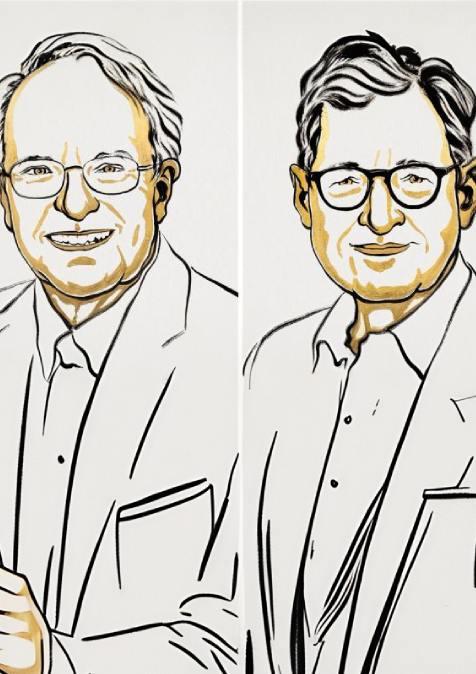
Robert E .Hall et Michael Woodford, Prix Nobel d’Économie 2026
October 26, 2026

Depuis que l’économie a été reconnue par les Nobel en 1969, il revient à cette discipline de clore les cérémonies annuelles d’attribution des Prix aux lauréats. C’est le 12 octobre 2026 que le jury du prix de la Banque de Suède, en sciences économiques en mémoire d’Alfred Nobel, a consacré deux Américains Prix Nobel de l’économie : Robert E. Hall et MichaelWoodford, pour leur contribution aux « fondements microéconomiques de la stabilisation macroéconomique de la stabilisation ».

Le choc pétrolier de 1973, aboutissant à la stagflation, va mettre à mal les recettes keynésiennes de l’après-guerre. Mais, à la différence de nombreux   Keynésiens qui désiraient tourner la page du Maitre de Cambridge, nos deux lauréats vont chercher à donner une nouvelle dimension à son analyse, à partir d’une approche micro économique comportementale des individus et des entreprises. Et ils vont agir en complémentarité, Robert E .Hall, en privilégiant la demande, Michael Wood, l’offre.

Robert E .Hall enseigne toujours à l’université de Stanford (Californie), aux États-Unis, après avoir soutenu sa thèse de doctorat, sous la direction de Robert Solow, Prix   Nobel d’Économie en 1987. Ses travaux vont porter principalement sur la prise en compte des anticipations dans la décision   de consommer ou de ne pas consommer. Avant sa contribution, on considérait que la consommation dépendait du revenu disponible et de lui seul. Hall va montrer qu’on ne peut comprendre l’évolution de la consommation sans prendre en compte les anticipations individuelles du consommateur, par exemple celle qui concerne son salaire ou son pouvoir d’achat. Dans un article fondateur de 1978, il montre que le changement de consommation est imprévisible, ce qui le conduit à conclure que la meilleure prédiction de la consommation ne peut se fonder que sur la consommation du moment, à une variation imprévisible près. (Son ouvrage de   référence : ‘’The 

Rational Consumer :Theory  and Evidence ‘’, MIT Press /Cambridge, Massachusetts 1990)

Michael Woodford enseigne à l’université de Columbia (New York). Ses travaux concernent la version offre de la problématique. Et ce, en analysant la fixation des prix par les entreprises, et plus particulièrement les raisons pour lesquelles , en cas de choc, les prix ne s’ajustaient pas rapidement. Il va montrer que si ces prix pouvaient baisser, cela ne pouvait être que très lentement, leur adaptation au choc nécessitant de multiples, et parfois couteuses, micro-décisions. À partir de ce constat, il va développer, en y intégrant, les travaux de Hall sur la consommation, un modèle macroéconomique beaucoup plus efficace, montrant, par exemple, que l’inflation globale est fonction des anticipations et du niveau actuel de la production, qu’il va intégrer à celui de Hall. Woodford va ainsi influencer les politiques économiques et monétaires du monde entier. Ce qui lui vaudra d’être qualifié par certains du « plus grand économiste monétaire de son temps ». ( Son ouvrage de référence : ‘’ Interest   and Prices :Foundations  of a Theory of Monetary Policy ‘’ Princeton University Press   2003 )

En distinguant un champ de recherche, celui de la nouvelle économie keynésienne, le jury ne pouvait en ignorer le pionner :Robert E .Hall , et celui qui va le plus contribuer à la faire progresser, allant jusqu’à la modéliser avec des applications concrètes : Michael Woodford.



RELATED CONTENT

  • Authors
    November 11, 2025
    Official Development Assistance (ODA) to developing countries has fallen in recent years to well below the UN target of 0.7% of developed countries’ gross national income. Global remittances have become the biggest inflow to poor countries, greater than ODA or foreign direct investment which has also declined. Against the backdrop of geopolitical tension between major powers, other countries including developing ones and development institutions have to do their parts in mobilizing ...
  • Authors
    November 10, 2025
    Almost a year after President Donald Trump’s return to the White House, the United States displays little of the isolationism many of the country’s international partners anticipated, and many of Trump’s supporters desired. From economic sanctions to military intervention, Trump is proving to be something of a foreign policy president, although with distinctly unilateral instincts. This approach is particularly evident in Washington’s current approach to the ‘South’, including Latin ...
  • November 4, 2025
    في هذه الحلقة، نناقش مستجدّات قانون المالية لسنة 2026، بما يشمل الإصلاحات الضريبية والتعديلات على الضرائب المباشرة وغير المباشرة، سياسات الإنفاق العمومي الجديدة، التحفيزات الاقتصادية للاستثمار والابتكار، والتدابير الاجتماعية لدعم الفئات الهشة، مع إبراز التحديات والآفاق المستقبلية للاقتص...
  • October 29, 2025
    Dans ce podcast, notre Senior Fellow Francis Perrin souligne que l’Afrique reste très dépendante des énergies fossiles : malgré 20 % de la population mondiale, elle ne consomme que 3,5 % ...
  • Authors
    October 28, 2025
    Now that a cease-fire is in place, it is time to consider Gaza’s reconstruction. This will be the fifth such effort in less than twenty years. Lessons from the previous four indicate that rebuilding houses, bridges, and roads is relatively straightforward. Far more challenging is building a thriving Gazan economy and society—one where young people live with dignity, have jobs, feel heard and included in their communities, and are hopeful about their future. Achieving this requires n ...
  • Authors
    Nizar Messari
    October 27, 2025
    This paper analyzes the impact of the BRICS+ Summit of July 2025 on the evolution of the bloc, as well as on the relationship between the bloc and the U.S. under President Trump. It also tackles the aftermath of the summit and in particular the impact it had in the souring of Brazil-U.S. relations. Before the paper analyzes the impact of BRICS+ on Morocco, it goes over the consequences of the events that resulted from the summit on the Brazilian political sphere.  ...
  • October 23, 2025
    On 1 October, China marked the 76th anniversary of the founding of the People's Republic. Few nations in modern history have experienced such a remarkable transformation in so short a time. In just over seven decades, China has ascended from poverty and fragmentation to become a technological, economic, and diplomatic powerhouse of global significance. This trajectory—driven by strategic planning, institutional stability, and a steadfast belief in the state as a catalyst for develop ...
  • Authors
    October 23, 2025
    The publication of the latest (74th) edition of the Statistical Review of World Energy (SRWE, 2025) is a good opportunity to take stock of some major trends in the world of energy. In this note, we focus on the African continent. All figures below are taken from this document and refer to the year 2024, unless otherwise indicated.SRWE figures relate to commercially-traded energies, which include fossil fuels, hydroelectricity, nuclear power and modern renewable energies other than h ...
  • Authors
    October 22, 2025
    This blog was originaly published on orfonline.org. The maritime cities of the 21st century are not merely legacies of the industrial age. Rather, they are becoming platforms of global connectivity and engines of economic transformation. As global trade shifts toward digital platforms and multimodal logistics, the traditional harbour is transforming into a 'Blue City' - a modern coastal centre where trade finance, service industries, and skilled workers are considered as k ...