Publications /
Policy Brief
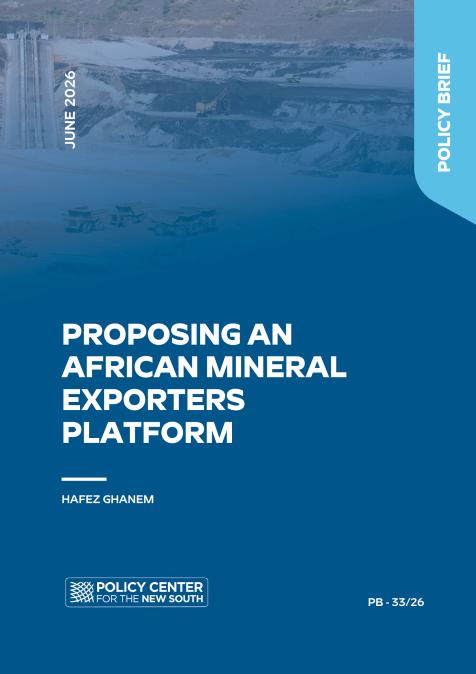
Geopolitical rivalries, and especially the competition for access to critical minerals, could be an opportunity for Africa. The objective of African mineral exporters is to diversify their partners and increase processing and value addition on the continent in order to create jobs and enhance export revenues.[1] To succeed, African exporters of critical minerals need to strengthen their coordination and develop joint infrastructure projects and regional value chains. The creation of a platform of key African mineral exporters would be an important step toward enhanced coordination and cooperation.
An Opportunity for Africa
On April 17, 2026, a group of six Multilateral Development Banks (MDBs) that participated in the G7 outreach issued a statement about critical minerals.[2] In their statement, the MDBs recognized the importance of working together to help build resilient and responsible critical minerals sectors in their client countries. They promised strengthened and more coordinated support to the sector in three areas: (1) policy and governance; (2) integrated infrastructure, corridor-based approaches, and value chain expansion; and (3) capital mobilization, private sector investment, and market development. They committed themselves “to urgent and results-focused engagement with client countries (i.e., developing countries and emerging economies) and global partners to rapidly scale diversified, resilient and responsible critical minerals-to-manufacturing value chains.” The new commitment of the MDBs to scale critical minerals production in developing countries and emerging economies, and the timing of the statement alongside the G7 outreach, reflects the increased geopolitical competition for access to these much-needed inputs in the high-tech and defense industries, as well as in green energy.
At a time of intensified great power rivalries, access to resources becomes particularly important. China, which is not a G7 country, dominates the world market for refining and processing critical minerals. It is the leading producer of refined copper, lithium, cobalt, graphite, and magnet rare earths. It produces 99% of battery-grade graphite, 60% of lithium chemicals, 40% of refined copper, 80% of refined magnet rare earths, and 70% of refined cobalt. China supplies more than 50% of United States demand for twenty-four critical minerals, and it has used export restrictions on critical minerals as a tool to pressure the United States during trade disputes. It is therefore no surprise that G7 countries are trying to catch up.
As pointed out by Canuto and Emran (2025), China’s market dominance is not due to large mineral reserves in its territory. Rather, it is because China has built a huge processing capacity and has invested in mines around the world to ensure access to raw materials. Since about one-third of global minerals reserves are in Africa, China became by far the largest foreign investor in African mines and, of course, the largest importer of African raw critical minerals.
The G7 countries have now decided to compete with China. The United States, the European Union, and Japan want to ensure uninterrupted access for their industries to the minerals they need. Beyond the G7, Arab Gulf countries (especially Saudi Arabia and the United Arab Emirates) are becoming increasingly interested in African critical minerals.[3] It is in this context that the MDB statement should be read. Sensitive to their shareholders’ needs, the MDBs have committed themselves to investing in the critical minerals sector. Their primary objective is to help their clients (developing countries and emerging economies). A secondary, but also very important, objective is to support the rich countries, which are also major MDB shareholders and key donors, in their quest for greater access to those minerals.
The MDBs’ interest in the sector, and the increased geopolitical competition, provides an excellent opportunity for Africa to maximize the benefits from its minerals by diversifying its partners and, critically, by reducing exports of raw minerals and increasing exports of processed products.[4] Several authors have made this point and have provided important and useful policy recommendations. Notable among those authors are Emran and Tayebi (2024, 2024b, and 2025); Ijjasz-Vasquez, Signe, and Songwe (2026); Boko and Kenewendo (2025); Arezki and Van Der Ploeg (2025); Arezki, Van Der Ploeg, and Ross (2026); and Cust and Zeufack (2023). In addition, there is a 2025 report by the AfDB and another 2025 report by the WB.
This policy brief builds upon the recommendations presented in this rich body of research. It argues that to implement those recommendations and maximize Africa’s benefits from its own mineral resources, it would be useful for African exporters of critical minerals to create a platform to coordinate their negotiation strategies with world powers and their regulatory frameworks, and to pool their resources to build the necessary infrastructure to develop processing capacity on the continent. This initiative, which would normally include a small number of countries, would complement and strengthen, rather than replace, current efforts by the African Union (AU) to coordinate at the continental level.
A Strategy to Develop Africa’s Critical Minerals Sector
Existing research and policy analyses (referred to above) add up to an African critical minerals strategy covering five areas: (1) strengthening governance; (2) diversifying partnerships and improving contract negotiations; (3) promoting domestic refining and processing; (4) increasing infrastructure investments; and (5) deepening regional integration.
Strengthening Governance. New mineral wealth could become a curse rather than a blessing if African countries fail to strengthen institutions and manage revenues effectively. Experience with other resource booms in Africa has shown that they often lead to increased corruption and elite capture, macroeconomic instability, and political fragmentation. Mineral wealth could also undermine economic diversification by concentrating political and economic power around extractive rents while discouraging broader productive investment, a phenomenon similar to the Dutch Disease.
To avoid the resource curse, African governments should act in three areas. First, there is a need to improve transparency in mining contracts, licensing, and revenue collection. Mining agreements have often been negotiated under opaque conditions, granting excessive concessions to foreign firms and facilitating corruption. This problem could be addressed through the public disclosure of contracts, stronger parliamentary oversight, independent auditing, and adherence to frameworks such as the Extractive Industries Transparency Initiative. Second, to avoid Dutch Disease, mineral revenues should be integrated into long-term development planning rather than short-term political spending. Countries could put in place sovereign wealth funds or stabilization mechanisms like those used in Norway and Botswana. Third, capacity development and institutional strengthening are essential. African governments often face asymmetries in legal and financial expertise when negotiating with multinational corporations. That is why they need to develop specialized mining ministries, geological institutions, fiscal expertise, and technical negotiators capable of evaluating complex contracts, taxation structures, and environmental obligations.
Diversifying Partnerships and Improving Contract Negotiations. Geopolitical rivalries provide an opportunity for Africa to diversify its partnerships and reduce dependency on a single country or bloc, thus enhancing its policy autonomy and bargaining power. It also allows Africa to negotiate better deals, including: (1) royalty systems and production-sharing arrangements, (2) technology transfer, (3) local employment and local content commitments, (4) infrastructure and downstream industrial investments, and (5) environmental protection. The Botswana–De Beers partnership, where Botswana succeeded through negotiations in securing increased domestic diamond sorting, trading, and processing activities, is often cited as a model for other countries to follow.[5] Negotiating these better partnership agreements requires the governance reforms and capacity development discussed above, and perhaps the establishment of separate, specialized legal and technical advisory units.
Promoting Domestic Refining and Processing. Diversifying partnerships and improving contract negotiations would help Africa avoid reproducing a colonial economic structure in which it exports unprocessed minerals while importing higher-value processed products. The greatest value in mineral supply chains is not captured during extraction, but during refining, chemical processing, battery precursor production, manufacturing, and technology assembly. Exporting raw ores generates relatively limited employment and value added, whereas processing industries create broader industrial ecosystems involving engineering, chemicals, logistics, finance, and technical services.
Two types of policies could be used to promote domestic processing. First, there are policies based on physical restrictions that could take the form of local content regulations, export restrictions, or outright bans on exporting raw minerals. Indonesia provides a successful example of this approach, where export bans on raw nickel helped stimulate large-scale smelting and battery-material investments. However, export bans should be used carefully, as they could backfire if countries lack adequate infrastructure and legal and regulatory frameworks conducive to investment. To avoid this, governments could require progressively higher levels of processing over time while simultaneously improving the quality of infrastructure and the incentive system facing investors. Second, there are policies that aim at incentivizing domestic processing and discouraging raw material exports. Differential royalty rates can encourage upgrading by taxing raw exports more heavily than processed products. Fiscal incentives, industrial zones, and subsidized electricity tariffs can also support domestic processing industries.
Increasing Infrastructure Investments. Mineral processing requires major infrastructure investments. Without reliable electricity, transport systems, ports, and logistics networks, it would be virtually impossible to develop domestic processing. Mineral refining and battery production are highly energy intensive. In view of low access to electricity on the continent, African mineral policy must be integrated with large-scale energy investment strategies. Transport infrastructure is equally critical. Railways, roads, ports, and border systems are necessary. High logistics costs often make domestic processing less competitive than exporting raw materials directly. In addition, developing a minerals processing industry requires digital infrastructure, geological mapping, and data systems.
Deepening Regional Integration. Most African countries are too small to negotiate with global powers from a position of strength or to impact global governance. Regional coordination is therefore needed as a mechanism for improving bargaining power. If African countries compete individually for foreign investment, they risk engaging in a “race to the bottom” involving weak taxation, low royalties, and excessive concessions. Coordinated regional policies could strengthen Africa’s negotiating position vis-à-vis multinational corporations and major powers. Moreover, Africa’s fragmented political landscape weakens its ability to shape global mineral governance. Greater continental coordination could help African states negotiate more effectively with China, the United States, and Europe while asserting stronger control over their own development trajectories.
Most African countries lack the scale to build complete critical mineral value chains on their own. Regional cooperation is therefore essential. The African Continental Free Trade Area (AfCFTA) could help create integrated regional markets and cross-border industrial clusters capable of supporting battery manufacturing and mineral processing. Moreover, infrastructure integration through regional electricity pools, transport corridors, customs harmonization, and shared industrial zones could help fill Africa’s infrastructure deficit and accelerate industrial transformation. Regional value chains where each country can specialize according to comparative advantage while benefiting from shared infrastructure and larger markets could be the way to transform the continent’s economy. For example, it is possible to develop a battery value chain where the Democratic Republic of Congo (DRC) would supply cobalt, Zambia copper, while regional industrial zones produce battery precursors and cathode materials.
The African Mineral Exporters Platform
An African Minerals Exporters Platform would enhance inter-African cooperation and coordination and thus contribute to implementing the regional critical minerals strategy. The Platform would not be a cartel that fixes prices and manipulates supply. It would function as a strategic coordination mechanism aimed at strengthening Africa’s bargaining power, promoting regional industrialization, improving governance, and accelerating cross-border integration around critical mineral value chains.
Platform Mission Statement. The mission statement of the Platform could be along the following lines: “The Platform will enhance cooperation among African mineral exporters and help them better coordinate their actions to obtain higher value for their products by expanding refining and processing in Africa with the aim of creating more employment, accelerating GDP growth, and reducing poverty.”
Platform Activities. The Platform’s activities could cover six areas. First, the Platform would support members in negotiating with foreign buyers. The Platform would help strengthen Africa’s negotiating position by coordinating among all exporters, promoting common principles and shared negotiating positions, particularly covering areas such as domestic value added and employment creation. Second, the Platform would support the development of regional value chains. Battery supply chains require multiple inputs, including cobalt, copper, lithium, graphite, manganese, nickel, and specialized chemicals. The DRC possesses cobalt, Zambia copper, Mozambique graphite, South Africa platinum group metals, and Zimbabwe lithium. Industrial transformation will require coordination among those different critical mineral producers to create integrated continental supply chains. Third, the Platform would help coordinate infrastructure investments needed for the refining and processing of critical minerals. Railways, power pools, ports, transmission lines, industrial zones, and logistics corridors increasingly require regional planning. Fourth, the Platform could ensure that African mineral exporters’ voices are heard in global governance institutions and make sure that MDB financing policies for the sector reflect Africa’s priorities. Fifth, it could help create an African observatory of critical minerals to provide policymakers with better information and data. Sixth, the Platform could coordinate training and capacity building. Regional centers of excellence would produce engineers, metallurgists, geologists, chemists, financial experts, and mining lawyers needed to develop a critical mineral refining and processing industry.
Possible Initial Membership. The Platform could begin with a group of ten to twelve strategically important mineral producers, which could include the DRC, Zambia, South Africa, Zimbabwe, Namibia, Mozambique, Gabon, Guinea, Madagascar, Tanzania, Morocco, and Botswana. The DRC and Zambia dominate the production of cobalt and copper. South Africa is an important producer of platinum group metals, manganese, and chromium. Zimbabwe and Namibia are emerging lithium producers. Mozambique and Madagascar are major graphite producers. Gabon is an important manganese exporter. Guinea controls some of the world’s largest bauxite reserves. Morocco occupies a strategically important position due to its industrial base, phosphate sector, and growing electric vehicle ecosystem. Botswana represents Africa’s most successful example of mineral governance and beneficiation through its long-term partnership with De Beers. While it makes sense for the Platform to start with a relatively small number of strategically important producers and exporters, over time it could be open to broader participation.
Partnerships with other African Institutions. The Platform’s legitimacy and effectiveness would depend on integration with existing African frameworks. The African Union should provide the overarching political framework. The Platform could serve as a specialized implementation mechanism aligned with the African Mining Vision and emerging AU policies on green minerals and industrialization. The AfCFTA would be central to the Platform’s industrial objectives as it facilitates the cross-border movement of inputs, intermediate goods, and manufactured products, which is essential for the creation of regional value chains. The AfDB—which already supports battery value chains, industrial corridors, and regional infrastructure projects—should be the Platform’s most important financial and technical partner. Thus, the Platform should act as a coordinating mechanism embedded within existing continental frameworks.
Risks and Mitigation. The Platform project faces three major risks. First, the Platform could drift toward cartel behavior and attempt to manipulate global supply or fix prices, which would be economically ineffective and politically damaging. Therefore, the Platform’s charter should explicitly prohibit coordinated production quotas or price-setting mechanisms and make clear that the Platform’s mandate is narrowly focused on industrialization, governance, infrastructure, and coordination. Second, the Platform could become just another underfunded African “talk shop” producing declarations without implementation. To avoid this, the Forum should begin with a limited number of practical objectives such as producing model mining contracts, developing a continental mineral data system, coordination on specific regional infrastructure, and cooperation on targeted industrial corridor projects. Third, there is the risk of external geopolitical pressure. Major powers may resist African coordination if they perceive it as threatening access to critical mineral supplies. That is why it is important to emphasize that the Platform seeks stable, transparent, and diversified supply chains rather than confrontation or exclusion.
Concluding Remarks
Africa’s critical mineral wealth has created a strategic opportunity, and now the continent occupies a central position in the future of global industry. Africa needs to seize this opportunity and avoid a replication of economic colonial structures where it exports raw materials and imports finished products. African producers and exporters of critical minerals need to cooperate and coordinate their actions to obtain better deals from multinational corporations and foreign powers and to build the infrastructure, institutions, and capacity needed to develop an African mineral refining and processing industry. The African Mineral Exporters Platform could be a useful mechanism to strengthen coordination and cooperation.
[1] See the African Union’s “Africa Mining Vision” and the joint AU and AfDB “Approach Paper Towards an African Green Minerals Strategy.”
[2] The six MDBs are the African Development Bank (AfDB), the Asian Development Bank (ADB), the European Bank for Reconstruction and Development (EBRD), the European Investment Bank (EIB), the Inter-American Development Bank (IDB), and the World Bank (WB). Their statement can be accessed here.
[3] See Ngwalda and Thompson (2026) or Tucker (2025).
[4] In the words of Fofack (2019), the objective should be to overcome the colonial development model of resource extraction.
[5] More on the negotiations between Botswana and DeBeers can be found here and here.