Publications /
Research Paper

Back
Morocco’s Services-Led Development: Scaling Quality into Economic Momentum
Authors
April 30, 2026

This paper is the second in a series examining services-led development and global value chain (GVC) integration in the Global South. It applies a three-category analytical framework covering knowledge services (ICT and professional business services), enabling services (transport, logistics, and finance), and local services (retail, hospitality, health, and personal services), to OECD Trade in Value Added indicators. The paper thus provides a structural assessment of Morocco's services sector over 2012–2022, benchmarked against the EU15.

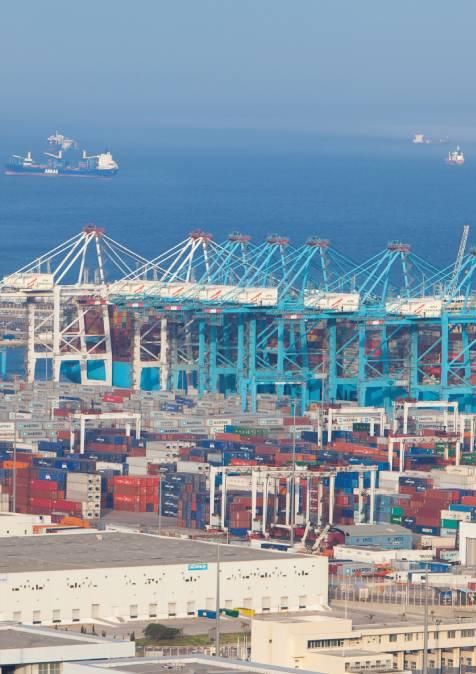
Morocco emerges as the most structurally advanced of the three North African economies examined in this series. Its computer programming and IT services sub-sector has achieved a degree of international market orientation that is the highest in the regional sample and broadly comparable to EU15 levels. This reflects the Casablanca nearshore ecosystem's deep integration with European client markets. Professional and technical services show the most dynamic trajectory in the regional dataset; forward integration into international markets rose steadily and substantially over the decade. The administrative and support services sector stands out for combining strong domestic supply chain embedding with growing international orientation simultaneously, a dual character that makes it the most structurally versatile knowledge services sub-sector in the study. Enabling services, anchored by the Tanger Med port complex, exhibit authentic GVC integration through deep assembly-and-re-export operations, with import content growing markedly over time. The paper further shows that Morocco's most competitive knowledge services sub-sectors—computer programming, professional services, and administrative services—have reached or exceeded EU15 levels of bilateral GVC embeddedness measured by both input sourcing and upstream positioning, making Morocco the only economy in the North African dataset that has crossed this threshold.

The central conclusion is that Morocco's structural challenge is scale rather than quality. Morocco’s leading knowledge services sub-sectors are internationally competitive but collectively too small to generate the spillovers and employment effects that self-reinforcing convergence requires. The big-push logic of this series' Framework Paper applies directly: Morocco possesses the quality foundations of a knowledge economy but has not yet reached the critical mass at which knowledge services spillovers become self-sustaining. The evidence supports a structural policy agenda of deliberate scaling of IT and professional services, combined with containment of a rising public administration share, which risks crowding out productive investment.
RELATED CONTENT

  • Authors
    Zakaria Elouaourti
    March 15, 2023
    The aims of this article were twofold. First, to tackle the issue of convergence from an analytical point of view by presenting the mathematical developments of the main economic growth models, which emphasized that the convergence of African economies is conditional to the investment level in the early stages of physical capital accumulation. As the latter increases, the convergence of African economies is determined by other factors (investment in research and development (R&D ...
  • Authors
    February 28, 2023
    This publication was originally published on https://www.euromesco.net/   The Moroccan job market offers few opportunities for young non-educated Moroccans. With the rise of the internet, many Moroccans sought to find new ways to generate an income and find financial stability. During the COVID-19 pandemic, we have seen a rise of Moroccan entrepreneurs in e-commerce and dropshipping and a dramatic increase of motivational and educational content that aims at en ...
  • Authors
    Sous la direction de Larabi Jaïdi
    September 29, 2022
    La succession des chocs pandémique, climatique et géopolitique a éprouvé les économies africaines. Les liens commerciaux et financiers avec le monde ne sont plus seulement considérés comme des moteurs de performance, mais aussi comme des sources potentielles de vulnérabilité. La défiance à l’égard de la mondialisation s’est accrue. Parce qu’elle est venue souligner la dépendance du continent, le dérèglement de ses rapports à la nature et sa vulnérabilité face aux tensions géopolitiq ...
  • Authors
    Noamane Cherkaoui
    July 25, 2022
    Foreign aid has a well-established and significant role in international relations. The role of foreign aid in the repertoire of international development programs is extensively documented, with its goal being the promotion of human and economic development. Foreign aid can be defined as “all forms of assistance that a country derives from other governments or multilateral agencies and financial institutions to fill noticeable gaps, especially in production, savings, and investment ...
  • From

    15
    6:00 pm July 2022
    L’apparition de de la COVID-19 a engendré une crise sanitaire mondiale, qui s’est rapidement transformé à d’autres crises bouleversant le vécu des humains de par la planète. En ce qui concerne les marchés mondiaux, notamment du travail, les incertitudes ont fortement impacté les comportements des agents. Aussi, les mises sous restrictions, totales ou partielles, des facteurs de production ont eu leur incidence sur l’activité globale -via différents canaux -, y compris celle des acteurs du marché du travail. À court terme, la pandémie est synonyme de fortes perturbations pour les citoyens et les marchés du travail. Celles-là concernent les revenues et les dépenses des particuliers comme elles portent sur l’activité des entreprises et donc les dynamiques de création d’emploi et ...
  • Authors
    Sous la direction de: Idriss El Abbassi
    Mariem Liouaeddine
    April 5, 2022
    Ce livre est l’aboutissement d’un appel à communications organisé conjointement par le Policy Center for the New South et le Laboratoire d’Economie appliquée de la Faculté des Sciences juridiques, économiques et sociales (FSJES) Rabat-Agdal. Il s’agit d’un nouveau maillon dans la collaboration entre les deux institutions depuis 2015 qui consacre la volonté et l’engagement du Policy Center for the New South d’entretenir des liens étroits avec le monde académique et d’offrir a ...
  • Authors
    Nassim Hajouji
    February 15, 2022
    Using education and elite configurations as the main variables of analysis, this Policy Paper aims to show how higher levels of popular sector incorporation during elite conflicts, namely in the process of formulating and implementing policies related to education reforms, can negatively affect the economic complexity of developing countries. To do so, it analyzes the experiences of Mauritius and Singapore and links foundational political economy theories, particularly developmental ...