Publications /
Research Paper

Back
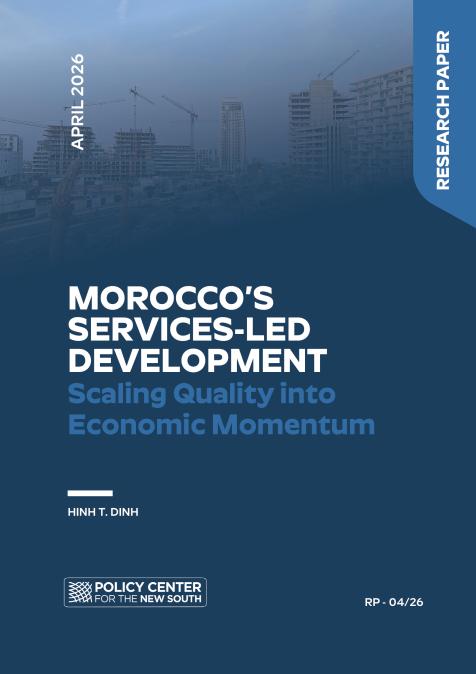
Morocco’s Services-Led Development: Scaling Quality into Economic Momentum
Authors
April 30, 2026

This paper is the second in a series examining services-led development and global value chain (GVC) integration in the Global South. It applies a three-category analytical framework covering knowledge services (ICT and professional business services), enabling services (transport, logistics, and finance), and local services (retail, hospitality, health, and personal services), to OECD Trade in Value Added indicators. The paper thus provides a structural assessment of Morocco's services sector over 2012–2022, benchmarked against the EU15.

Morocco emerges as the most structurally advanced of the three North African economies examined in this series. Its computer programming and IT services sub-sector has achieved a degree of international market orientation that is the highest in the regional sample and broadly comparable to EU15 levels. This reflects the Casablanca nearshore ecosystem's deep integration with European client markets. Professional and technical services show the most dynamic trajectory in the regional dataset; forward integration into international markets rose steadily and substantially over the decade. The administrative and support services sector stands out for combining strong domestic supply chain embedding with growing international orientation simultaneously, a dual character that makes it the most structurally versatile knowledge services sub-sector in the study. Enabling services, anchored by the Tanger Med port complex, exhibit authentic GVC integration through deep assembly-and-re-export operations, with import content growing markedly over time. The paper further shows that Morocco's most competitive knowledge services sub-sectors—computer programming, professional services, and administrative services—have reached or exceeded EU15 levels of bilateral GVC embeddedness measured by both input sourcing and upstream positioning, making Morocco the only economy in the North African dataset that has crossed this threshold.

The central conclusion is that Morocco's structural challenge is scale rather than quality. Morocco’s leading knowledge services sub-sectors are internationally competitive but collectively too small to generate the spillovers and employment effects that self-reinforcing convergence requires. The big-push logic of this series' Framework Paper applies directly: Morocco possesses the quality foundations of a knowledge economy but has not yet reached the critical mass at which knowledge services spillovers become self-sustaining. The evidence supports a structural policy agenda of deliberate scaling of IT and professional services, combined with containment of a rising public administration share, which risks crowding out productive investment.
RELATED CONTENT

  • September 23, 2025
    في هذا العدد من برنامجنا، نسلّط الضوء على موقع المغرب الاستراتيجي الذي يجعله حلقة وصل بين الأطلسي والمتوسط، ودوره المتصاعد في التجارة الدولية والاقتصاد البحري. نناقش التحديات والفرص التي تطرحها هذه الدينامية، من تطوير البنية التحتية وتأهيل الكفاءات، إلى استكشاف آفاق الاقتصاد الأزرق وضما...
  • Authors
    Sana Hninou
    June 25, 2025
    This Paper was originally published on springer.com This study investigates the impact of female agricultural cooperatives on women’s empowerment in Morocco, with a focus on the rural Marrakech-Safi region. The research evaluates the effectiveness of these cooperatives in enhancing women’s empowerment through economic opportunities, participatory governance, and leadership roles. The Global Empowerment Index (GEI) was adopted to measure empowerment across five key dimensions: p ...
  • May 13, 2025
    تتناول هذه الحلقة موضوع تعويم نظام الصرف في المغرب وتأثيراته الاقتصادية، حيث نعرض تاريخ نظام الصرف في البلاد والأسباب التي تدفع نحو تبني هذا الخيار في 2026. نناقش تأثير التعويم على الواردات والصادرات وعلى القدرة الشرائية للمواطنين، مع التركيز على التحديات التي قد يواجهها الاقتصاد المغرب...
  • Authors
    Zakaria Elouaourti
    May 6, 2025
    This paper was originaly published on sciencedirect.com   This paper introduces a novel empirical approach, combining sigma convergence and sigma counterfactual statistics, to examine the dynamics of structural transformation in Morocco from 1990 to 2018. The findings reveal that Morocco experienced structural transformation driven by labor productivity reallocation across sectors during specific sub-periods (1991–1993, 1996–1997, and 1998–2003). However, this process ca ...
  • Authors
    Karim El Mokri
    Idriss El Abbassi
    October 23, 2024
    This paper was originally published on cambridge.org   This paper explores the (de-)routinisation of employment structure in developing countries, through the case of Morocco. We investigate employment (de-)routinisation from an often-overlooked perspective, aiming to elucidate the interplay between the dynamics of occupational employment composition by the level of routine tasks intensity and two structural aspects: premature deindustrialisation and the prevalence of in ...
  • Authors
    Zakaria Elouaourti
    September 13, 2024
    This Paper was originally published on emerald.com   Purpose This paper examines the dynamics of structural transformation in Morocco since 1970 by analyzing input-output tables expressed in terms of employment and output levels across 24 sectors. Design/methodology/approach This study employs a twofold methodological approach. Firstly, it examines the evolution of sectoral employment shares over time using World Bank data. Secondly, it utilizes Input-Output analysis to ex ...
  • Authors
    Ilham Najib
    January 29, 2024
    Morocco is positioned as a new global hub of the automotive industry in an increasingly volatile international context, with various emerging countries competing intensively to gain the best returns on openness and globalization. The Moroccan automotive industry’s recent performance shows it to be the most dynamic sector in the economy: from 2014 to 2019, value-added in the automotive sector increased by almost 70% while the overall national value-added increased by only 15%. In the ...
  • Authors
    Ali Elguellab
    Elhadj Ezzahid
    November 1, 2023
    The role of the production network in shock propagation has been an issue of considerable interest since the Great Recession. However, the empirical literature has only focused on advanced and emerging countries. This paper aims to contribute to filling this gap by examining the case of Morocco, a developing country belonging to the lower-middle-income group. The question is whether its production network is a factor in amplifying idiosyncratic industry-level shocks or, conversely, ...