Publications /
Book / Report

Back
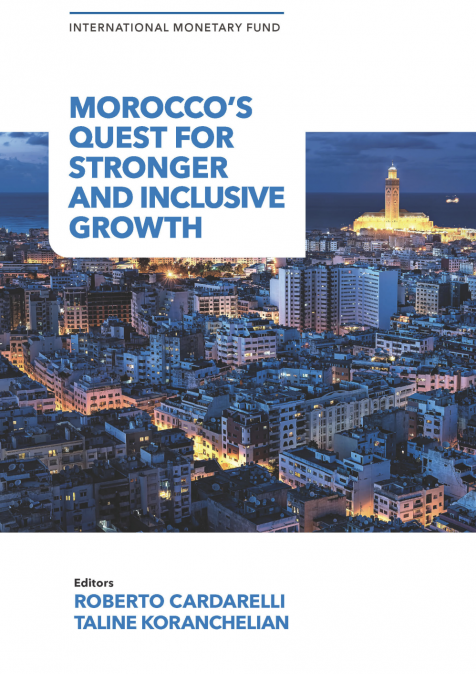
Morocco’s Quest for Stronger and Inclusive Growth
Authors
Edited by Roberto Cardarelli
Taline Koranchelian
October 9, 2023

This book was originally published on elibrary.imf.org


Throughout the past two decades, Morocco has faced several external and domestic shocks, including large swings in international oil prices, regional geopolitical tensions, severe droughts, and most recently the impact of the pandemic and the economic fallout from Russia’s invasion of Ukraine. Despite rough waters, the government stayed the course and remained focused not only on immediate stability, but also on the long-term needs of the Moroccan economy. This involved the adoption of a series of difficult measures, like the elimination of energy subsidies, and a strategy aimed at improving the country’s infrastructure, diversifying the production and export bases by attracting foreign investment, and modernizing the governance structure of the public administration. The road to higher and more inclusive growth, however, remains steep. Despite gains in poverty reduction, literacy and lifespans, Morocco economy continues to face a high share of inactive youth, large gaps in economic opportunities for women, a fragmented social protection system, and remaining barriers to private sector development. An ambitious reform agenda is needed to better meet the aspirations of Moroccans, by making economic growth stronger, more resilient and more inclusive, particularly to provide greater opportunities for young, women, and entrepreneurs. Morocco appears well positioned to address these challenges, and indeed, the country has recently sought to define and pursue a new “model of development”, through national debates and a more inclusive approach to reform. Significant reforms have been announced recently that revamp both the social protection system and the SOEs business model. This book draws lessons from the reforms Morocco has implemented in the past few decades and charts a course for Morocco by addressing key areas for reform.
RELATED CONTENT

  • July 11, 2019
    The rise of the middle class in the emerging economies is affecting significantly consumption habits and thus, transforming these economies. The size and growth of the middle class is of interest to gauge market potential for many products, and can serve as a barometer of political awareness. Measuring the Middle Class using income presents many challenges, beginning with finding an appropriate definition. Previous research by Ali and Dadush (2012) suggested an alternative measure, ...
  • Authors
    Comité scientifique :
    Ahmed Bousselhami
    Idriss El Abbassi
    Amine Marrat
    Lahcen Oulhaj
    Aziz Ragbi
    Said Tounsi
    June 13, 2019
    L’analyse des mutations qu’a connues l’économie marocaine après la crise économique et financière de 2008, offre l’opportunité d‘évaluer l’orientation des politiques macroéconomiques gérées dans un contexte relativement difficile, mettant à l’épreuve les décideurs publics en matière de politique économique et leur engagement à préserver la stabilité du cadre macroéconomique. Un diagnostic approfondi revient à apprécier la pertinence des choix de politiques macroéconomiques par rappo ...
  • Authors
    Edition et coordination : Abdellatif Chatri
    April 25, 2019
    L’économie marocaine se trouve aujourd’hui à une étape cruciale de son évolution. Le ralentissement tendanciel de la croissance, persistance du chômage de masse, faibles gains de productivité, perte en compétitivité, lenteur de la transformation structurelle, approfondissement des inégalités, déclassement social... etc. sont autant d’indicateurs, dont la liste n’est pas fermée, qui plaident pour le dépassement du modèle de croissance poursuivi depuis plusieurs années. La nécessité d ...
  • Authors
    Afrique Contemporaine
    February 28, 2019
    Dans son édition n°266, la revue scientifique Afrique Contemporaine consacre son Dossier à la question de l’industrialisation en Afrique. D’après la Rédaction de la publication, le choix de la thématique s’imposait d’autant plus que « la recomposition de l’ordre mondial repose la question de la place du continent à l’échelle planétaire, en l’occurrence sur le plan économique, social et environnemental tout à la fois. » Outre la coordination du Dossier, Dr. Karim Et Aynaoui, Préside ...
  • Authors
    Yassine Msadfa
    February 25, 2019
    La transformation structurelle d’une économie demeure un point de passage nécessaire pour toute nation qui souhaite gravir les échelons du développement, cette transformation est souvent tributaire de la capacité d’une économie à s’ériger d’une société agraire de subsistance, dans son stade initial, vers une économie de productivité. Pour ce qui est du Maroc, le débat a pris de l’ampleur quant à la capacité des dynamiques actuelles à accélérer le rythme de l’activité économique au p ...
  • Authors
    February 6, 2019
    This paper examines Turkey's case against Morocco before the World Trade Organization (WTO), over anti-dumping duties on hot-rolled steel products. Turkey's complaint constitutes both a precedent and an opportunity. First, it is a precedent in that Morocco was previously never involved in a case before GATT or WTO, neither as a plaintiff nor as a defendant. Second, it is an opportunity as the evaluation of the legal process of the complaint enables an assessment of adequacy of Moroc ...
  • Authors
    February 6, 2019
    Ce papier examine la plainte initiée par la Turquie devant l’Organisation mondiale du commerce (OMC) contre le Maroc au sujet des droits antidumping appliqués aux produits d’acier laminés à chaud. La plainte de la Turquie constitue à la fois un précédent et une opportunité. Un précédant d’abord, car jamais le Maroc n’a été impliqué, ni en qualité de partie plaignante ni en qualité de partie défenderesse, dans une affaire devant le GATT ou l’OMC. Une opportunité ensuite, par ce que l ...
  • January 1, 2019
    Morocco has moved towards a more flexible exchange rate system, by widening its currency fluctuation bands to +/- 2.5% around a central price. This transition will, in time, equip the Moroccan economy with a macroeconomic instrument acting as a shock absorber and facilitating rapid adjustment at lower costs. In the absence of such a mechanism, adjustment to macroeconomic shocks at times requires a contraction in demand and thereby a cyclical downturn in growth to restore external ba ...
  • November 1, 2018
    This policy brief shows that the downward trend of employment in manufacturing in Morocco is due primarily to labor productivity improvement and that the increased deficit in manufacturing trade also plays an important role. While recognizing the crucial importance of a vibrant manufacturing sector in Morocco, this brief argues that Morocco cannot rely primarily on manufactures to “pull” labor out of agriculture. To provide more jobs, Moroccan policies should pay more attention to s ...
  • Authors
    Sabine Cessou
    November 1, 2018
    Le séminaire de haut niveau, organisé par OCP Policy Center ce 2 novembre 2018 à Rabat, est axé sur « La migration : réconcilier les visions du Nord et du Sud ».  Il sera question dans cette rencontre, organisée en partenariat avec le Ministère délégué auprès du ministre des Affaires étrangères et de la Coopération internationale, Chargé des Marocains résidant à l’étranger, des affaires de la migration et l’IeMED, de la coopération internationale pour « lever les obstacle ...