Publications /
Research Paper

Back
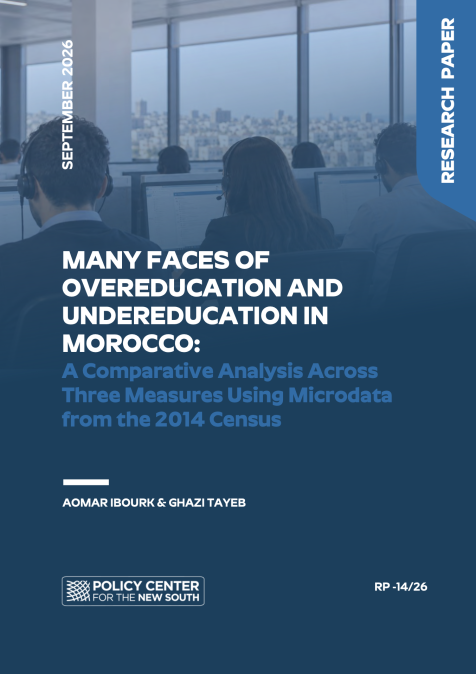
MANY FACES OF OVEREDUCATION AND UNDEREDUCATION IN MOROCCO: A Comparative Analysis Across Three Measures Using Microdata from the 2014 Census
September 11, 2026

Since the early 2000s, the Moroccan labour market has experienced continuous educational expansion that has not been matched by an equivalent transformation of the economy's productive structure, giving rise to situations of vertical mismatch between employed workers' education levels and the requirements of the jobs they hold. This study analyzes the determinants of overeducation and undereducation using anonymized microdata from the 2014 General Population and Housing Census (RGPH 2014, HCP), on a sample of 945,866 employed workers. Three categorical measures of mismatch are constructed — a National Normative Approach (NNA), an International Normative Approach (INA) aligned with ILO standards, and a Statistical Approach (SA) based on the empirical distribution of years of schooling by occupation — with determinants estimated using Multinomial Logit models. 

The descriptive results reveal a marked divergence depending on the measure used: the normative approaches conclude that undereducation is massive, at 62.7 percent (NNA) to 66.0 percent (INA), whereas the statistical approach establishes matching as the majority outcome (67.0 percent). This diagnosis is consistent, in its ranking, with that of the HCP (2018), which reports on exhaustive RGPH 2014 data a 45.7 percent matching rate, 46.7 percent undereducation, and 7.6 percent overeducation — the latter reaching 55.8 percent among specialized technicians and showing a threefold gap between urban (10.4 percent) and rural (3.2 percent) areas. Econometrically, overeducation disproportionately affects young workers, women, urban residents, public-sector employees, and individuals from the most affluent households (richest quintile: β = 0.918), while undereducation dominates among older workers, the selfemployed, family helpers, and rural residents.
RELATED CONTENT

  • Authors
    March 29, 2023
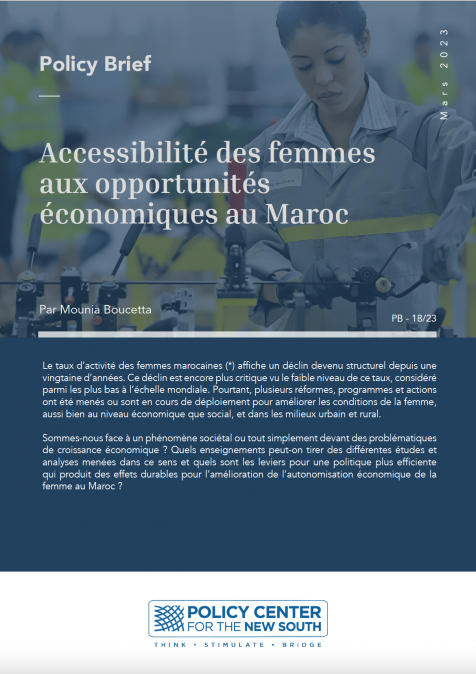
    Le taux d’activité des femmes marocaines (*) affiche un déclin devenu structurel depuis une vingtaine d’années. Ce déclin est encore plus critique vu le faible niveau de ce taux, considéré parmi les plus bas à l’échelle mondiale. Pourtant, plusieurs réformes, programmes et actions ont été menés ou sont en cours de déploiement pour améliorer les conditions de la femme, aussi bien au niveau économique que social, et dans les milieux urbain et rural. Sommes-nous face a ...
  • Authors
    March 29, 2023
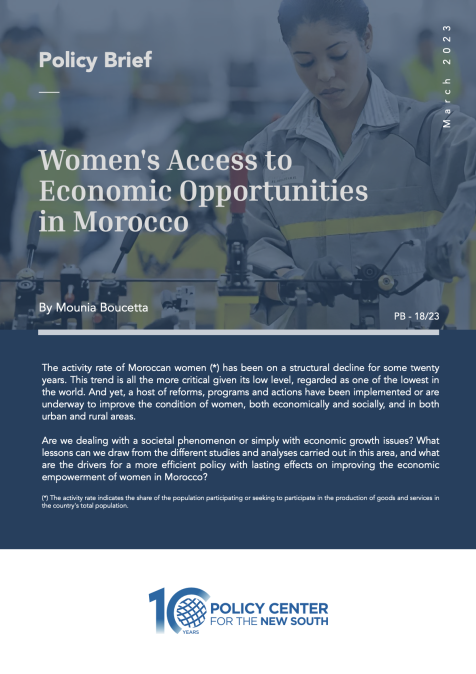
    The activity rate of Moroccan women (*) has been on a structural decline for some twenty years. This trend is all the more critical given its low level, regarded as one of the lowest in the world. And yet, a host of reforms, programs and actions have been implemented or are underway to improve the condition of women, both economically and socially, and in both urban and rural areas. Are we dealing with a societal phenomenon or simply with economic growth issues? What lessons can we ...
  • March 28, 2023
    كشفت دراسة نشرتها المنظمة الدولية للهجرة حول العاملات الموسميات بعد انتهاء مدة إقامتهن في إسبانيا والعودة إلى المغرب، أن أكثر من 83٪ من النساء يدعمن أسرة مالياً. وقد تم إجراء العديد من ال ...
  • Authors
    February 28, 2023
    This publication was originally published on https://www.euromesco.net/   The Moroccan job market offers few opportunities for young non-educated Moroccans. With the rise of the internet, many Moroccans sought to find new ways to generate an income and find financial stability. During the COVID-19 pandemic, we have seen a rise of Moroccan entrepreneurs in e-commerce and dropshipping and a dramatic increase of motivational and educational content that aims at en ...
  • November 25, 2022
    Le présent travail s’intéresse à la question de l’accompagnement et la réintégration des travailleuses marocaines saisonnières en Espagne. Il met en avance l’existence de déficits à plusieurs niveaux. Des plus importants sont : une inclusion financière et un accompagnement en matière de renforcement de l’employabilité ; un accompagnement en matière d’alphabétisation financière ; un accompagnement en matière de création, et post-création, d'activités génératrices de revenus ; un acco ...
  • Authors
    September 15, 2022
    Le dialogue social est à la croisée des chemins. Le deuxième round du dialogue social va être lancé aujourd’hui. À l’ordre du jour, la négociation sur des dossiers en instance depuis de longues années (le droit de grève, la représentation des syndicats, le code du travail, les libertés syndicales,…). Mais la grande question qui figure dans l’agenda des parties prenantes est bien celle de l’institutionnalisation des mécanismes d’un dialogue pérenne et efficace, en plus de celle de so ...
  • From

    15
    6:00 pm July 2022
    L’apparition de de la COVID-19 a engendré une crise sanitaire mondiale, qui s’est rapidement transformé à d’autres crises bouleversant le vécu des humains de par la planète. En ce qui concerne les marchés mondiaux, notamment du travail, les incertitudes ont fortement impacté les comportements des agents. Aussi, les mises sous restrictions, totales ou partielles, des facteurs de production ont eu leur incidence sur l’activité globale -via différents canaux -, y compris celle des acteurs du marché du travail. À court terme, la pandémie est synonyme de fortes perturbations pour les citoyens et les marchés du travail. Celles-là concernent les revenues et les dépenses des particuliers comme elles portent sur l’activité des entreprises et donc les dynamiques de création d’emploi et ...