Publications /
Research Paper

Back
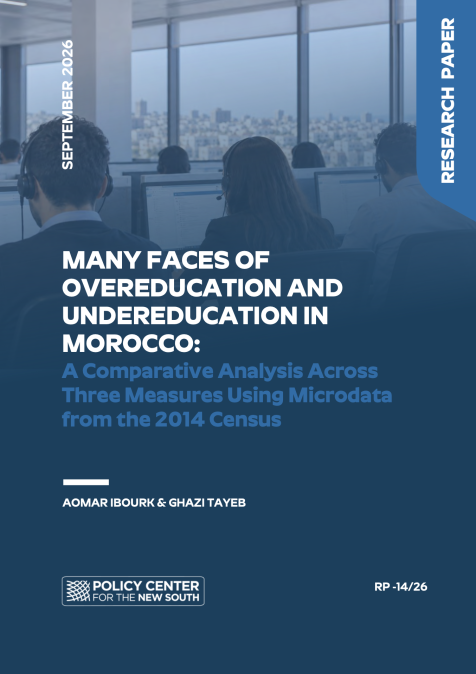
MANY FACES OF OVEREDUCATION AND UNDEREDUCATION IN MOROCCO: A Comparative Analysis Across Three Measures Using Microdata from the 2014 Census
September 11, 2026

Since the early 2000s, the Moroccan labour market has experienced continuous educational expansion that has not been matched by an equivalent transformation of the economy's productive structure, giving rise to situations of vertical mismatch between employed workers' education levels and the requirements of the jobs they hold. This study analyzes the determinants of overeducation and undereducation using anonymized microdata from the 2014 General Population and Housing Census (RGPH 2014, HCP), on a sample of 945,866 employed workers. Three categorical measures of mismatch are constructed — a National Normative Approach (NNA), an International Normative Approach (INA) aligned with ILO standards, and a Statistical Approach (SA) based on the empirical distribution of years of schooling by occupation — with determinants estimated using Multinomial Logit models. 

The descriptive results reveal a marked divergence depending on the measure used: the normative approaches conclude that undereducation is massive, at 62.7 percent (NNA) to 66.0 percent (INA), whereas the statistical approach establishes matching as the majority outcome (67.0 percent). This diagnosis is consistent, in its ranking, with that of the HCP (2018), which reports on exhaustive RGPH 2014 data a 45.7 percent matching rate, 46.7 percent undereducation, and 7.6 percent overeducation — the latter reaching 55.8 percent among specialized technicians and showing a threefold gap between urban (10.4 percent) and rural (3.2 percent) areas. Econometrically, overeducation disproportionately affects young workers, women, urban residents, public-sector employees, and individuals from the most affluent households (richest quintile: β = 0.918), while undereducation dominates among older workers, the selfemployed, family helpers, and rural residents.

RELATED CONTENT

  • April 18, 2024
    L'émergence fulgurante de l'intelligence artificielle (IA) représente un phénomène mondial, marqué par une croissance exponentielle des publications et des investissements massifs atteignant 189,6 milliards USD en 2021, contre environ 14,7 milliards en 2013. Cette accélération suscite une prise de conscience accrue de la nécessité pressante de mettre en place une gouvernance efficace de l'IA, comme en témoigne l'augmentation significative du nombre de projets de loi dédiés, passant ...
  • April 8, 2024
    This paper was originally published on tandfonline.com   Unemployment hysteresis, where joblessness persists even after economic improvement, reveals the lasting impact of initial downturns. We delve into this puzzle in Morocco from 1999Q1 to 2019Q3, using four methods to examine the non-accelerating inflation rate of unemployment (NAIRU) time series for unit root causes. Across all methods, we consistently find a hysteresis effect. We also explore how inflation and NAIR ...
  • October 9, 2023
    This paper was originally published on mdpi.com   The labor market can be a daunting place for young graduates; this paper aims to shed light on how they navigate it. By examining the ways in which they enter the workforce and the impact of individual and socioeconomic factors on their career paths, we gain a deeper understanding of the challenges they face. We use a two-stage approach to study this issue: first, we create a typology of graduates’ integration paths ...
  • August 28, 2023
    Le secteur informel joue un rôle crucial dans le développement économique et social du Maroc en tant que filet de sécurité pour de nombreux travailleurs. Cependant, sa concentration dans de petites entreprises qui manquent de moyens de production sophistiqués peut entraver la croissance...
  • August 16, 2023
    L’amélioration de la qualité des apprentissages constitue un défi majeur pour le système éducatif marocain, qui, d'après de nombreuses évaluations qualitatives et quantitatives, se positionne parmi les moins performants en termes de compétences scolaires. Les résultats des tests internationaux tels que TIMSS et PIRLS mettent en évidence des scores préoccupants en mathématiques, sciences et lecture, démontrant que plus de 40 % des élèves ne parviennent pas à atteindre ...
  • July 18, 2023
    Le secteur informel est une composante essentielle de l'économie marocaine, employant une large partie de la population, mais nuisant à la productivité, aux recettes fiscales de l’État et à la croissance économique à long terme. Sur la base de la définition adoptée dans cette étude et qui définit les travailleurs informels comme étant ceux qui ne sont pas couverts par les régimes contributifs de sécurité sociale de la Caisse nationale de sécurité sociale (CNSS) et d ...
  • Authors
    Zakaria Elouaourti
    July 13, 2023
    This paper was originally published on tandfonline.com   This paper explores new pathways to women's empowerment, including household structure, family support, satisfaction and self-esteem, and trust in institutions and politicians, and their impact on labor market participation, with a specific focus on gender differences. Using a microeconomic database of 7,860 individuals from North Africa and employing a Probit model, we find that gender significantly influences lab ...
  • June 26, 2023
    L’amélioration de la qualité des apprentissages constitue un défi majeur pour le système éducatif marocain. D’après de nombreuses évaluations, aussi bien qualitatives que quantitatives, le Maroc se place parmi les pays les moins performants en matière de qualité des acquis scolaires. Un autre aspect des faibles réalisations du pays au niveau des tests internationaux est le poids des élèves dits « peu performants1 », et considérés comme particulièrement à risque. L’importance de ce ...
  • Authors
    Abdelkhalek Touhami
    Dorothée Boccanfuso
    June 8, 2023
    The targeting of public policies, particularly those related to the reform of the social protection system in Morocco, is a major challenge, especially in assessing the impact of these measures on multidimensional poverty. By developing two targeting methods to approach the impact of the reform of the social protection system in Morocco on multidimensional poverty as measured by the Multidimensional Poverty Index (MPI), we show that the three simulated reforms on education and healt ...