Publications /
Research Paper
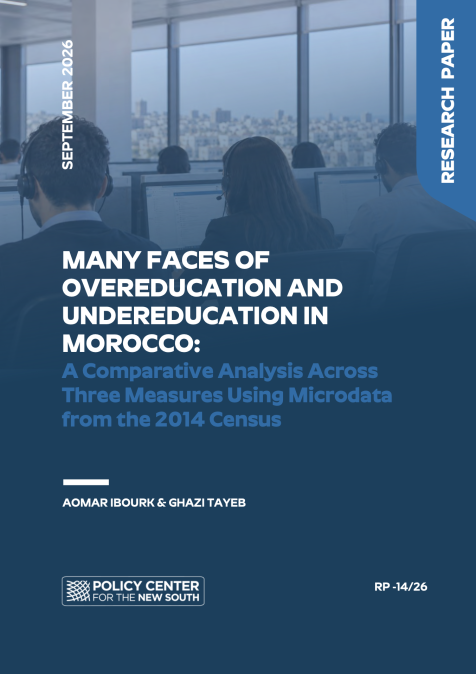
Since the early 2000s, the Moroccan labour market has experienced continuous educational expansion that has not been matched by an equivalent transformation of the economy's productive structure, giving rise to situations of vertical mismatch between employed workers' education levels and the requirements of the jobs they hold. This study analyzes the determinants of overeducation and undereducation using anonymized microdata from the 2014 General Population and Housing Census (RGPH 2014, HCP), on a sample of 945,866 employed workers. Three categorical measures of mismatch are constructed — a National Normative Approach (NNA), an International Normative Approach (INA) aligned with ILO standards, and a Statistical Approach (SA) based on the empirical distribution of years of schooling by occupation — with determinants estimated using Multinomial Logit models.
The descriptive results reveal a marked divergence depending on the measure used: the normative approaches conclude that undereducation is massive, at 62.7 percent (NNA) to 66.0 percent (INA), whereas the statistical approach establishes matching as the majority outcome (67.0 percent). This diagnosis is consistent, in its ranking, with that of the HCP (2018), which reports on exhaustive RGPH 2014 data a 45.7 percent matching rate, 46.7 percent undereducation, and 7.6 percent overeducation — the latter reaching 55.8 percent among specialized technicians and showing a threefold gap between urban (10.4 percent) and rural (3.2 percent) areas. Econometrically, overeducation disproportionately affects young workers, women, urban residents, public-sector employees, and individuals from the most affluent households (richest quintile: β = 0.918), while undereducation dominates among older workers, the selfemployed, family helpers, and rural residents.