Publications /
Research Paper

Back
L’initiative atlantique et les relations Maroc–Mauritanie
Authors
Fadoua Ammari
August 28, 2025

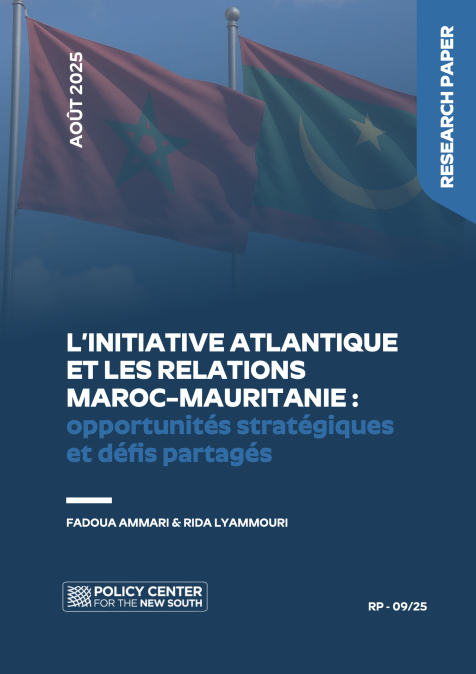
L’Initiative Atlantique, annoncée par le Roi Mohammed VI en novembre 2023, visant à offrir aux pays sahéliens enclavés un accès à l’océan Atlantique via le territoire marocain, promet de redessiner en profondeur la relation bilatérale entre Rabat et Nouakchott. Cet article examine comment ce projet inédit crée de nouvelles opportunités stratégiques tout en soulevant des défis partagés pour le Maroc et la Mauritanie. Sur le plan diplomatique, le rapprochement autour de l’Initiative Atlantique intervient dans un contexte régional délicat, où la question du Sahara demeure politiquement sensible et où les équilibres au sein de l’Union africaine (UA) sont en constante évolution. Sur le plan économique, cette coopération pourrait ouvrir des corridors commerciaux traversant la Mauritanie, développer les infrastructures (routes, chemins de fer, ports) et stimuler le développement mauritanien, notamment via le port de Nouadhibou, tout en contribuant à la sécurité alimentaire et à l’intégration régionale. Sur le plan sécuritaire, enfin, la concrétisation de l’Initiative implique de relever d’importants défis liés à l’instabilité sahélienne : terrorisme, protection des routes, collaboration militaire entre Rabat et Nouakchott. Dans des environnements régional et international complexes, entre Zone de libre-échange continentale africaine (ZLECAf), reconfigurations en Afrique de l’Ouest, et intérêts de l’Union européenne (UE), le succès de l’Initiative Atlantique dépendra de la capacité du Maroc et de la Mauritanie à surmonter ces écueils diplomatiques, économiques et sécuritaires.

RELATED CONTENT

  • October 23, 2026
    In this episode, Mehran Haghirian explores the global economic consequences of disruptions in the Strait of Hormuz, beyond oil and gas. He examines their impact on trade, fertilizer suppl ...
  • Authors
    Paul Isbell
    October 9, 2026
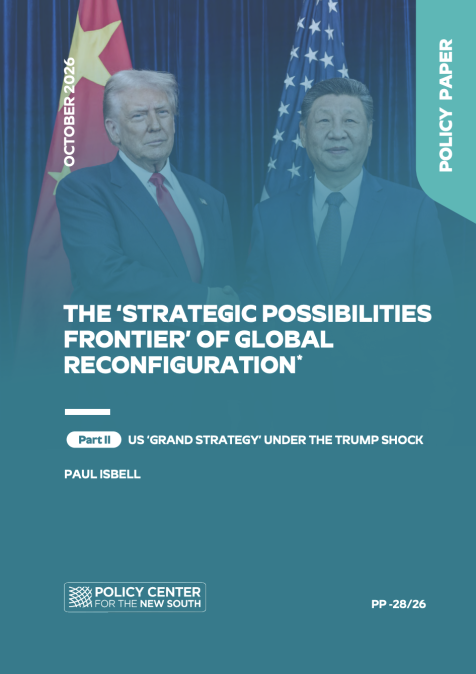
    In the first seven Policy Briefs of this ongoing series of analysis on Pan-Atlanticism: The Atlantic Basin in a Multipolar-Transnational World, we developed the argument that the strategic significance of the Atlantic Basin is on the rise for a range of international actors (states, regions and non-state agents) and from distinct political or ideological perspectives. In addition, in the most recently published Policy Brief -- “The U.S. and the Current International Reconfiguration: ...
  • September 25, 2026
    Dans cet épisode d’Africafé, Amadou Diop analyse les défis de sécurité maritime auxquels font face les pays de l’Afrique atlantique, de la piraterie aux trafics transfrontaliers. Il souligne la nécessité de mutualiser les moyens et de partager l’information entre États. L’échange aborde...
  • Authors
    Meryam Amarir
    August 13, 2026
    Les crises récentes au Moyen-Orient, notamment les attaques ciblant les navires commerciaux en mer Rouge et les tensions autour du détroit d'Ormuz, ont mis en évidence la vulnérabilité des principaux corridors stratégiques du commerce mondial. Plus qu'un bouleversement de l'organisation des échanges, elles accélèrent une transformation déjà engagée, fondée sur la recherche de chaînes de connectivité plus résilientes, la diversification des itinéraires commerciaux et le développement ...
  • Authors
    Meryam Amarir
    August 13, 2026
    Recent crises in the Middle East, particularly attacks targeting commercial vessels in the Red Sea and tensions surrounding the Strait of Hormuz, have highlighted the vulnerability of the main strategic corridors of global trade. Rather than fundamentally disrupting the organization of trade flows, these crises are accelerating an ongoing transformation driven by the search for more resilient connectivity chains, the diversification of trade routes, and the development of logistics ...
  • Authors
    June 8, 2026
    The energy shock caused by the war between the United States and Israel and Iran has highlighted the need for Africa to refine more of its own crude oil. Africa is a net hydrocarbon exporter, but remains stuck in the old colonial economic model: it mostly exports raw materials and imports refined products. Africa exports about 2.6 billion barrels of crude oil every year, and imports about 1.4 billion barrels of refined products. This is a problem for two reasons. First, Africa ...
  • June 5, 2026
    Driven by its mission to reflect on and analyze the major geopolitical, economic, and societal transformations shaping the contemporary world, and with a view to contributing to knowledge-sharing and disseminating the main outcomes of its research program, the Policy Center for the New South regularly publishes collective volumes addressing issues of particular importance to Morocco, Africa, and the broader Global/New South. In this spirit, the Center has recently released two volum ...