Publications /
Policy Paper

Back
The International Justice System: The ICJ, the ICC, the Challenge and Risk of Double Standards
Authors
April 25, 2025

The International Court of Justice and the International Criminal Court play key roles in upholding international law but face criticism over selective enforcement. The ICJ’s reliance on state consent and UN Security Council enforcement often weakens its impact, while the ICC’s jurisdictional limits and selective prosecutions raise concerns about equity. Contrasting global responses to similar rulings reveal geopolitical influences. The study underscores the need for institutional reform to strengthen credibility, ensure consistent application of international law, and restore trust, particularly in the Global South.
RELATED CONTENT

  • Authors
    Stephan Klingebiel
    Andy Sumner
    September 4, 2026
    This Paper was originally published on cgdev.org. Escalatory attacks on multilateral rules and institutions in this era of raw power politics have plunged international politics into uncharted territory. Traditional alliances have been fractured and new partnerships between unlikely bedfellows are emerging. No longer in transition, the post-World War II world order is in rupture. This paper examines international cooperation under these conditions and argues that a new "flexi-l ...
  • Authors
    August 25, 2026
    The next Secretary-General should begin with an act of institutional rebellion: refuse to become the Secretary-General ofeverything. Over three decades the office's political and administrative reach has spread across sustainable development, climate, health, migration, digital governance, financing, gender, food systems, and a still-growing list of global priorities. These issues are not unimportant; the trouble is that institutional ambition has simply outrun institutional capabil ...
  • Authors
    August 13, 2026
    The Resolution adopted by an overwhelming majority of elected European officials in Strasbourg on June 10, 2021, on "the violation of the UN Convention on the Rights of the Child and the exploitation of minors by the authorities in the migration crisis in Ceuta" (2021/2747/RSP), could not fail to leave its mark.Decoding the ResolutionThe Resolution shocked Moroccans to such an extent that it was quickly set aside at the time, as if there were a wish to forget it as fast as possible. ...
  • Authors
    August 11, 2026
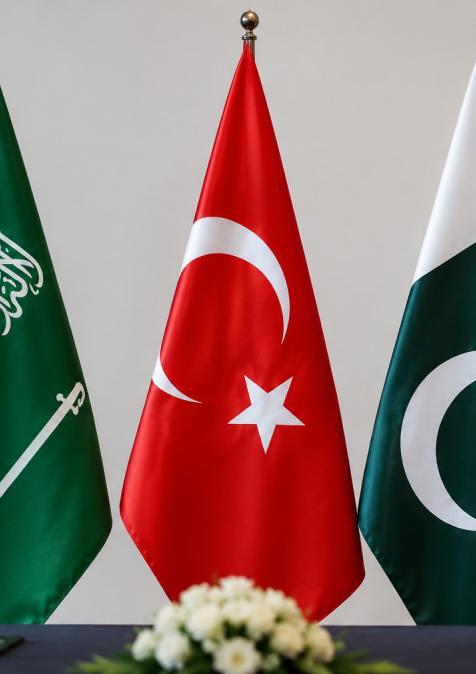
    The Mecca Agreement: A First Step Towards a New Regional Security Architecture? On 7 August, Saudi Arabia, Türkiye and Pakistan signed the Mecca Agreement, a trilateral defense pact aimed at strengthening collective security and defense cooperation between the three countries. At its core lies a collective defense commitment under which an attack on one member is considered an attack on all three. While many details concerning its practical implementation remain unclear, the agreeme ...
  • July 10, 2026
    For much of the post-war period, the Global South was framed as an object of history, defined by dependency, constrained by structural asymmetries, and confined to the margins of global decision-making. That narrative, once empirically grounded, is now no longer adequate. A profound yet uneven transformation is underway. The Global South is no longer only reacting; it is increasingly shaping rules, institutions, and narratives.This Policy Brief argues that the Global South is thus t ...
  • Authors
    April 17, 2026
    The International Court of Justice’s (ICJ) 2025 advisory opinion on climate change marks a significant expansion of international law into the governance of global public goods. By framing climate inaction as a potential violation of international law and human rights, the Court advances a progressive legal agenda that extends beyond existing political consensus and enforcement capacity. This article develops a realist critique of the ruling that avoids both legal romanticism and ni ...
  • March 27, 2026
    Human rights are central to the legitimacy of legal systems, not only through their recognition but also through the manner in which courts resolve conflicts between rights. Judicial decisions require well-founded reasoning, drawing on interrelated legal sources to ensure coherence, legitimacy, and predictability while minimizing non-legal influences. In EU law, the Court of Justice employs grammatical, contextual, comparative, and teleological methods of interpretation, alongside p ...
  • Authors
    Nizar Messari
    December 19, 2025
    The U.S. military buildup in the Caribbean—the most significant since the Cuban Missile Crisis—comes at a moment when a new world order is taking shape, its contours still unclear, and in which the U.S. seeks to be more assertive in the Western Hemisphere. This disposition toward South America and the Caribbean was underscored by the recent publication of the new U.S. National Security Strategy, in which the Monroe Doctrine is explicitly invoked. This Policy Brief situates the devel ...
  • Authors
    December 3, 2025
    Resolution 2797 of the United Nations Security Council does not mark the end of an issue, but the culmination of masterful time management. Morocco has not only won support, it has won the tempo. By combining the Chronos of constancy and the Kairos of opportunity, it has demonstrated that a foreign policy can be based on the philosophy of time as much as on geopolitics.This diplomacy of controlled time can today be seen as an implicit doctrine of the Kingdom: a strategy in which pat ...
  • Authors
    December 3, 2025
    La résolution 2797 du Conseil de sécurité des Nations Unies ne marque pas la fin d’un dossier, mais l’aboutissement d’une gestion magistrale du temps. Le Maroc n’a pas seulement gagné des appuis, il a gagné le tempo.
En combinant le Chronos de la constance et le Kairos de l’opportunité, il a démontré qu’une politique étrangère pouvait s’appuyer sur la philosophie du temps autant que sur la géopolitique.Cette diplomatie du temps maîtrisé peut aujourd’hui être considérée comme une doc ...