Publications /
Book / Report

Back
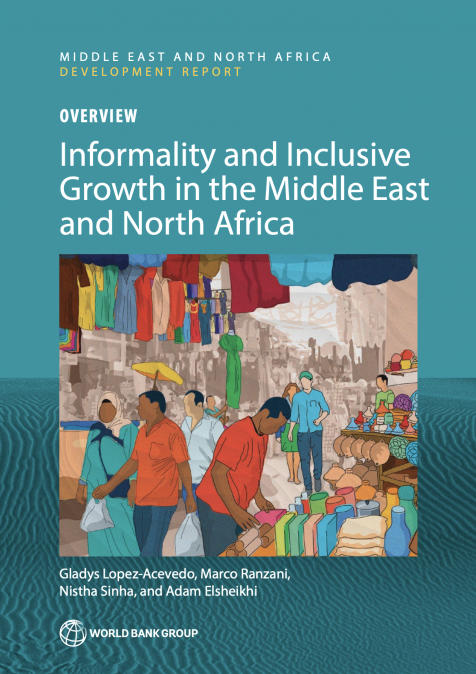
Informality and Inclusive Growth in the Middle East and North Africa
Authors
Gladys Lopez-Acevedo
Marco Ranzani
Nistha Sinha
Adam Elsheikh
June 23, 2023

This report was originally published on openknowledge.worldbank.org

The long-standing informality debate in the Middle East and North Africa (MENA) Region has taken on a new urgency as it looks for a pathway to more socially inclusive growth that is less reliant on fossil fuels. This is occurring against a backdrop of subpar labor market outcomes, further growth setbacks, and deteriorating fiscal and current account de ficits in the aftermath of the COVID-19 pandemic—and in the wake of high in flation and supply chain disruptions triggered by the Russian Federation–Ukraine war. "Informality and Inclusive Growth in the Middle East and North Africa" aims to better understand the characteristics and incentive structure that have led to the prevalence of informal employment in three MENA countries—the Arab Republic of Egypt, Morocco, and Tunisia. The report breaks new ground by adopting a comprehensive perspective to focus on the features of, and interrelationships among, different aspects of these countries’ institutional landscapes to make sense of the complex incentive structure that workers and firms face when deciding between formal and informal options. Specifically, the report groups these issues in three broad realms:(1) entrepreneur-worker relations, (2) taxes and transfers, and (3) market conditions.

“This report is an extremely welcome addition to the literature on MENA labor markets. By analyzing the incentive structure and institutional factors that have led to the prevalence of informal employment in Egypt, Morocco, and Tunisia, it points the way to policy actions that can be taken to reduce informality and increase social protection for workers. It is a must-read for anyone who cares about greater economic inclusion in MENA.” Ragui Assaad, Professor, Hubert H. Humphrey School of Public Affairs, University of Minnesota

“A compelling account of the implications of informality in the workforce and how economies of MENA can design appropriate policy responses. This timely report comes amid multiple social reforms in MENA and is a must-read for policy practitioners and economists in the region.” Karim El Aynaoui, Executive President, Policy Center for the New South

“This report is particularly timely given the negative impact the COVID-19 pandemic and subsequent crises have had on living standards and poverty rates around the world and especially in MENA countries. While the focus on boosting growth and achieving the Sustainable Development Goals has revolved around financing, the report sheds new light on the bene fits that tackling informality through institutional, regulatory, and policy changes could present to achieving these goals.” Mahmoud Mohieldin, Executive Director, International Monetary Fund.

RELATED CONTENT

  • November 30, 2023
    In this episode, we dive into the pressing necessity for climate initiatives in Africa. Despite its minimal global emissions, Africa grapples with severe climate challenges and a substantial funding shortfall. Yet, as obstacles persist, including the disconnect between investor expectat...
  • Authors
    Ali Elguellab
    Elhadj Ezzahid
    November 1, 2023
    The role of the production network in shock propagation has been an issue of considerable interest since the Great Recession. However, the empirical literature has only focused on advanced and emerging countries. This paper aims to contribute to filling this gap by examining the case of Morocco, a developing country belonging to the lower-middle-income group. The question is whether its production network is a factor in amplifying idiosyncratic industry-level shocks or, conversely, ...
  • Authors
    Jean Louis-Sarbib
    October 18, 2023
    Addressing inequalities in all their forms has emerged as one of the major global challenges faced by numerous countries across the globe, particularly in Africa. In a context where Africa faces many pressing challenges that are the subject of much analysis (Sarbib et al. 2022), there is a clear gap in conducting comprehensive reviews focused on inequalities, partly due to the lack of available data. Inequalities, which are both consequences and partial causes of poor development o ...
  • Authors
    Sous la direction de
    September 21, 2023
    Cette édition du Rapport économique de l’Afrique est construite autour d’une thématique d’une grande actualité : les conséquences des incertitudes et des risques aussi bien sanitaires que climatiques et sécuritaires sur les économies du continent. L’exercice est d’autant plus légitime que la recomposition de l’ordre mondial questionne la place du continent à l’échelle planétaire, sur les plans économique, social et environnemental. L’économie mondiale est confrontée à des défis glo ...
  • August 28, 2023
    Le secteur informel joue un rôle crucial dans le développement économique et social du Maroc en tant que filet de sécurité pour de nombreux travailleurs. Cependant, sa concentration dans de petites entreprises qui manquent de moyens de production sophistiqués peut entraver la croissance...
  • Authors
    August 17, 2023
    Défis et opportunités économiques en Afrique : Renforcer la stabilité financière pour un développement durable L’Afrique est un continent qui connaît de nombreux défis économiques et sociaux, mais aussi de grandes opportunités de développement. Pour réaliser son potentiel, le continent a besoin de renforcer sa stabilité financière, c’est-à-dire sa capacité à faire face aux chocs internes et externes qui peuvent affecter sa croissance et son développement. (Figure 1) La stabilité f ...