Publications /
Policy Brief
This paper was initially published in French on the website of the Fondation Jean-Jaurès.
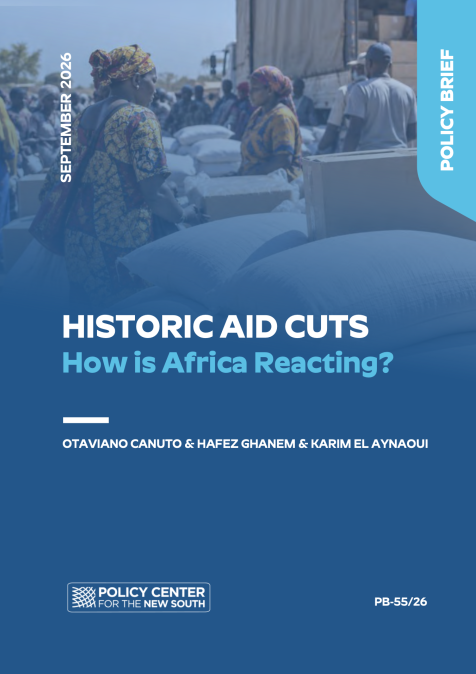
There was a historic decline in Official Development Assistance (ODA) in 2025. Foreign aid to developing countries from members of the OECD-DAC fell by some 23%, the largest decline on record and the second consecutive annual decline. Aid to Africa fell by more than 25%. The International Monetary Fund (IMF) described this decline in ODA to Africa as “a shock like no other.” It differs from previous shifts in foreign assistance because of its scope and depth, as well as the speed, simultaneity, and unexpected nature of the cuts. Moreover, these cuts are occurring at a time when other sources of finance for Africa—including multilateral institutions and NGOs—are facing their own financing problems.
Chinese lending to Africa has also declined. New Chinese loan commitments fell from a peak of $29 billion in 2016 to just $2.1 billion in 2024, while debt-service payments on earlier loans have continued to rise. As a result, Africa now pays more to China in debt service than it receives in new disbursements. At the same time, African countries are burdened by large and increasingly unsustainable debts. About half of Africa’s 54 countries spend more than 10% of their budget revenue on interest payments.
A Structural Shift or a Temporary Shock?
The decline in ODA appears to represent a structural shift rather than a temporary shock. OECD expects further declines in 2026 and beyond. The United States, Germany, France, the United Kingdom, and Japan account for almost all of the decline in 2025. These were policy decisions embedded in national budgets. OECD countries are facing fiscal pressures as they deal with post-Covid deficits and rising defense spending.
Foreign aid is also unpopular in donor countries. As nationalism rises, voters increasingly question the usefulness of sending taxpayers’ money to distant countries when needs at home are growing. ODA is widely perceived as ineffective and wasteful and is therefore an obvious target for budget cuts.
In addition to the decline in the quantity of aid, the nature of aid is also changing. ODA is no longer allocated primarily to support economic development and poverty reduction. It is now increasingly expected to support donor countries’ geopolitical and economic interests. United States Secretary of State Marco Rubio expressed this shift most clearly. He explained that every program funded by the United States and every dollar spent must be justified on the basis of whether it makes America stronger, safer, or wealthier. Similarly, in Europe, the European Union’s Global Gateway program explicitly aims to support Europe’s geopolitical and geostrategic interests.
Foreign aid has always reflected a degree of donor self-interest. Nevertheless, this explicit shift toward making self-interest the main—or, as in the case of the United States, even the only—justification for ODA is significant. It implies a shift in donors’ financing priorities. Social programs, education, food security, and poverty reduction will decline, while critical minerals, counterterrorism, pandemic prevention, and energy security will receive greater priority.
The Impact on African Economies
The overall impact of this structural shift in donor policies on African economies is significant, especially for low-income countries. According to the IMF, ODA represented around 3% of African GDP. Low-income African countries are being hit the hardest because, for them, ODA represented 6.4% of GDP. In some countries—such as South Sudan—it represented more than one-third of GDP. By contrast, ODA represented only 0.4% of GDP in middle-income African countries.
Middle-income countries may be able to replace aid with domestic resources and foreign investment. However, the adjustment will be more difficult for low-income countries that have relied on grants and concessional financing to support their social and poverty-reduction programs. Many programs in the health and food-security sectors have been abruptly halted because of aid cuts, with serious consequences for the poorest and most vulnerable.
The main victims of the sharp decline in ODA are the poor, refugees, women, and children in low-income and fragile countries. Aid cuts have an immediate impact on the health sector, where many donors have traditionally been very active. Ferreira da Silva et al. (2026) estimate that a continuation of the current downward trend in ODA could lead to 9.4 million additional deaths in low-income countries, including 2.5 million children under the age of five. According to UNAIDS, the suspension and reduction of major donor programs led to an immediate disruption in HIV-prevention services across Africa. As a result, the number of people receiving pre-exposure prophylaxis dropped by 38%, while HIV testing fell by 22%. At the same time, the World Food Program (WFP) warns that funding shortfalls are putting refugee lifelines at risk and that humanitarian aid cuts are pushing millions deeper into hunger.
Africans’ Reactions
While cognizant of these difficulties, many African and international observers argue that the decline in ODA to Africa may not be such a bad thing after all, provided that Africa is able to seize the moment to strengthen its economic and development sovereignty. This was the general sentiment expressed during a webinar on the subject organized by the Policy Center for the New South. This view is also supported by Rama Yade of the Atlantic Council and former Kenyan President Uhuru Kenyatta.
A group of African leaders meeting in Ibadan, Nigeria, responded to the first announcements of ODA cuts affecting agriculture and food security. They wrote: “Africa’s future has never been in aid; it is in Africans’ hands. If Africa acts now, it will not only feed itself—it will feed the world.”
These statements are reminiscent of an old but still influential current of development economics, which argues that long-term ODA—as opposed to short-term humanitarian assistance—undermines development by creating dependency, weakening institutions, distorting incentives, and discouraging domestic resource mobilization.
Peter Bauer was one of the earliest proponents of the aid-dependency argument. He believed that the main problem facing developing countries was not a shortage of capital, but rather the weakness of domestic institutions and a lack of entrepreneurship. He argued that ODA weakened the relationship between governments and their citizens. Governments that rely on foreign aid have little incentive to develop effective tax systems or remain accountable to their populations.
More recently, William Easterly argued that aid created incentives for governments to satisfy donors rather than pursue locally owned development strategies. Development succeeds when entrepreneurs, farmers, and citizens respond to market signals, not when aid agencies attempt to direct a top-down economic transformation.
In her 2009 book, Zambian economist Dambisa Moyo pointed out that more than fifty years of ODA had failed to generate sustained growth in Africa. She argued that aid fostered corruption, weakened institutions, discouraged entrepreneurship, and created incentives for governments to focus on donors rather than their own citizens.
So, is ODA good or bad for development? The answer to this question must be nuanced. ODA and humanitarian assistance have had many positive impacts around the world. On the other hand, Bauer, Easterly, and Moyo do have a point: development depends on domestic institutions and leadership, not on continued reliance on foreign assistance. The recent sharp decline in ODA means that Africa will now face an unintended test of Bauer, Easterly, and Moyo’s hypothesis. Will the decline in aid incentivize Africans to build strong institutions and put better economic policies in place?
Political pronouncements by African leaders following the aid cuts point in the right direction. The old international order—including the aid architecture—is dead. In any case, the old aid policies and programs have not been particularly successful in Africa. It is time for Africa to take charge of its own development. Policy pronouncements are important, and it is encouraging that African leaders have announced that they will prioritize economic and developmental sovereignty. However, while such declarations are important, actions are what ultimately matter. To translate the various declarations of economic sovereignty into real progress on the ground, African leaders need to act at both the national and regional levels.
Building a National Consensus for Change
The cuts in foreign assistance and the need to increase self-reliance provide an opportunity for African countries to build a national political consensus around a new development model. African countries that have achieved strong development results have typically started by building a national political consensus around an economic program. It is important to point out that such a consensus can be achieved under very different political systems. The three examples presented below illustrate consensus-building under an open democratic parliamentary system in Mauritius, a more closed democracy relying more heavily on traditional tribal structures in Botswana, and a Singapore-style autocracy in Rwanda.
As a small island, poor in natural resources and with an ethnically diverse population, Mauritius was not considered a likely candidate to become a development success story. In fact, Nobel Laureate James Meade predicted that Mauritius would fail. After all, it was a typical African economy—dependent on a single crop, sugar cane; vulnerable to terms-of-trade shocks; experiencing rapid population growth; and susceptible to ethnic tensions. Yet Mauritius today is a resounding success story. It followed the East Asian model, starting with agricultural exports, then moving into labor-intensive manufacturing, and subsequently into high-value-added services. Its GDP per capita in current US dollars increased 54-fold, from $246 in 1970 to $13,300 in 2024. Measured in constant dollar purchasing-power-parity dollars, this translates into a 13-fold improvement in real living standards.
According to Subramanian (2009) and Frankel (2010), Mauritius was able to prove Meade wrong by establishing a political system—based on a Westminster-style parliamentary democracy—that was inclusive and capable of keeping social conflict manageable. Nearly all governments in Mauritius were based on coalitions among different parties. This encouraged consensus-building and allowed for the development of strong economic institutions and a shared national vision for development policy. Mauritius’s success in overcoming its macroeconomic imbalances in the early 1980s provides an example of how this consensus worked. There was a national agreement around a macroeconomic adjustment program, which was ultimately implemented by three different governments with divergent ideological orientations.
Botswana is another African success story. Unlike Mauritius, Botswana is a resource-rich country. Since the 1970s, income from diamond mining has accounted for about one-third of national income and 75% of exports. Unlike other African countries that suffered from a “resource curse,” Botswana used its diamond revenues wisely and gradually began processing diamonds domestically, thereby creating a new industry. As a result, Botswana’s GDP per capita in nominal terms increased 74-fold, from $103 in 1970 to $7,600 in 2024. Measured in constant purchasing-power-parity dollars, this translates into an 11-fold increase in real living standards.
Acemoglu, Johnson and Robinson (2001) and Robinson (2009) argue that—like Mauritius—Botswana’s success is due to a consensus around a development vision that allowed for the building of strong economic institutions, which in turn implemented sound policies. Botswana’s political system differs from that of Mauritius. It holds elections that are considered fair and transparent, but those elections consistently gave a simple majority to one party, which then selected the president. Moreover, the same party—the Botswana Democratic Party (BDP)—was in power for 58 years, from independence in 1966 until 2024, when it lost to the Umbrella for Democratic Change (UDC). The UDC was supported by a former BDP president, who also happened to be the son of Botswana’s first president and founder of the BDP.
Consensus building in Botswana was facilitated more by the traditions of the Tswana tribal states than by the institutions of Western democracy. The Tswana tribes are governed by chiefs and a council, the kgotla, an assembly of all adult males in which all issues of public interest had to be discussed. Even though they were intended to be advisory, the kgotlas provided an effective way for commoners to criticize the chiefs and kings. This tradition continued after the creation of the modern Botswanan state. As laws were passed and decisions made, presidents traveled across the country, appearing before kgoltas to explain, discuss, and justify their actions. This helped develop a shared vision for Botswana’s future.
Rwanda is emerging as another success story. Between the end of the genocide in 1994 and 2024, its GDP per capita in current dollars rose nearly sevenfold, from $145 to $1,000. This translated into a nearly threefold improvement in living standards, as measured in constant purchasing-power-parity dollars. Rwanda has leapfrogged from smallholder subsistence agriculture to high-value-added services and ICT. This has occurred under a political system that Freedom House classifies as not free. The Rwandan Patriotic Front (RPF), which has ruled the country since it ousted the forces responsible for the 1994 genocide, has methodically suppressed all forms of political dissent. President Kagame—the leader of the RPF—has won successive presidential elections with more than 90% of the vote.
There are three possible explanations for President Kagame’s success in building support for his economic program despite the lack of political freedom. First, the memory of the genocide created a societal demand for stability and order, which gave the RPF political legitimacy. The government has emphasized the importance of maintaining national unity and even has a Ministry for National Unity and Civic Engagement. Activities in this area include national unity programs, civic education, community reconciliation initiatives, commemoration ceremonies, and local dialogue fora.
Second, the government produced a Vision 2020 and later Vision 2050, which it widely publicized and used in national discussions and local government meetings. This helped build a coalition of business leaders, technocrats, and urban elites in support of the economic program.
Third, like the late Prime Minister of Singapore, Lee Kwan Yu, President Kagame relies more on performance legitimacy than on electoral legitimacy. The implicit social contract is that government delivers security, growth, health, education, and public services, while citizens support the development program.
What Would New National Consensuses Achieve?
African countries need to build a national consensus around new economic programs that would mobilize resources to replace the lost ODA. These could include actions to: (1) increase domestic tax revenue; (2) deepen the financial sector; (3) attract more private foreign investment; (4) increase export revenues and remittances; and (5) develop new international partnerships in addition to those with China and the OECD-DAC countries.
Because of the ODA cuts, domestic resource mobilization has become more important than at any time since African independence. As aid declines, expanding domestic revenue is necessary to maintain public spending on infrastructure, education, health, security, and social protection. The importance of taxation extends beyond the simple need for revenue. Taxation strengthens the relationship between governments and citizens because governments that depend on taxpayers have stronger incentives to provide services, maintain accountability, and promote economic growth.
Africa's average tax performance has historically been weak. The continent’s average tax-to-GDP ratio was 16.1% in 2023—less than half that of the OECD, at 34%, and below those of Asia, at 19.6%, and Latin America and the Caribbean, at 21.3%. Action is therefore needed to improve domestic resource mobilization across the continent.
Countries can follow the example of some African leaders in this area. Morocco has consistently maintained tax-to-GDP ratios above 25%, while Tunisia has often exceeded 30%, and South Africa typically collects around 25–27% of GDP in taxes. These countries demonstrate that African states can build effective revenue systems when political commitment, administrative capacity, and policy consistency are present. They have been able to improve tax administration and broaden the tax base by reducing informality, using digitalization, taxing multinational corporations, improving the taxation of mineral resources, and reducing tax exemptions.
As ODA declines, African governments will also increasingly need to raise resources from domestic financial markets. Africa possesses more than $4 trillion in financial assets, bank deposits, and insurance reserves that remain underutilized because financial markets are shallow and fragmented. Using the ratio of private-sector credit to GDP as an indicator of financial depth, it is clear that Africa lags behind the rest of the world. In 2023, this ratio was 25% in Africa, 80% in East Asia, and more than 100% in the OECD. To catch up, African countries need to strengthen their banking systems, expand digital finance, develop their pension and insurance sectors, deepen capital markets, and mobilize diaspora savings.
Domestic financial markets alone will not be sufficient to fill the gap left by the ODA cuts. Countries that have succeeded in their economic development have relied much more on foreign direct investment (FDI) than on ODA. This has been the experience of Singapore, China, Malaysia, and Costa Rica. Africa attracts only about 6% of global FDI—equivalent to 2-4% of the continent’s GDP—although it accounts for 20% of the world’s population. Nevertheless, FDI flows to Africa amounted to $97 billion in 2024, considerably more than ODA, which stood at $59 billion that year.
A few African countries—Mauritius, Rwanda, Morocco, and Egypt—have been successful in attracting FDI, and other countries on the continent could learn from their experiences. The experiences of relatively successful African countries point to eight factors that help attract FDI. These are: (1) political stability and security; (2) a supportive macroeconomic framework that maintains low inflation, sustainable debt, stable exchange rates, and predictable fiscal policies; (3) adequate infrastructure, including electricity, digital connectivity, roads, ports, railways, and airports; (4) a supportive regulatory framework that simplifies business registration, limits licensing requirements, expedites customs procedures, protects property rights, and ensures the enforcement of contracts; (5) trade openness, allowing investors to pursue export opportunities rather than being limited to the domestic market; (6) strong human capital and the availability of skilled workers; (7) effective investment-promotion agencies that help investors identify target sectors, facilitate approvals, and resolve administrative obstacles; and (8) strong institutions that ensure a transparent legal system, low levels of corruption, predictable regulation, and an effective public administration.
As ODA declines, African countries face a foreign-exchange gap in addition to a public-finance gap. Therefore, offsetting the fall in ODA will also require increasing foreign exchange earnings from exports of goods and services, as well as from workers’ remittances. According to UNCTAD, Africa’s exports of goods increased from $140 billion in 1995 to $650 billion in 2023, but Africa’s share of total world exports remains very small, at 2-3%. One reason for the relatively low revenue from merchandize exports—described in UNCTAD’s Economic Development in Africa report—is that Africa mainly exports primary goods, such as crude petroleum, minerals, and agricultural commodities, with very little domestic processing and value addition. Hence, industrial policies that encourage the export of processed goods rather than primary commodities would be an important component of any economic program aimed at addressing the decline in ODA.
Policymakers tend to focus on merchandise exports as a source of foreign exchange. However, according to World Bank data, service exports could be just as important. Africa has been increasing its foreign-exchange earnings from tourism and the export of digital services, including ICT, business-process outsourcing, and financial services. Those efforts need to accelerate to compensate for the decline in ODA.
In addition to being an important source of foreign exchange, the tourism industry creates large numbers of jobs, both directly and indirectly. Africa has excellent tourism potential, including cultural tourism, beach tourism, and safaris, and several African countries are building large and dynamic tourism sectors. In 2024, tourism revenues amounted to $15.3 billion in Egypt, $11.2 billion in Morocco, $5.4 billion in South Africa, $3.9 billion in Tanzania, and $2.1 billion in Mauritius.
The digital economy is an important driver of growth and innovation. Moreover, digitally enabled services could be an important source of foreign exchange earnings. In 2024, Africa’s digital exports amounted to $41.3 billion, of which $7.0 billion came from South Africa, $6.7 billion from Morocco, $5.2 billion from Ghana, $4.0 billion from Egypt, and $3.5 billion from Mauritius. Nevertheless, Africa’s total digital exports remain less than 1% of the global total. Hence, there is considerable room for growth. African public and private sectors need to invest in digital infrastructure, digital know-how, digital platforms, and digital education.
Worker remittances are the most stable source of foreign exchange flowing to developing countries. At the global level, remittance flows to developing countries now exceed both FDI and ODA. In 2024, Africa received more than $100 billion in remittance flows, far exceeding ODA as a source of financing. Unlike ODA, remittances are private and flow directly to households. Moreover, they tend to be more stable and may even increase during crises. Some African countries have been particularly successful in mobilizing remittances. For example, in 2024, Egypt received $22.7 billion in remittances, Nigeria received $19.8 billion, and Morocco received $12.0 billion. Successful countries have reduced remittance costs by introducing digital payment systems, ensuring mobile money interoperability, maintaining realistic exchange rates, and simplifying foreign exchange procedures. Countries have also engaged with their diasporas to encourage savings and investment, as well as knowledge transfer.
As support from OECD countries and China declines, it is reasonable for African countries to consider ways of building new partnerships. An obvious option is to develop relations with a new generation of emerging-market partners, including the United Arab Emirates (UAE), Saudi Arabia, Türkiye, and India. These countries have strong interests in Africa and would like to expand their relationships as OECD countries and China retreat. They may not be able to completely replace ODA from the OECD countries and financing from China, but they can be important sources of FDI, trade, and technology transfer. In any case, Africa should not try to substitute one dependency for another. The objective should be to diversify partnerships—and possibly increase competition among partners—in ways that support African development priorities.
The process of expanding Africa’s partnerships has already begun and is moving quickly. The UAE has already become the largest source of greenfield investment projects in Africa, with UAE companies announcing $50 billion of greenfield investments in 2023. UAE investments are concentrated mainly in logistics, renewable energy, ports, telecommunications, and mining. Saudi Arabia is also expanding its economic engagement through investments in agriculture, mining, energy, and infrastructure. Türkiye has dramatically expanded its diplomatic and economic presence in Africa. The number of Turkish embassies on the continent has more than tripled over the last two decades, while trade with Africa rose from $5 billion in 2003 to about $40 billion today. Turkish companies are active in construction, transport infrastructure, manufacturing, and aviation. India has consistently ranked among the top ten sources of greenfield FDI in Africa over the last decade. Indian firms have become important investors in pharmaceuticals, ICT, agriculture, and manufacturing. Indian development cooperation emphasizes technical assistance, education, and capacity building.
Actions at the Regional Level
All African countries are facing the same challenge of declining ODA. Concomitantly, geopolitical tensions and protectionist policies in rich countries signal the end of globalization as we have known it. Rich countries are increasingly adopting policies of near-shoring and friend-shoring. Regionalism is replacing globalism, and Africa needs to adapt to the new world order. To confront the challenge of a “shock like no other,” African countries need to accelerate regional integration through the full implementation of the Africa Continental Free Trade Area (AfCFTA) and by strengthening regional development finance institutions.
Declining ODA makes implementation of the AfCFTA—which creates a single market of 1.4 billion people—even more important. Regional integration through the AfCFTA would attract more foreign and domestic investment, expand and deepen regional value chains, and encourage greater investment in regional infrastructure. It would therefore support export growth and help generate more foreign exchange. The World Bank (2020) estimates that the full implementation of the AfCFTA would raise Africa’s income by 7% and lift 30 million people out of extreme poverty by 2035. At a time when Western ODA is shrinking and Chinese financing is less forthcoming than before, Africa must rely more on its own markets, firms, investors, and consumers. The AfCFTA is an excellent instrument for achieving this objective.
In addition to trade integration aimed at encouraging greater savings and investment, Africa could offset the decline in ODA by expanding and strengthening the continent’s own development finance institutions. These include the African Development Bank (AfDB), the African Export-Import Bank (Afreximbank), and the Africa Finance Corporation (AFC). Those institutions could help Africa mobilize more of its own savings, leverage private capital, finance intra-African infrastructure, support regional value chains, and finance intra-African trade. Stronger regional institutions would enhance the continent’s financial sovereignty and thus become a pillar in a new African development model.
Regional financial institutions could be strengthened through actions in three areas. First, their capital should be increased. This would require greater contributions from member countries. Since institutions such as the AfDB are able to leverage their capital significantly—so that one dollar of additional capital would lead to about a seven-dollar increase in AfDB lending—a capital increase would result in a net increase in the financing available for investment on the continent. Second, the AfDB, Afreximbank, and AFC could sponsor an Africa-wide investment vehicle to mobilize long-term capital from pension funds, insurance companies, and sovereign wealth funds—much of which is currently invested abroad—for investment on the continent. Third, Africa could create a continent-wide guarantee institution specializing in guarantees for infrastructure investment—an Africa Infrastructure Guarantee Facility (AIGF). This would help channel more private capital, both African and foreign, into much-needed infrastructure sectors.
Concluding Remarks: Could Aid Cuts Be Good for Africa?
Aid cuts are obviously painful and create significant human costs and suffering. On the other hand, the old model of ODA has not worked for Africa. The continent continues to lag behind on many development indicators. While seeking to support African development, donors may have ended up weakening African agency. It is time to consider a new development model in which Africans take much greater responsibility for their own future.
In this sense, cuts in ODA may ultimately prove beneficial for Africa by serving as a wake-up call. They remind Africans of their responsibilities and compel them to pursue home-grown responses to the continent’s challenges. Declining aid also means that African countries can no longer rely on donors—many of them former colonial powers—to address these challenges. More than 60 years after achieving political independence, they must now pursue greater economic independence, which is essential for sustained development.
- All Purchasing Power Parity GDP data used in this policy brief is from the Maddison Project database.
- For data on revenue collection in Africa, see OECD (2025).
- For more information on the reforms needed to strengthen African resource mobilization systems, see the African Tax Administration Forum.
- For further details, see the Africa Finance Corporation.
- Data are from the World Bank.
- See AfDB (2024).
- ODA data are from the OECD, while FDI data are from UNCTAD.
- For more information on FDI to Africa, see UNCTAD (2025).
- See World Bank (2013).
- See also the World Bank’s Digital Economy for Africa initiative.
- See World Bank (2024).
- Remittance data are from the World Bank.
- See also the African Union’s Diaspora Division.
- See also African Union (2025).