Publications /
Policy Brief

Back
Financing Solutions for Developing Countries: Quick Wins
Authors
Sven Grimm
Mavis Owusu-Gyamfi
Rob Floyd
Neuma Grobbelaar
Brahima Coulibaly
Abbi Kedir
Iliana Olivié
Sara Pantuliano
September 27, 2024

This paper was originally published on t20brasil.org


Geopolitical fragmentation and rising debt have constrained fiscal space in many developing economies, particularly in Africa, limiting investments in critical sectors such as health, education, and infrastructure. Key challenges include the inefficacy of the G20’s Common Framework for debt restructuring, the inequitable allocation of Special Drawing Rights (SDRs), and funding shortages for concessional financing through the International Development Association (IDA).

To address these financial constraints, three key recommendations are proposed. First, reforming the G20 Common Framework to enhance efficiency and inclusivity in debt restructuring. Second, reallocating SDRs through the African Development Bank to provide greater liquidity for African nations. Third, ensuring a robust replenishment of the IDA and the African Development Fund (ADF) to sustain development financing.

The African Union’s inclusion in the G20 presents a strategic opportunity to advocate for these reforms. Strengthening coordination among African nations and engaging proactively with the G20 could help mobilize financial resources, fostering economic resilience and sustainable growth across the continent.
RELATED CONTENT

  • Authors
    Under the Supervision of
    Philippe Chalmin
    July 4, 2016
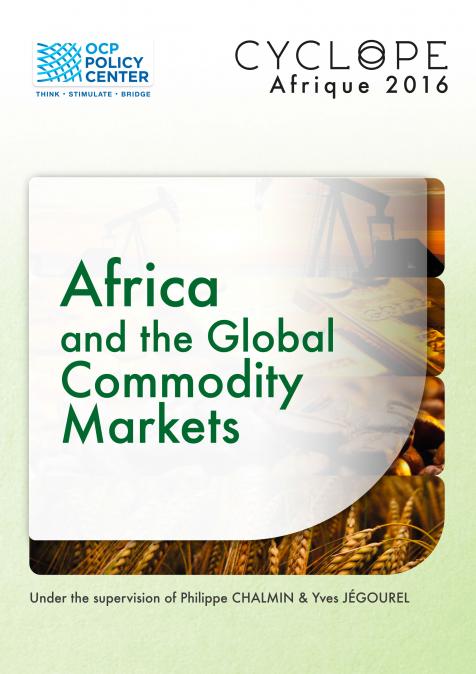
    Guinea’s bauxite, Moroccan phosphates, Nigerian Bonny Light, Zambian copper, Côte d'Ivoire’s cocoa, Ethiopian coffee or Madagascar’s vanilla: all are examples demonstrating that raw materials have a dimension that is as global as it is local. Global by the markets on which they are traded, local by their quality, a key element of their price, and their macroeconomic impact, particularly for Africa. In line with the 2016 CyclOpe report, which celebrates three decades of existence thi ...
  • Authors
    Karim EL Mokri
    June 21, 2016
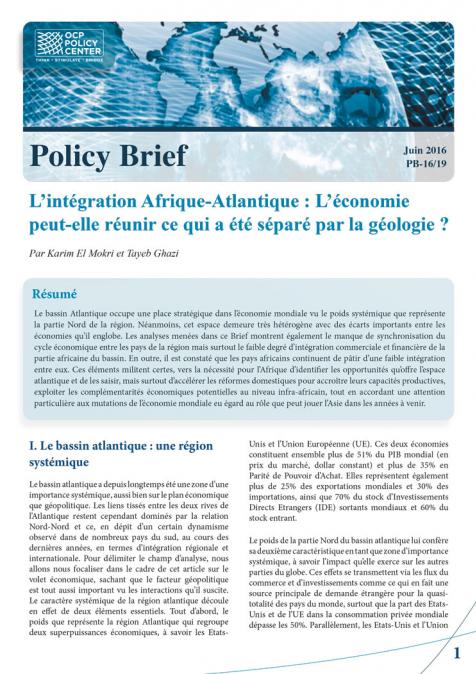
    Le bassin Atlantique occupe une place stratégique dans l’économie mondiale vu le poids systémique que représente la partie Nord de la région. Néanmoins, cet espace demeure très hétérogène avec des écarts importants entre les économies qu’il englobe. Les analyses menées dans ce Brief montrent également le manque de synchronisation du cycle économique entre les pays de la région mais surtout le faible degré d’intégration commerciale et financière de la partie africaine du bassin. En o ...
  • Authors
    June 16, 2016
    L’écart entre filles et garçons en termes de scolarisation, au Maroc, a longtemps préoccupé tant les académiciens que les décideurs. En revanche, très peu d’études se sont penchées sur l’analyse de cet écart sous une toile de fond quantitative. Ce présent travail s’intéresse à l’écart genre en termes d’acquis scolaires en lecture. La finalité étant de mettre en exergue les facteurs influençant les différences de performance entre les genres ainsi que leur ampleur. Pour ce faire, une ...
  • Authors
    Silvia Colombo
    Mohamed El Harrak
    Nicolò Sartori
    May 27, 2016
    Energy is at the core of the remarkable current transitions in the global economy and geopolitics, and natural gas plays a crucial role in these processes. In this context of rapidly evolving trends at the market level and developing dynamics between regional and global actors, The Future of Natural Gas aims at analysing the role of natural gas in the future energy mix by considering several key factors: the ambitious climate policies agreed by the international community, cost issu ...
  • Authors
    May 20, 2016
    The 2015-2030 strategic vision innovates the Moroccan educational system. Unlike previous reforms, this vision addresses problems that have long been ignored. Among these problems is the quality of education. Although educational quality may have been included in previous reform programs, it is considered as one of the priorities in this new vision. The purpose of this Policy Brief is to assess the status of learning achievement, which is an integral part of educational quality, of ...