Publications /
Policy Brief

Back
Financing Solutions for Developing Countries: Quick Wins
Authors
Sven Grimm
Mavis Owusu-Gyamfi
Rob Floyd
Neuma Grobbelaar
Brahima Coulibaly
Abbi Kedir
Iliana Olivié
Sara Pantuliano
September 27, 2024

This paper was originally published on t20brasil.org


Geopolitical fragmentation and rising debt have constrained fiscal space in many developing economies, particularly in Africa, limiting investments in critical sectors such as health, education, and infrastructure. Key challenges include the inefficacy of the G20’s Common Framework for debt restructuring, the inequitable allocation of Special Drawing Rights (SDRs), and funding shortages for concessional financing through the International Development Association (IDA).

To address these financial constraints, three key recommendations are proposed. First, reforming the G20 Common Framework to enhance efficiency and inclusivity in debt restructuring. Second, reallocating SDRs through the African Development Bank to provide greater liquidity for African nations. Third, ensuring a robust replenishment of the IDA and the African Development Fund (ADF) to sustain development financing.

The African Union’s inclusion in the G20 presents a strategic opportunity to advocate for these reforms. Strengthening coordination among African nations and engaging proactively with the G20 could help mobilize financial resources, fostering economic resilience and sustainable growth across the continent.

RELATED CONTENT

  • Authors
    October 27, 2026
    Mozambique’s extractive-industry development model is a textbook case of how enormous FDI funds derived from its rich mineral base have not been leveraged to   promote inclusive economic growth and generate food security for all. It is a textbook case of the resource curse.  Instead, only a few have benefitted, leaving the poor and vulnerable, who constitute the vast majority, to struggle unassisted. These include smallholders in subsistence-oriented agriculture ...
  • October 23, 2026
    In this episode, Mehran Haghirian explores the global economic consequences of disruptions in the Strait of Hormuz, beyond oil and gas. He examines their impact on trade, fertilizer suppl ...
  • October 15, 2026
    The Policy Center for the New South, in partnership with The Asian Network, is organizing a webinar titled “Emerging Powers and the Remaking of Global Order” to examine the growing role of emerging powers and the Global South at a time of profound transformation in the international sys...
  • October 14, 2026
    في ظل التوترات الجيوسياسية المتصاعدة، تتغير طرق التجارة العالمية وتتبدل معها موازين الممرات الاستراتيجية. تفتح هذه الحلقة من «حديث الثلاثاء» النقاش حول التقاء المسارات البحرية والبرية داخل هذه الممرات، والعوامل التي تتحكم في طبيعة السلع التي تعبرها. وتبحث كذلك في ما يمكن للمغرب أن يجنيه...
  • Authors
    Florent Parmentier
    October 12, 2026
    Cet article soutient que le Chief Geopolitical Officer (CGO) doit être repensé à partir de l’expérience des entreprises africaines. Dans un environnement multipolaire et fragmenté, leur principal défi n’est pas seulement la gestion des risques, mais la préservation de plusieurs options stratégiques simultanément selon une logique de hedging. Trois modèles de CGO sont à distinguer : l’intermédiation (Office chérifien des Phosphates (OCP), Tanger Med), l’intégration régionale (Ethiopi ...
  • October 09, 2026
    Can Nigeria’s Dangote refinery help strengthen Africa’s energy security amid disruptions to global supply routes? This discussion considers how expanding local refining capacity can reduc ...
  • Authors
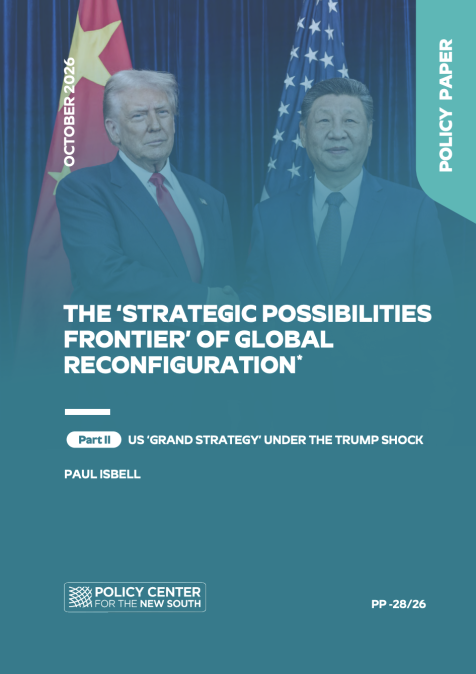
    Paul Isbell
    October 9, 2026
    In the first seven Policy Briefs of this ongoing series of analysis on Pan-Atlanticism: The Atlantic Basin in a Multipolar-Transnational World, we developed the argument that the strategic significance of the Atlantic Basin is on the rise for a range of international actors (states, regions and non-state agents) and from distinct political or ideological perspectives. In addition, in the most recently published Policy Brief -- “The U.S. and the Current International Reconfiguration: ...
  • October 8, 2026
    This paper was originaly published on Higher Education Policy Journal This article critically assesses the alignment between Morocco’s public guidance schemes for international students and its national development goals. Specifically, it investigates the capacity of these mechanisms to transform student mobility from a potential ‘brain drain’ into a tangible ‘brain gain’. Employing a qualitative case study approach, we conducted a systematic content analysis of 204 mobili ...