Publications /
Policy Brief

Back
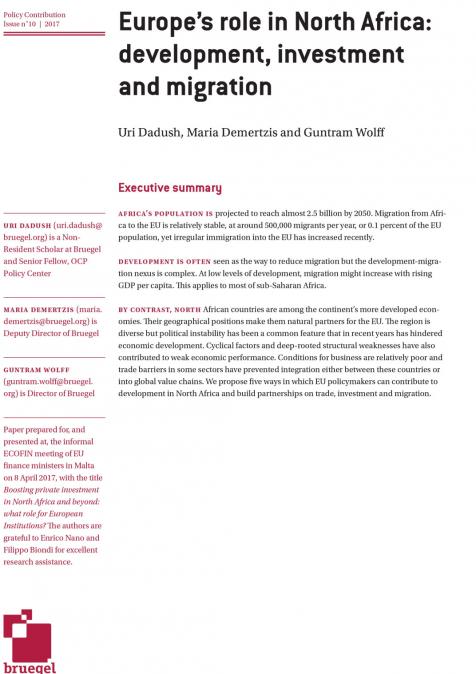
Europe’s role in North Africa: development, investment and migration
Authors
Maria Demertzis
Guntram Wolff
May 2, 2017

Africa’s population is projected to reach almost 2.5 billion by 2050. Migration from Africa to the EU is relatively stable, at around 500,000 migrants per year, or 0.1 percent of the EU population, yet irregular immigration into the EU has increased recently.

Development is often seen as the way to reduce migration but the development-migration nexus is complex. At low levels of development, migration might increase with rising GDP per capita. This applies to most of sub-Saharan Africa.
By contrast, North African countries are among the continent’s more developed economies. Their geographical positions make them natural partners for the EU. The region is diverse but political instability has been a common feature that in recent years has hindered economic development. Cyclical factors and deep-rooted structural weaknesses have also contributed to weak economic performance. Conditions for business are relatively poor and trade barriers in some sectors have prevented integration either between these countries or into global value chains. We propose five ways in which EU policymakers can contribute to development in North Africa and build partnerships on trade, investment and migration.
RELATED CONTENT

  • Authors
    August 6, 2026
    With America's 250th anniversary, there will be many analyses of the country's history from domestic and international perspectives. But the meaning of the American story should also be assessed in key regional settings, from Asia to Latin America, and in transatlantic terms. In this vein, it is worth exploring the U.S. engagement in and with the Mediterranean world, one of the first places of U.S. international activism, and a setting where diverse aspects of U.S. foreign policy ha ...
  • Authors
    July 27, 2026
    Is Europe Prepared for War?European public opinion is moving from treating a major conflict as unthinkable to regarding it as a possibility for which governments must prepare. Attention is increasingly focused on Russian hybrid operations, vulnerabilities in critical infrastructure and the risk of fragmentation within NATO. European defence policy is consequently undergoing a rapid transition from post-Cold War complacency towards preparations for high-intensity warfare. Recent ...
  • Authors
    July 15, 2026
    We Are Watching You In April 2026, the UK Ministry of Defence revealed that it had tracked a covert Russian submarine operation apparently intended to map critical undersea cables and pipelines in the North Atlantic and the North Sea. A Russian attack submarine and two specialised intelligence vessels operated by the Main Directorate of Deep-Sea Research, commonly known as GUGI, were reportedly monitored for four weeks by the Royal Navy, including HMS St Albans and P-8 Poseidon ...
  • Authors
    April 10, 2026
    On February 10, 2026, the European Parliament endorsed an asylum reform that expands the use of the ‘safe third country’ concept and introduces a common European Union list of ‘safe countries of origin’. This reform represents more than a technical adjustment of asylum procedures, as it signals a structural reorientation of EU asylum governance toward faster filtering of claims and greater reliance on external actors.The concept of a safe third country already exists in European asy ...
  • February 18, 2026
    Following Donald Trump’s statements asserting that the United States should acquire Greenland, fundamental questions about sovereignty, alliances, and the authority of international law have resurfaced. The Greenland case reveals the tensions between security imperatives, alliance cohes...
  • February 13, 2026
    Le général Olivier Tramond analyse la réduction de la présence militaire française en Afrique comme un changement stratégique profond plutôt qu’un renoncement. Au-delà des coups d’État et ...
  • Authors
    February 13, 2026
    On January 27, 2026, the Spanish government adopted a Royal Decree for the extraordinary regularization of persons in an irregular administrative situation or involved in an international protection procedure. The choice of a royal decree allows for the rapid implementation of the measure, without the need for parliamentary debate, in a political context that is highly polarized on migration issues.Regularization applies to people who can prove their presence on Spanish territory be ...