Publications /
Opinion
This Opinion was originally published by the Hanns Seidel Stiftung on January 19th, 2026.
The author of this opinion, Gabriela Keseberg Dávalos, is a 2013 alumna of the Atlantic Dialogues Emerging Leaders Program.
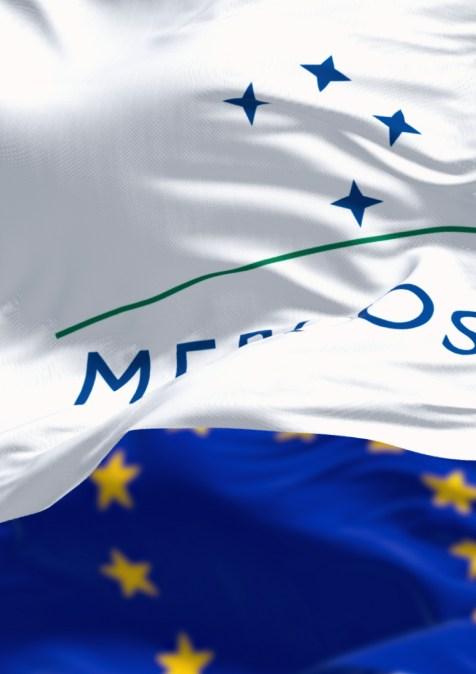
The signing of the EU–Mercosur agreement is a small geopolitical miracle. Signed on 17 January 2026 in Paraguay, it arrives at a moment when Europe is unmistakably being cast aside by the United States. Meanwhile Latin America, and with it, the Mercosur countries (Brazil, Argentina, Uruguay, Paraguay and Bolivia), is being rediscovered by the same superpower.
Why this was never really just about trade
When negotiations began 25 years ago, the world looked very different. Diplomats could afford to argue over quotas, environmental clauses, and regulatory detail. That world is gone. Today, Europe finds itself squeezed between an assertive China and a United States that has formally redefined its global commitments. The EU needs to demonstrate that its much-invoked “strategic autonomy” can translate into action. Mercosur needs to show it has options. The timing is not just aligned, it is crucial.
The deal, signed by European Commission President Ursula von der Leyen and the Foreign Ministers of the Mercosur states, is now the world’s largest trade agreement, covering 31 countries and nearly 800 million people. Trade in goods already exceeds €110 billion annually, and EU projections show that ratification could raise EU exports to Mercosur by up to €49 billion a year. Mercosur’s gains, by contrast, are more limited and sector-specific. They largely concentrate in Brazilian agriculture and commodity exports.
Yet viewing the deal through a purely commercial lens misses the point. Its real value lies in geopolitics. For Europe, it signals that the EU can still negotiate, and deliver; even if slowly. For Mercosur, the agreement represents recognition of agency. Instead of choosing between China’s purchasing power and Washington’s attention, the bloc gains a third pillar: Europe’s market and political stability. The triangulation increases both regions’ bargaining power and cushions them against external shocks. A production slowdown in China, a sudden U.S. policy swing, or renewed tariff threats, could become less dangerous.
From rhetoric to responsibility
The weeks leading up to the signing have been difficult for European policymakers. If the warning was not already clear after U.S. Vice President JD Vance’s speech at the Munich Security Conference in February 2025, it soon became impossible to ignore. The U.S. National Security Strategy published this past December reinforced the message. Subsequent U.S. actions in the Western Hemisphere, particularly in Venezuela, removed any remaining doubt. Together, these signals confirmed that the transatlantic bond between Brussels and Washington has weakened.
“Weak”, and even “decaying”, that is how Donald Trump described Europe in an interview. Unfortunately, the suspense surrounding the agreement’s final stretch only reinforced that judgment. A prolonged back-and-forth among EU member states and EU institutions strained Mercosur’s patience. It also exposed the increasingly nationalist reflexes shaping European politics. Domestic concerns have always driven foreign policy, but the inward turn of some EU countries, amplified by far-right movements, is making the adaptation to the new global order far more difficult than needed.
As European Commission President Ursula von der Leyen said at the 2023 summit between the EU and the Community of Latin American and Caribbean States (CELAC), “like-minded friends like the EU and Latin American and Caribbean partners need to get closer.” But, despite shared democratic values and institutional traditions, the relationship between both regions long remained superficial. Europe maintained cordial ties, but high-level visits were rare. Political attention was sporadic. The EU-CELAC summit last November illustrated this neglect: senior European leaders did not attend. While the EU’s Global Gateway committed around €80 billion to Sub-Saharan Africa, it invests only €31 billion across all of Latin America. Although familiar and friendly, the region was treated as strategically marginal. It was left largely to China and the United States.
That era is ending. Europe has learned the cost of overdependence on a narrow set of suppliers for energy, critical and raw materials. Combined with growing insecurity caused by the fading international order, the need for reliable partners in trade and multilateral forums has become severe. Europe needs new, like-minded allies.
Paraguay’s President Santiago Peña accurately captured this shift. He called the agreement “more than just a commercial alliance.” Mercosur countries are equally eager to diversify. They face China’s overwhelming trade dominance, U.S. assertiveness, and economic stagnation. For Brazil in particular, the bloc’s economic heavyweight, this agreement offers more than market access. It offers diplomatic leverage. It proves that Latin America can anchor relations with Europe on its own terms, rather than as a bystander in great-power competition. Both sides suddenly need what the other can offer: balance, resources, stability. And, most importantly, political room to maneuver.
“Strategic autonomy”, finally tested
Signing the agreement is the “easy” part. Implementation will require sustained political discipline.
If Europe delivers, it will prove that “strategic autonomy” is more than a slogan. If Mercosur delivers, it will signal cohesion, credibility, and readiness for further agreements. The stakes are high. The deal affects roughly 10% of the world’s population.
The EU–Mercosur agreement gives both sides more room to operate in an increasingly fragmented world. But that scope could vanish quickly. If implementation stalls or becomes hostage to domestic politics and overstressed conditions, Mercosur would lose an opportunity, but Europe would lose credibility. It would confirm the narrative that the EU can talk endlessly about autonomy, partnership, and strategy, yet still fails to act when it matters.
If the deal succeeds, then January 17, 2026 will go down in history as a rare turning point – one in which two world regions chose cooperation over estrangement.