Publications /
Policy Brief

Back
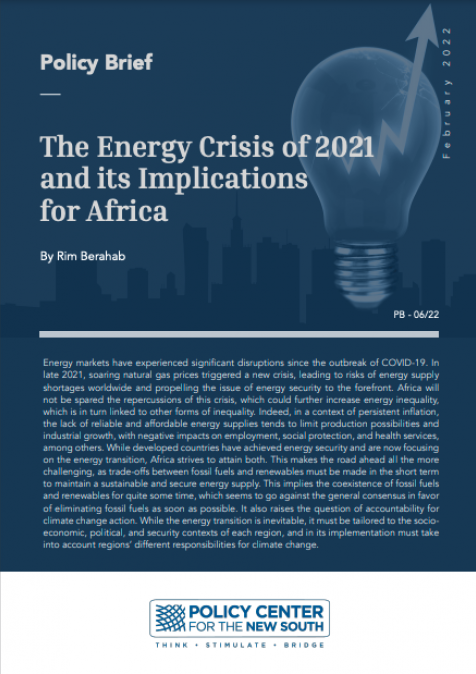
The Energy Crisis of 2021 and its Implications for Africa
Authors
February 9, 2022

Energy markets have experienced significant disruptions since the outbreak of COVID-19. In late 2021, soaring natural gas prices triggered a new crisis, leading to risks of energy supply shortages worldwide and propelling the issue of energy security to the forefront. Africa will not be spared the repercussions of this crisis, which could further increase energy inequality, which is in turn linked to other forms of inequality. Indeed, in a context of persistent inflation, the lack of reliable and affordable energy supplies tends to limit production possibilities and industrial growth, with negative impacts on employment, social protection, and health services, among others. While developed countries have achieved energy security and are now focusing on the energy transition, Africa strives to attain both. This makes the road ahead all the more challenging, as trade-offs between fossil fuels and renewables must be made in the short term to maintain a sustainable and secure energy supply. This implies the coexistence of fossil fuels and renewables for quite some time, which seems to go against the general consensus in favor of eliminating fossil fuels as soon as possible. It also raises the question of accountability for climate change action. While the energy transition is inevitable, it must be tailored to the socio- economic, political, and security contexts of each region, and in its implementation must take into account regions’ different responsibilities for climate change.

RELATED CONTENT

  • Authors
    Ali Elguellab
    Elhadj Ezzahid
    November 1, 2023
    The role of the production network in shock propagation has been an issue of considerable interest since the Great Recession. However, the empirical literature has only focused on advanced and emerging countries. This paper aims to contribute to filling this gap by examining the case of Morocco, a developing country belonging to the lower-middle-income group. The question is whether its production network is a factor in amplifying idiosyncratic industry-level shocks or, conversely, ...
  • Authors
    Jean Louis-Sarbib
    October 18, 2023
    Addressing inequalities in all their forms has emerged as one of the major global challenges faced by numerous countries across the globe, particularly in Africa. In a context where Africa faces many pressing challenges that are the subject of much analysis (Sarbib et al. 2022), there is a clear gap in conducting comprehensive reviews focused on inequalities, partly due to the lack of available data. Inequalities, which are both consequences and partial causes of poor development o ...
  • Authors
    Sous la direction de
    September 21, 2023
    Cette édition du Rapport économique de l’Afrique est construite autour d’une thématique d’une grande actualité : les conséquences des incertitudes et des risques aussi bien sanitaires que climatiques et sécuritaires sur les économies du continent. L’exercice est d’autant plus légitime que la recomposition de l’ordre mondial questionne la place du continent à l’échelle planétaire, sur les plans économique, social et environnemental. L’économie mondiale est confrontée à des défis glo ...
  • August 28, 2023
    Le secteur informel joue un rôle crucial dans le développement économique et social du Maroc en tant que filet de sécurité pour de nombreux travailleurs. Cependant, sa concentration dans de petites entreprises qui manquent de moyens de production sophistiqués peut entraver la croissance...
  • Authors
    August 17, 2023
    Défis et opportunités économiques en Afrique : Renforcer la stabilité financière pour un développement durable L’Afrique est un continent qui connaît de nombreux défis économiques et sociaux, mais aussi de grandes opportunités de développement. Pour réaliser son potentiel, le continent a besoin de renforcer sa stabilité financière, c’est-à-dire sa capacité à faire face aux chocs internes et externes qui peuvent affecter sa croissance et son développement. (Figure 1) La stabilité f ...
  • July 20, 2023
    Artificial intelligence (AI) is playing an increasingly important role in our daily lives. Having experienced considerable growth in recent years, artificial intelligence corresponds to technologies capable of processing hybrid sources, particularly unstructured data. Complex tasks are thus delegated to increasingly autonomous technological processes, capable of driving economic and social development. In current African society, AI is becoming more popular and seeking to cover all ...