Publications /
Policy Brief

Back
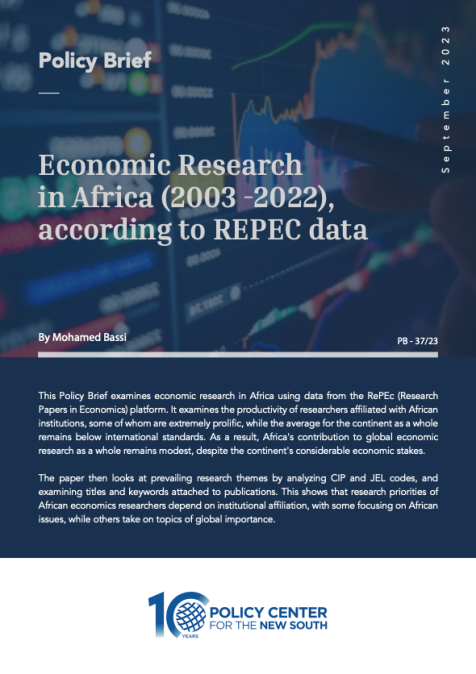
Economic Research in Africa (2003 -2022), according to REPEC data
Authors
Mohamed Bassi
September 21, 2023

This Policy Brief examines economic research in Africa using data from the RePEc (Research Papers in Economics) platform. It examines the productivity of researchers affiliated with African institutions, some of whom are extremely prolific, while the average for the continent as a whole remains below international standards. As a result, Africa's contribution to global economic research as a whole remains modest, despite the continent's considerable economic stakes.

The paper then looks at prevailing research themes by analyzing CIP and JEL codes, and examining titles and keywords attached to publications. This shows that research priorities of African economics researchers depend on institutional affiliation, with some focusing on African issues, while others take on topics of global importance.


RELATED CONTENT

  • Authors
    Marie-Noelle Nwokolo
    October 6, 2026
    The author of this opinion, Marie-Noelle Nwokolo, is a 2024 alumna of the Atlantic Dialogues Emerging Leaders Program.In September 1978, delegations from 138 countries gathered in Buenos Aires, Argentina, around a powerful idea: developing countries had knowledge, experience and capabilities worth sharing with one another. The Buenos Aires Plan of Action gave institutional form to what we now call South-South Cooperation, part of a wider post-colonial effort by developing ...
  • Authors
    October 2, 2026
    Le Cameroun dispose d'importants gisements de minerais, notamment de fer, de la bauxite, d'or, de cobalt, de nickel, de manganèse, de calcaire, de marbre, de diamants, entre autres. L'industrie minière du pays est restée dominée par l'exploitation artisanale et à petite échelle, en particulier l'orpaillage, tandis que les hydrocarbures ont représenté l'essentiel des recettes issues des industries extractives. Le pays cristallise ainsi le paradoxe africain : malgré l’ampleur et la di ...
  • September 28, 2026
    This paper was initially published in French on the website of the Fondation Jean-Jaurès. There was a historic decline in Official Development Assistance (ODA) in 2025. Foreign aid to developing countries from members of the OECD-DAC fell by some 23%, the largest decline on record and the second consecutive annual decline. Aid to Africa fell by more than 25%. The International Monetary Fund (IMF) described this decline in ODA to Africa as “a shock like no other.” It differ ...
  • September 25, 2026
    Dans cet épisode d’Africafé, Amadou Diop analyse les défis de sécurité maritime auxquels font face les pays de l’Afrique atlantique, de la piraterie aux trafics transfrontaliers. Il souligne la nécessité de mutualiser les moyens et de partager l’information entre États. L’échange aborde...
  • Authors
    Luladay Berhanu Mengistie
    Guillaume Gérout Suominen
    September 21, 2026
    The African Union Summit of February 2026 instructed the African Continental Free Trade Area (AfCFTA) Council of Ministers to negotiate a Protocol on Industrial Policy and Development. This work, handled without adequate preparation, is likely to reproduce the weaknesses it is meant to remedy. This paper is a conceptual mapping exercise, written to raise the preparatory questions before drafting begins, rather than to prescribe outcomes.It proceeds in five sections:1. It works towar ...
  • September 11, 2026
    Since the early 2000s, the Moroccan labour market has experienced continuous educational expansion that has not been matched by an equivalent transformation of the economy's productive structure, giving rise to situations of vertical mismatch between employed workers' education levels and the requirements of the jobs they hold. This study analyzes the determinants of overeducation and undereducation using anonymized microdata from the 2014 General Population and Housing Census (RGPH ...
  • September 11, 2026
    Le marché du travail marocain connaît, depuis les années 2000, une expansion continue de la scolarisation qui ne s'est pas accompagnée d'une transformation équivalente de la structure productive de l'économie, ouvrant la voie à des situations d'inadéquation verticale entre le niveau de formation des actifs occupés et les exigences des emplois qu'ils occupent. La présente étude analyse les déterminants du déclassement (sur-éducation) et du surclassement (sous- éducation) à partir des ...