Publications /
Paper in Academic Journals

Back
Does aid stimulate foreign direct investment? The role of social cohesion
Authors
Tony Addison
August 24, 2020

We explore the effects of foreign aid on FDI in a large number of aid-recipient countries using data for the period 1985-2008 and focusing in particular on the impact of the interplay of aid and social cohesion. The preliminary results suggest that the independent effect of aid on FDI is negative in sub-Saharan Africa (SSA) and Latin America (LAC) and positive in other regions, while aid seems to crowd out FDI in countries with high levels of human capital. In addition, we find that the interplay of aid and social cohesion in SSA and LAC has an inverted-U relationship with FDI, suggesting diminishing returns to social cohesion in these two regions

RELATED CONTENT

  • June 15, 2026
    Cette interview revient sur le rôle structurant des infrastructures portuaires dans l’industrialisation du Maroc, à travers l’exemple de Tanger Med. Elle souligne aussi l’importance de la digitalisation, de la formation et de la connexion des régions intérieures pour renforcer la compét...
  • Authors
    June 8, 2026
    The energy shock caused by the war between the United States and Israel and Iran has highlighted the need for Africa to refine more of its own crude oil. Africa is a net hydrocarbon exporter, but remains stuck in the old colonial economic model: it mostly exports raw materials and imports refined products. Africa exports about 2.6 billion barrels of crude oil every year, and imports about 1.4 billion barrels of refined products. This is a problem for two reasons. First, Africa ...
  • May 29, 2026
    This Paper was originally published on tandfonline.com This paper examines how reductions in transportation costs reshape regional economic and environmental outcomes in Morocco. We simulate a reduction in delivered (purchasers’) costs via a transport-margin efficiency improvement – implemented as a margin-saving technical change in the transport sector – within a province-level Spatial Computable General Equilibrium (SCGE) framework. Simulating a 1% decline in transport costs, ...
  • Authors
    January 27, 2026
    This paper revisits Big Push industrialization theory in the context of open economies deeply integrated into global value chains (GVCs). While classical Big Push models emphasize demand complementarities and coordination failures in largely closed economies, many middle-income countries now industrialize through foreign-owned, import-intensive production networks. We develop an extended Big Push framework that incorporates GVC integration and import leakage, and show how these feat ...
  • Authors
    Arkebe Oqubay
    November 17, 2025
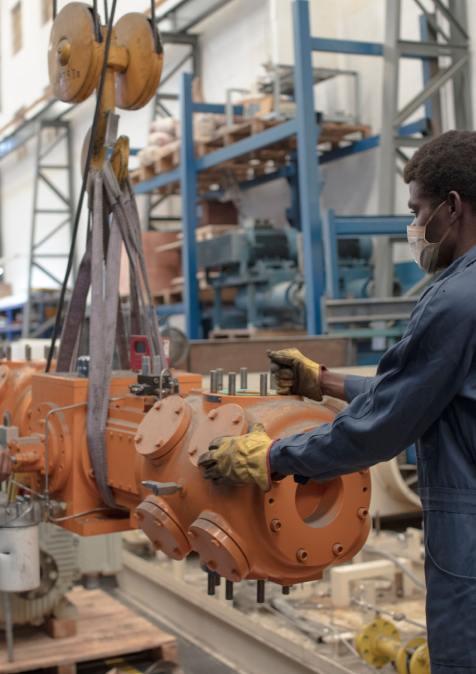
    Morocco has emerged as one of Africa's success stories, achieving significant progress in economic transformation and the green transition over the past 25 years. Continuing and deepening this transformation is essential to reach the country’s goal of becoming a high-income economy in the coming decades. Significant challenges include managing the risk of the middle-income trap, addressing demographic pressures, promoting inclusive growth, ensuring environmental sustainability, and ...
  • October 3, 2025
    In this episode, we explore Africa’s industrial challenges and opportunities, showing how AfCFTA-driven integration, green sectors, and inclusive policies for women, youth, and SMEs can foster sustainable growth, resilience, and domestic value capture. ...
  • July 11, 2025
    In this episode, we discuss whether Africa’s sub-regions foster unity or deepen divides, examine how they handle political crises, and consider the impact of global powers on regional dynamics. We explore what’s needed for stronger cooperation and how Africa can preserve its diversity w...