Publications /
Policy Paper

Back
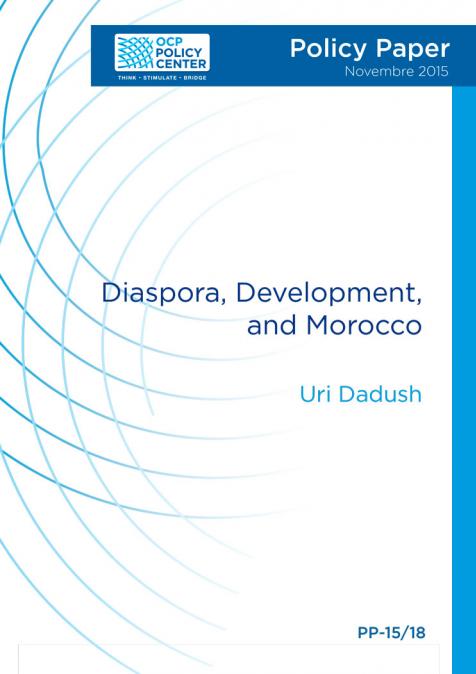
Diaspora, Development and Morocco
Authors
November 25, 2015

The contribution that the diaspora makes to development in the country of origin is examined. Drawing on a recent World Bank survey of migrants from the MENA countries, the needs of the diaspora and the development role it can play through its organizations are reviewed. A constructive interaction with the diaspora can be greatly enhanced by supportive policies in the country of origin. The main focus of the paper is on the Middle East and North African region, and more specifically on Morocco and how it compares with other world regions where migration plays an important role. The best possible outcome for the migrants’ countries of origin would be reforms that accelerate growth and foster job creation. However, even the best designed and most assiduously implemented reforms will not yield results quickly enough for the young and burgeoning population. That is why policies that forge stronger links with the diaspora and facilitate emigration of those that cannot find good jobs at home can make sense as part of a broader development strategy. Many of today’s high income countries, such as Ireland, Italy, and Swedenwere once countries of very high emigration.

RELATED CONTENT

  • June 4, 2026
    Cet épisode revient sur les principaux enseignements du chapitre consacré au secteur extérieur marocain, en mettant en lumière le paradoxe d’un déficit commercial structurel persistant combiné à une forte résilience des équilibres externes. Badr Mandry explique comment les transferts de...
  • June 1, 2026
    Cette interview met en lumière le rôle central du secteur textile et de l’habillement dans l’économie marocaine, tant en matière d’emploi que d’exportations. Notre économiste, Mr. Fahd Azeroual revient sur son évolution historique, ses principaux défis, notamment la dépendance aux impor...
  • Authors
    May 22, 2026
    This paper, the fourth in a research series on services-led growth in the Global South, examines Egypt’s potential for growth and economic transformation through the integration of services into Global Value Chains (GVCs). It employs a new taxonomy that classifies services into Knowledge Services (KS), Enabling Services (ES), and Local Services (LS) and applies OECD 2025 Trade in Value-Added (TiVA), Trade in Employment (TiM), and input-output databases to benchmark Egypt against Mor ...
  • Authors
    May 15, 2026
    This paper is the third in a series of country and comparative studies that together comprise a research program on services as drivers of economic growth and structural transformation in the Global South. The paper analyzes the pattern of Tunisia's services-led economic growth from 2012- 2022 using a specialized three-category framework: knowledge services (KS), enabling services (ES), and local services (LS). Using data from the OECD Trade in Value Added (TiVA), Trade in Employmen ...
  • Authors
    April 20, 2026
    This paper was published as a book chapter in “The Economic Potential of Islamic Countries, Part B: Sustainability, Governance, Energy and Digital Transformation,” released by Emerald Publishing. The COVID-19 pandemic exposed significant deficiencies within social protection systems worldwide, especially in Middle Eastern and North African (MENA) countries. This underscores the urgent need to fortify these social protection schemes to ensure resilience in the face of crises (Sa ...
  • Authors
    March 12, 2026
    Historically, manufacturing has served as the primary pathway to economic development, offering strong scale economies, learning-by-doing effects, and the capacity to generate the foreign exchange necessary to import capital goods and technology. However, advances in robotization and artificial intelligence (AI) are fundamentally undermining manufacturing’s traditional role, making it increasingly skill- and capital-intensive while limiting its ability to absorb labor. Thi ...
  • Authors
    January 23, 2026
    Introduction: COP30 as a Test of Reality, Not AmbitionCOP30 in Belém was never going to be a breakthrough. In a world marked by fiscal exhaustion, geopolitical rivalry, and eroding trust in multilateralism, expecting transformational climate cooperation bordered on denial. The choice of the Amazon as host carried symbolic weight, but symbolism does not override power, interests, or institutional capacity.The outcome of COP30 confirms a deeper truth: the global climate regime has ent ...
  • Authors
    Zakaria Elouaourti
    August 7, 2025
    This paper was originally published on tandfonline.comYouth’s life paths have become increasingly challenging, especially for those classified as ‘Not in Education, Employment, or Training’ (NEET), who comprise 31.2% of North Africa’s youth population. This paper contributes to the growing discourse on the NEET phenomenon by exploring its structural and psychosocial dimensions in North Africa, with a specific focus on gender. Using a rich micro-level dataset of 7,815 individuals age ...
  • February 10, 2025
    Depuis 1956, l’économie égyptienne est en crise. Durant la période entre 1956 et 2024, elle a connu douze dévaluations et huit crises majeures de sa balance des paiements. Avec un déficit récurrent de sa balance courante, le pays est exposé au plus grand des risques : le risque souverain. Ce qui est une première faiblesse. Mais ce pays, qui a toujours réussi à s’épargner ce risque, témoigne aussi de certaines forces, ce qui constitue sa première force. De ce constat est ...