Publications /
Policy Brief
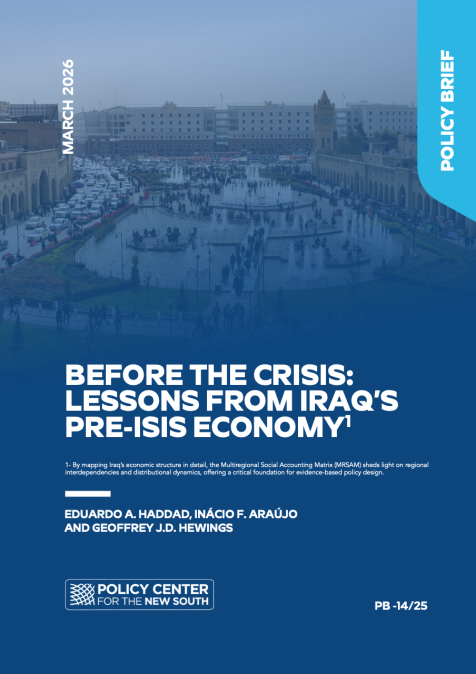
By mapping Iraq’s economic structure in detail, the Multiregional Social Accounting Matrix (MRSAM) sheds light on regional interdependencies and distributional dynamics, offering a critical foundation for evidence-based policy design.
Key Messages
Iraq is dependent on oil, but this dependence is felt unevenly. In 2013, oil accounted for nearly half of GDP, over 90% of exports, and almost all fiscal revenues, but less than 2% of jobs; benefits from oil were concentrated in Basra and Baghdad, and among wealthier households.
Regional disparities are deep-rooted. The MRSAM shows that most governorates rely heavily on spillovers from Baghdad and Basra, with weak local absorptive capacity to translate income into growth.
Distributional effects are regressive. Oil revenues primarily benefit capital owners and high-income households, leaving poorer households and labor with marginal gains, unless supported by redistributive policies.
Policy action is critical. Iraq must use oil wealth to diversify its economy, build local capacity, strengthen social protection, and manage spatial inequalities. These challenges are technical but also deeply political.
1. Introduction
Iraq’s economy is among the most oil-dependent in the world. Hydrocarbons account for more than 90% of export earnings and nearly all government revenues. This dependence is not new, but it has deepened over the past two decades as production capacity has expanded and global oil prices have been very volatile. Since 2003, following the fall of the regime of Saddam Hussein, Iraq’s oil industry has undergone major transformations: international oil companies re-entered the sector, production rose from under 2 million barrels per day in the early 2000s to more than 4.5 million barrels per day by 2019, and export infrastructure centered on Basra became the lifeline of the national economy.
Yet this oil-based growth has brought heightened vulnerability. The oil price collapse of 2014-2017 and the simultaneous ISIS crisis exposed Iraq’s structural fragility, severely straining public finances and disrupting production across several governorates (Araujo et al, 2026). The combined shocks forced deep budget cuts and revealed the narrowness of Iraq’s economic base. Meanwhile, regional disparities deepened: Basra, the source of nearly half of Iraq’s exports, captured only part of the wealth it generated, while Baghdad consolidated its role as the country’s fiscal and administrative hub. Oil revenues largely bypassed local development needs, reinforcing perceptions of inequity, and fueling political discontent across regions.
The construction of the Multiregional Social Accounting Matrix (MRSAM)[SG1] [EH2] offers an insight into these dynamics. Anchored in 2013, just before the ISIS conflict and the oil price downturn, the MRSAM captured Iraq’s economic structure at a pivotal moment: oil production was at historic highs, state revenues were booming, and the vulnerabilities of dependence had yet to be fully exposed. This makes the framework both a technical tool for modeling and a vital baseline for understanding the trajectory of Iraq’s oil-driven economy, and for identifying lessons that remain relevant today.
2. Structural Insights From The MRSAM
The MRSAM for Iraq (Haddad et al, 2026) provides a detailed view over how the country’s oil dependence has translated into regional dynamics and household welfare. Three sets of findings stand out: the diffusion of oil shocks, Baghdad’s central role in the economy, and the unequal distributional consequences of oil revenues. Together, they illustrate the structural strengths and weaknesses of Iraq’s pre-crisis economy.
Oil Shocks and Spillovers
The simulation using the MRSAM of an increase in oil exports from Basra[SG3] [EH4] , Iraq’s principal exporting governorate, provides a striking contrast between two analytical perspectives. In a conventional interregional input-output (IIO) framework, almost all of the impact from the increase remains localized in Basra, with little evidence of transmission to the rest of the economy. This narrow view reinforces the perception of Basra as both the source and beneficiary of Iraq’s oil wealth.
However, when household income and expenditure linkages are introduced through the full MRSAM framework, the picture changes considerably. The accounting multipliers show that oil revenues do not remain confined to Basra. Baghdad, Sulaymaniyah, Nineveh, and Erbil emerge as meaningful secondary beneficiaries. The reason is straightforward but crucial for policy: once households receive additional income, their spending triggers demand for a wide range of goods and services, which in turn stimulates activity in other governorates. In other words, the diffusion of oil wealth operates primarily through consumption channels, rather than direct production linkages. This insight emphasizes the importance of taking into account distributional impacts on household demand in any strategy to broaden the benefits from oil exports.
Baghdad as the Economic Hub
A second main insight from the MRSAM relates to Baghdad’s role in Iraq’s economic geography. Analyzing average MRSAM output multipliers across sectors reveals a polarized structure: most governorates rely heavily on interregional spillovers to capture growth, while Baghdad exhibits a more balanced pattern, with relatively strong local and external linkages. This unique position reflects Baghdad’s concentration of population, government functions, service industries, and demand from higher-income households.
Consequently, Baghdad functions as the core node in Iraq’s economy, mediating flows between oil revenues, household consumption, and production across the country. While this centrality strengthens national integration, it also creates vulnerabilities. Over-reliance on Baghdad as the principal hub could lead to inequalities being amplified, as regions that lack strong internal absorptive capacity depend disproportionately on the capital to access the benefits of oil rents. This finding echoes broader concerns about the concentration of political and economic power in Baghdad. It points to the need for strategies that strengthen regional economies without undermining national cohesion. These tensions have surfaced periodically in political debates, most visibly during the 2019-2021 protests in Basra, when demands for greater administrative and budgetary autonomy reflected widespread frustration over the central government’s control of oil revenues, and the limited reinvestment of local wealth.
Unequal Distributional Outcomes
The third major insight relates to how oil revenues are distributed across households and institutions. The decomposition of the accounting multiplier reveals a highly skewed pattern: capital, corporates (particularly public enterprises), and high-income households capture the largest gains from oil export shocks. By contrast, labor and low-income households see only marginal improvements. For example, the top income decile secures more than four times the benefits accruing to all bottom deciles combined.
This inequality is structural, not incidental. It reflects both asset distribution in Iraq, with wealth concentrated in a narrow segment of the population, and the design of fiscal mechanisms. These channel oil rents primarily through government spending and corporate accounts. Without robust redistributive policies, the multiplier effects of oil revenues tend to reinforce existing disparities, rather than mitigate them. In this sense, the MRSAM not only quantifies Iraq’s dependence on oil, but also exposes its regressive consequences, with oil wealth fueling growth without delivering broad-based welfare improvements.
Bringing the Insights Together
Taken together, these findings highlight the paradox of Iraq’s oil economy. Oil wealth can generate wide spillovers, but the actual transmission is shaped by the structure of household demand and the centrality of Baghdad. The distributional analysis makes clear that growth is not synonymous with equity: oil rents have historically amplified inequality, leaving large parts of the population and most governorates dependent on indirect and uncertain channels of benefit. By situating these dynamics in 2013, the MRSAM offers both a snapshot of Iraq’s pre-crisis economy and a framework for diagnosing the enduring challenges of oil dependence, regional polarization, and inequality.[SG5] [EH6]
3. Policy Implications
The results of the MRSAM analysis offer important lessons for Iraq’s economic strategy. They highlight both the opportunities that could arise from leveraging oil wealth more effectively, and the risks of continuing along a path of uneven and fragile development. Four policy areas stand out: strengthening local absorptive capacity, diversifying beyond oil, addressing inequality, and managing Baghdad’s central role.
Strengthening Local Absorptive Capacity
One of the most striking findings from the simulations is the limited extent to which oil revenues stimulate local economies beyond Basra and Baghdad. In most governorates, the multipliers show that growth effects depend heavily on interregional spillovers rather than internal linkages. This suggests that when new income flows into a governorate, much of the demand is met by goods and services produced elsewhere.
To change this pattern, Iraq must invest in the absorptive capacity of local economies. This means targeted infrastructure investment, from transport networks that connect rural areas to urban markets, to reliable electricity that supports small and medium enterprises (SMEs). It also requires human capital investments in education, skills training, and vocational programs, to ensure that local labor can respond to new demand. By strengthening supply capacity within governorates, Iraq can capture greater shares of the multiplier effects locally, reducing dependence on Baghdad and Basra as conduits of growth.
Diversification Beyond Oil
While oil will remain the cornerstone of Iraq’s economy for the foreseeable future, the MRSAM analysis confirms the dangers of excessive dependence. The 2013 baseline described a structure in which oil accounted for nearly half of GDP, over 90% of government revenues, and almost all exports, but less than 2% of employment. This imbalance leaves Iraq extremely vulnerable to oil price volatility, and perpetuates a growth model that creates few jobs.
Diversification strategies should focus on non-oil tradable sectors, particularly manufacturing and agriculture, which can absorb labor and generate spillovers across regions. Service industries (e.g. logistics, communications, finance, and tourism) also offer potential, especially in urban centers with stronger human-capital bases. By using oil revenues strategically to support these sectors, Iraq can build buffers against global price shocks, and embark on a more inclusive and resilient development path.
Addressing Inequality Directly
The decomposition of the accounting multiplier reveals that the gains from Iraq’s oil exports are distributed very unevenly. Capital owners, public enterprises, and high-income households capture the greatest shares, while lower-income households and laborers benefit only marginally. This pattern confirms that, without deliberate intervention, oil rents reinforce inequality.
Policies must therefore go beyond general growth strategies to address inequality directly. Expanding social-protection systems through targeted cash transfers, food security programs, and universal access to health and education, can redistribute oil wealth more fairly. Support for SMEs is equally important, as these businesses provide employment and generate income at community level. Fiscal reforms to strengthen non-oil tax bases could also make government revenues more sustainable and less regressive. Without such measures, the multiplier effects of oil revenues will continue to bypass the poorest households, exacerbating social and political tensions.
Managing Baghdad’s Central Role
Finally, the MRSAM results highlight the polarized structure of Iraq’s economy, with Baghdad functioning as the central hub. The capital’s strong internal linkages and diversified economy enable it to absorb and redistribute shocks more effectively than other governorates. However, this centrality also creates risks: over-dependence on Baghdad reinforces spatial inequalities, leaving peripheral regions vulnerable and politically marginalized.
Policymakers must strike a balance between acknowledging Baghdad’s dominant role and promoting a more balanced regional-development strategy. Strengthening regional linkages (e.g. by developing secondary hubs in Erbil, Basra, and Sulaymaniyah) can reduce pressure on Baghdad, while fostering broader integration. Decentralization of fiscal resources, coupled with accountability mechanisms, would empower governorates to shape their own development priorities, while maintaining national cohesion.
Bringing the Policy Implications Together
The MRSAM provides a clear message: Iraq cannot rely solely on oil rents and the centrality of Baghdad to sustain inclusive growth. The country must strengthen the absorptive capacity of local economies, invest in diversification, adopt redistributive policies to tackle inequality, and manage its spatial polarization more deliberately. Doing so will not be easy, particularly in a context still shaped by conflict, fiscal pressures, and political fragmentation. But the baseline insights from 2013 suggest that these challenges are structural, not temporary. Addressing them is essential if Iraq is to convert its resource wealth into long-term prosperity for all its citizens.
4. Conclusion
The construction and application of the Multiregional Social Accounting Matrix (MRSAM) for Iraq marks a significant step forward in understanding the country’s economic structure. For the first time, it has been possible to trace how an oil shock originating in Basra reverberated across regions and households, revealing both the opportunities for national spillovers and the entrenched inequality in their distribution. The analysis reveals three enduring features of Iraq’s economy: the overwhelming dependence on oil, the polarizing centrality of Baghdad, and the regressive distribution of income gains. These findings remain highly relevant today, even though the MRSAM is benchmarked to 2013, just before the ISIS conflict and the collapse of global oil prices. In fact, the 2013 snapshot serves as both a baseline for assessing structural change and a diagnostic tool for identifying persistent vulnerabilities.
From a policy perspective, the MRSAM highlights the importance of strengthening local absorptive capacity, diversifying beyond oil, and tackling inequality directly. It also stresses the need to manage Iraq’s spatial polarization in a more targeted way by building up regional economies alongside Baghdad. Taken together, these lessons point toward a development strategy that leverages oil revenues to stimulate broad-based, regionally inclusive growth, not just to sustain fiscal balances.
Yet a note of caution is necessary. Iraq’s political economy has long posed formidable obstacles to reform. Deeply entrenched patronage networks, competition among elites, and persistent governance weaknesses complicate the implementation of policies that would redistribute oil rents more equitably, or that would decentralize development opportunities. In practice, measures such as fiscal transfers to governorates, investment in local infrastructure, or expansion of social protection systems are often constrained by political fragmentation and weak institutional capacity. Public mistrust in government, shaped by years of uneven service delivery and perceived inequities, poses an additional barrier to reform.
For these reasons, while the MRSAM provides a robust analytical foundation for designing forward-looking strategies, its insights must be interpreted with realism about Iraq’s political constraints. Technical solutions alone will not suffice; successful reform will require political will, institutional strengthening, and mechanisms to ensure that oil wealth is managed transparently and equitably. Only then can the structural lessons from the MRSAM be translated into durable improvements in economic resilience and inclusive development. Despite these challenges, the MRSAM equips Iraq with the analytical tools needed to plan a more resilient, diversified, and inclusive future, provided that its lessons are coupled with the political commitment to act on them.
References
Araújo, I. F., Donaghy, K. P., Haddad, E. A., & Hewings, G. J. D. (2026). Supply-chain propagation of local economic shocks: an interregional general equilibrium analysis of the ISIS conflict in Iraq. Economic Systems Research, 1–25. https://doi.org/10.1080/09535314.2025.2611259.
Haddad, E., Araujo, I., & Hewings, G. J. D. (2026). Constructing the Iraqi Multiregional Social Accounting Matrix (MRSAM). In K. Donaghy & A. Rose (Eds.), Modeling transportation logistics systems in post-conflict zones: promoting economic viability, resilience, and sustainability in Iraq. Springer.
[1] This brief summarizes the main finding presented in Haddad et al (2026).