Publications /
Policy Paper

Back
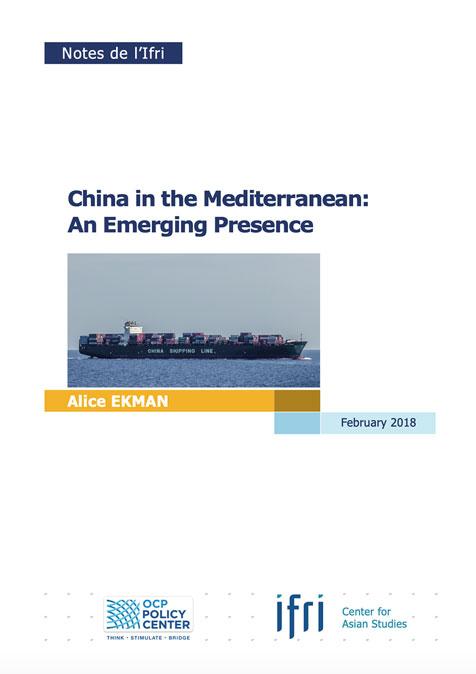
China in the Mediterranean : An Emerging Presence
Authors
Alice Ekman
February 22, 2018

The Chinese presence in the Mediterranean is raising new questions among the diplomatic services of the Maghreb countries, as well as those of southern Europe. Indeed, over the past five years, China has been translating its national priorities with increasing activism in the Mediterranean. This activism can be summarised into three main areas: creating China-Southern Europe sectoral cooperation forums, investments in transport, energy and telecommunications infrastructure, and conducting military exercises in the Mediterranean as part of the overall development of the Chinese maritime presence.

Admittedly, it is primarily in the East China Sea and the South China Sea, an area which encompasses several of the country’s so-called “core” interests, where China is concentrating its efforts and developing a strategy in the face of a US presence that Beijing considers as illegitimate. At this stage, it is difficult to identify a Chinese strategy which would apply to the whole Mediterranean region, while the Chinese institutions involved in the decision-making process continue to approach the region by sub-areas (southern Europe, northern Africa, etc.) However, the deployment of the Chinese maritime presence in the
Mediterranean already raises a number of economic questions: the port of Piraeus is becoming a major entry point for Chinese products in Europe, and Chinese investments in transport infrastructure are starting to affect the business of other traditional port and logistics hubs in the region (such
as Rotterdam, Antwerp or Hamburg).

The question of the long-term geopolitical consequences of current Chinese investments in the Mediterranean is also raised. More and more Mediterranean countries – particularly those benefiting from vast Chinese investments – could be inclined to support Chinese positions in the region and beyond – in the South China Sea for example, or to develop civilian and military maritime cooperation with Beijing.

At the same time, the new sub-regional forums promoted by China could potentially call into question the political framework defended by the European Union in some Mediterranean countries. While it has beenconducting an all-out investment policy since the Euro crisis – increasing investments in the countries most affected by the crisis, such as Greece – China no longer hesitates to emphasise Brussels’ weaknesses and to position itself as an alternative market to these countries. In the coming
years, it cannot be ruled out that Beijing will seek to more actively promote an alternative development and governance model, by positioning itself as an example, as it already does for a growing number of countries facing economic difficulties in Africa, Latin America or Southeast Asia. In the face of this activism, which is supported – among other Chinese initiatives – by training programmes for civil servants and engineers, and a communication strategy in the local language, some countries around the Mediterranean will more than ever be faced with fundamental questions, related to the choice of their economic model and a fortiori the choice of their political system.
RELATED CONTENT

  • February 18, 2026
    Following Donald Trump’s statements asserting that the United States should acquire Greenland, fundamental questions about sovereignty, alliances, and the authority of international law have resurfaced. The Greenland case reveals the tensions between security imperatives, alliance cohes...
  • Authors
    February 12, 2026
    Divergent regulatory regimes for data, driven by different motivations, ranging from privacy protection in the European Union to information control in China, could eventually produce distinctively different, and possibly contradictory, bodies of data. Artificial-intelligence models trained on those datasets could produce differing and possibly even conflicting outputs. To the extent that AI outputs start to shape human perception and to influence decisions, in governments and ...
  • January 30, 2026
    En 2019, Donald Trump a proposé d’acheter le Groenland, déclenchant un refus catégorique du Danemark et une tension diplomatique transatlantique. Cette initiative reflétait l’intérêt stratégique et économique des États-Unis pour l’Arctique et ses ressources. L’épisode a mis en lumière l...
  • Authors
    December 18, 2025
    The return of President Donald Trump to the White House at the start of 2025 was expected to signal an American retreat from international engagement, especially in regions of traditional security interest, such as southern Europe, North Africa, and the Middle East. To the surprise of many observers around the Mediterranean, and perhaps to the dismay of some in the Trump administration’s ideological orbit, this has not happened. If anything, the second half of 2025 has seen a high d ...
  • Authors
    December 16, 2025
    An unusual gesture indeed—the dictator, more often than not a recluse, withdrawn behind his fortress and protected by 1.2 million armed soldiers, finally admitted what had long been seen on the battlefield in Ukraine and by spy satellites far above. North Korean soldiers—possibly 12,000 of them—are fighting on front lines alongside Russian troops, and they are falling or being wounded; some 4,000 men so far, by current estimates.  ...
  • October 23, 2025
    Depuis plus de trente ans, les relations entre le Maroc et l’Union européenne (UE) se caractérisent par un équilibre entre pragmatisme politique, ouverture économique et convergence stratégique. Le processus de Barcelone de 1995 a marqué le début d’une coopération euro-méditerranéenne renforcée, consolidée par l’Accord du Statut avancé en 2008 et le Partenariat euro-marocain de prospérité partagée, faisant de l’UE le principal partenaire économique du Royaume. Dans un contexte régio ...
  • Authors
    Niagalé Bagayoko
    Eugène Berg
    Christophe Chabert
    Thierry Garcin
    Alain Oudot de Dainville
    Florent Parmentier
    Anne Sophie Raujol
    Hassan Saoudi
    October 23, 2025
    Prochainement disponible sur Livremoi & Amazon. Les Dialogues Stratégiques, fruit d'une collaboration entre le HEC Center for Geopolitics et le Policy Center for the New South, constituent une plateforme d'échanges biannuelle dédiée à l'analyse des grandes tendances mondiales et des problématiques régionalesqui lient l'Europe et l'Afrique. Réunissant praticiens, décideurs, universitaires et représentants desmédias, cet espace de réflexion permet de décoder les transfor ...
  • October 23, 2025
    The UN’s funding crisis, fueled by unpaid contributions and expanding mandates, is worsening as U.S. disengagement strains peacekeeping and development efforts, particularly in Africa. This shift also strengthens rivals like China and Russia and raises deeper questions about the legitim...