Publications /
Policy Paper

Back
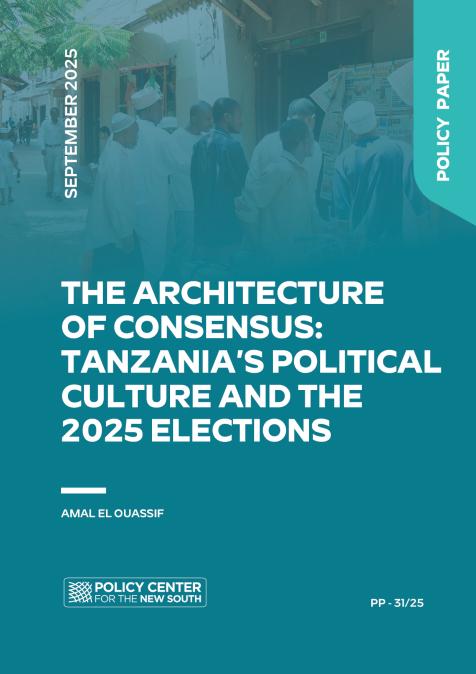
The Architecture of Consensus: Tanzania’s Political Culture and the 2025 Elections
Authors
September 15, 2025

The October 2025 general elections in Tanzania unfold within a political culture grounded in consensus and institutional continuity. President Samia Suluhu Hassan’s leadership has reopened political space by restoring elite dialogue, easing restrictions on rallies, and facilitating the return of exiled figures. Yet the exclusion of CHADEMA—the principal opposition party—highlights the enduring limits of pluralism. This paper analyzes the Tanzanian electoral process less as a conventional test of democratic competition than as a recalibration of consensus politics, where inclusion and exclusion are managed within a hegemonic framework shaped by the legacies of ujamaa and the dominance of Chama Cha Mapinduzi (CCM). Drawing on the works of Hyden and others, the analysis situates the 2025 elections within a historical continuum in which elections function as instruments of national affirmation and elite negotiation rather than mechanisms for alternation of power. The discussion develops along three interrelated dimensions: the persistence of elite accommodation within CCM, the bounded openness of civic and opposition space, and the symbolic but limited role of procedural pluralism. It argues that Samia’s leadership reflects a strategy of “negotiated legitimacy,” with reforms carefully calibrated to safeguard stability and international credibility while preserving the architecture of dominance. The conclusion reflects on the implications of this model for Tanzania’s future: while stability is maintained through consensus without contestation, growing demographic, social, and digital pressures may test the resilience of this political order beyond 2025.

RELATED CONTENT

  • Authors
    April 20, 2021
    The briefing document by Ambassador Dr. Len Ishmael created in collaboration with MDPD KAS reviews the process of the EU-OACPS negotiations, reviews the process of the EU-OACPS negotiations, with a view to providing insights on the following issues: - The challenges and bottlenecks in the process and those issues that have created tension. - The future roles of the African Union (AU) and #OACPS Secretariats in the EU-OACPS relationship, and in Africa’s relationship with the #EU. ...
  • April 09, 2021
    C’est dans un contexte marqué à la fois par la crise sanitaire liée à la pandémie de COVID-19 et par l’émergence de nouvelles menaces à la paix et à la sécurité du continent africain que ...
  • Authors
    March 24, 2021
    Tillabéri region of Niger is witnessing unprecedented level of ethnic-based violence. The January 2 massacre caught the national and international actors’ attention, however; the event was preventable. Accessing communities through ethnically charged and other exploitative language has proved to be a game changer for the expansion of violent extremist organizations (VEOs) expansion since 2012. The failure of national and international actors to recognize the seriousness of the situa ...
  • March 17, 2021
    Cette étude concerne la Communauté économique des Etats d'Afrique de l'Ouest (CEDEAO), rappelant, tout d'abord, leur diversité géographique, démographique et économique. Montrant ce que ces Etats ont en commun mais, aussi, ce qui les différencie. La CEDEAO, qui réunit quinze pays parmi les plus pauvres de la planète, si on se réfère à leur PIB par habitant, en dollar courant ou en parité de pouvoir d'achat/PPA/. Ce qui explique une démographie explosive, sans que l'on puisse dire si ...
  • Authors
    Christophe Bertossi
    Matthieu Tardis
    February 26, 2021
    Si les migrations en provenance d’Afrique constituent la priorité des politiques européennes de contrôle des frontières extérieures de l’Union européenne (UE), les dynamiques migratoires africaines sont pourtant avant tout régionales. Les migrations subsahariennes sont très peu connectées aux flux transcontinentaux : plus de 70 % restent en Afrique. Si l’on observe le continent dans son ensemble, en y ajoutant les pays du Maghreb et l’Afrique du Sud (deux régions mieux connectées a ...
  • Authors
    January 21, 2021
    In the Western Sahara Advisory Opinion, formal questions specifically requested by the General Assembly were only on terra nullius and ‘legal ties’ at the time of Spain’s colonization of the Saharan Provinces. however, two other issues, which had not been specifically requested, were added to the formal question of ‘legal ties.” The additional issues concern the right to self- determination and ‘territorial sovereignty.’ The statements on additional issues have recently been referre ...
  • Authors
    January 20, 2021
    The self-declared Sahrawi Arab Democratic Republic’s (SADR) declaration on the Guerguerat crisis, in November 2020, to terminate the 1991 ceasefire agreement and go to war with Morocco raises a problem regarding the legality of third States granting State recognition to the self-declared SADR. International law imposes an obligation on third States to not grant ‘premature recognition.’ Moreover, premature recognition would constitute illegal intervention in the internal affairs of t ...
  • Authors
    Céline PAJON
    January 8, 2021
    Durant  son  mandat  (2012-2020),  le  Premier  ministre  Shinzo  Abe  s’est évertué  à  démontrer  le  fort  intérêt  duJapon  pour  l’Afrique,s’engageant notamment sur un soutien financier d’un total de 60 milliards de dollars lors des sommets de la Tokyo International Conference on African Development(TICAD)  en  2013  et  2016  et  dévoilant  sa  vision&nb ...
  • Authors
    Sabine Cessou
    January 4, 2021
    Mali, Niger, Burkina Faso… L’insécurité fait tache d’huile au Sahel, menaçant de s’étendre aux pays du Golfe de Guinée. Le terrorisme a entraîné la formation de milices d’auto-défense communautaires, et ainsi créé des « friches » sécuritaires dans tout le Sahel, du Bassin du lac Tchad à la région du Liptako-Gourma. Les budgets consacrés à la défense augmentent, contrairement à ceux qui soutiennent le capital humain, santé et éducation. Dans un contexte de croissance démogr ...