Publications /
Opinion
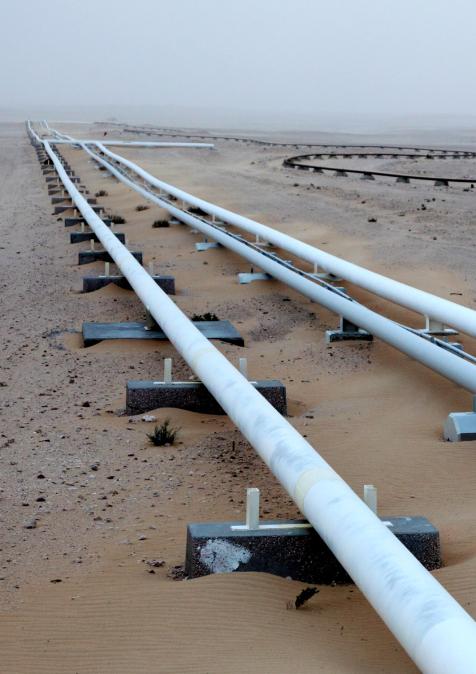
Some of the designs are etched into the desert sand like intricate spiderwebs. Others wind through African jungles like giant serpents, transforming pristine landscapes into conduits of profit, constructed from metal, plastic, and cement. Pipes, endless pipes, stretching for thousands of kilometers, even reaching beneath the sea. Europe’s thirst for oil and gas has intensified, especially since the outbreak of the Russia-Ukraine war—whether that conflict drags on for months or years, until exhaustion sets in, or peace prevails.
Meanwhile, the African continent is advancing economically, with half a dozen pipeline projects either in the planning stages or under construction. Unsurprisingly, China is involved in at least two of these ventures. For instance, the China National Offshore Oil Corporation (CNOOC) is part of the $10 billion East African Crude Oil Pipeline project. Similarly, the China Petroleum Pipeline Bureau is contributing to the $6 billion African Renaissance Pipeline Project, which will connect Mozambique’s gas-rich Rovuma Basin to a South African province 2,600 kilometers away. The joint venture, involving China and Empresa Nacional de Hidrocarbonetos, Mozambique’s national oil and gas company, is set to deliver a capacity of 18 billion cubic meters (bcm). Since 2002, Nigeria, Niger, and Algeria have discussed a project to link the West African nation with Algeria’s Hassi R’Mel via a 4,128 km pipeline. This pipeline is intended to export 30 bcm of gas annually, connecting to the “Transmed” pipeline through Tunisia and Sicily towards Europe—a timely project given Europe’s urgent need for oil and gas.
Alas, not a drop of gas has flowed through this envisaged pipeline, despite Lagos reportedly investing one, possibly two billion US dollars into the project. Local media suggest that the project may ultimately fall through. A recent military coup in Niger has certainly deterred investors, and Niger’s decision to withdraw from the Economic Community of West African States (ECOWAS) could signal a reluctance or inability to allow the 523 miles of planned pipeline to traverse its territory.
The most ambitious pipeline project on the African continent is slated to begin construction by the end of this year: a 5,600-kilometer link between Nigeria—ranked 10th globally in oil reserves and 8th in gas reserves—and Morocco. Once completed, it will be the longest pipeline ever built on the continent, traversing and integrating eleven West African nations: Benin, Togo, Ghana, Côte d'Ivoire, Liberia, Sierra Leone, Guinea, Guinea-Bissau, The Gambia, and Senegal. This $25 billion mega-project has been championed by King Mohammed VI of Morocco, not merely as a bilateral endeavor but as a strategic initiative for the entire African region.
This is no mere vision—the project is already taking shape. Topographic surveys in the northern section, including Morocco, Mauritania, and Senegal, are in advanced stages, and a Dutch company has commenced seabed inspections in West Africa to identify suitable locations for enormous underwater pipelines.
- Do you view the $25 billion investment in constructing the 5,600-kilometer pipeline linking Nigeria with Morocco more as a geopolitical initiative—connecting the kingdom with a major oil and gas supplier along with eleven additional West African nations—or is the project primarily an economic challenge?
A major energy project, such as a gas pipeline, must be profitable; otherwise, it would not attract financing and move forward. However, when an energy project involves several states, it inherently carries a geopolitical dimension. Energy issues are always strategic. So, it is not a question of economy or geopolitics, but rather economy and geopolitics. The real challenge lies in reconciling these two key dimensions, which is easier said than done.
As far as the Nigeria-Morocco gas pipeline project is concerned, it encompasses several key dimensions. It is, of course, an energy project, and a strategic one at that, but it also serves as a means to foster economic cooperation among West African states, reduce gas flaring in Nigeria, boost electricity production through natural gas-fueled power stations, increase fertilizer production, support agricultural production in Africa, and enhance gas exports to Europe.
- As we’ve seen with other African pipeline projects, there are risks, particularly regarding security. How do you plan to protect such an enormously long project?
This will be an extremely long gas pipeline, primarily offshore, spanning a dozen countries. Security is, of course, a critical concern, as it is with any strategic project. And the complexity increases when so many states are involved, compared to a project involving just two or three countries. Nevertheless, it is not Mission Impossible. Success will require extensive cooperation among several governments and private companies, as well as close coordination between state security forces, intelligence services and private security firms. A balanced approach combining human surveillance with electronic monitoring will be essential.
- How can the African stakeholders of the project respond if, by the time the pipeline is completed, the Russia-Ukraine war has ended, competitors have completed their pipelines, and international gas markets are oversupplied?
For such a pipeline to be built, it would require securing gas contracts prior to making the final investment decision (FID). This highlights a very significant difference between oil and gas projects. In the oil industry, a significant discovery is developed with the confidence that there will always be a market for oil production. In contrast, natural gas projects need to secure markets before development begins. Financing a $25 billion gas pipeline project relies on having a significant portion of the transported volumes committed through medium-term and long-term contracts.
- This question also concerns global oil markets—how can investors in pipeline projects be certain that petroleum won’t be replaced by alternatives to fossil fuels, such as electricity for vehicles, hydrogen, biodiesel, ethanol, or propane? With the climate crisis pushing for reduced fossil fuel use, are these pipeline projects at risk from declining oil, petrol, and gas consumption in the coming decades?
In the medium to long term, the outlook remains positive. While world oil consumption will not continue to rise indefinitely, it is still increasing. Oil demand reached a record level in 2023, and this record is expected to be surpassed in 2024 and 2025. A peak in demand is likely between the end of this decade and 2040, but this does not imply a sudden collapse in consumption. Moreover, oil demand is increasing in developing and emerging regions such as Asia, Latin America, the Middle East and Africa. There is still some room for new oil pipelines or for the extension of existing pipelines in various countries and regions.
Let us take an example in Africa. Uganda is a future oil producer. Oil production should begin in 2025, with most of the output destined for export. As Uganda is landlocked, a pipeline is being constructed through Uganda and Tanzania to a terminal on the Indian ocean. The consortium overseeing this project, which includes both oil production and pipeline transport, comprises TotalEnergies, CNOOC, and the national companies UNOC of Uganda and TPDC of Tanzania. The estimated investment cost for this Uganda-Tanzania project is $10 billion.
- In your opinion, is Beijing, which is involved in at least two African pipeline projects, active in Africa purely for economic reasons, or is China also aiming to secure its own energy needs?
Chinese national oil companies (NOCs) are involved in oil projects in Niger (including oil production and a pipeline from Niger to the Atlantic through Benin), in Uganda (covering both oil production and the pipeline) and in three liquefied natural gas (LNG) projects in Mozambique, one of which is already operational. These NOCs would not be involved in these projects unless they were deemed profitable or expected to become profitable in the future. China is also interested in securing its energy needs. The internationalization strategies of these NOCs are a key aspect of the global world oil industry.
- Are you surprised that African governments are willing to cede control of oil, gas, diamonds, gold, and rare earth resources to Russia and China? In some cases, does this shift in control resemble a form of reverse colonialism?
No. This trend has been observable for some time. African governments are leveraging competition among oil, gas and mining companies to their advantage. That being said, it is important to note that Western oil companies remain the dominant players in Africa’s oil and gas projects. Russian companies are largely absent from the scene, while Chinese firms are expanding their activities in upstream (exploration, development and production of oil and gas) and midstream (transport) segments of the hydrocarbons industry. However, the most important players in Africa’s oil and gas sector today are still Western companies like ExxonMobil, Shell, TotalEnergies, Chevron, and Eni, rather than Chinese firms like CNOOC, Sinopec or CNPC.
- Is the Nigeria-Morocco pipeline project an act of courage or a calculated risk? Never before on the continent, perhaps with the exception of the laying of railroad tracks, have so many nations been involved in a single project. Some faced threats from radical, militant movements that could potentially exploit the pipeline for blackmail or theft, such as in northern Nigeria, for example.
This project is, above all, an act of vision—both economic and geopolitical. However, it carries a significant degree of risk, encompassing economic, commercial, financial and geopolitical challenges. Whether these risks can be successfully managed remains to be seen. The main challenge is to find buyers for the gas. The pipeline is designed to have a capacity of 30 bcm per year, with up to 18 bcm/year potentially earmarked for Europe. A key question is whether European countries and companies will commit to long-term gas supplies from Sub-Saharan Africa via a pipeline. The jury is still out on this issue.