Publications /
Book / Report

Back
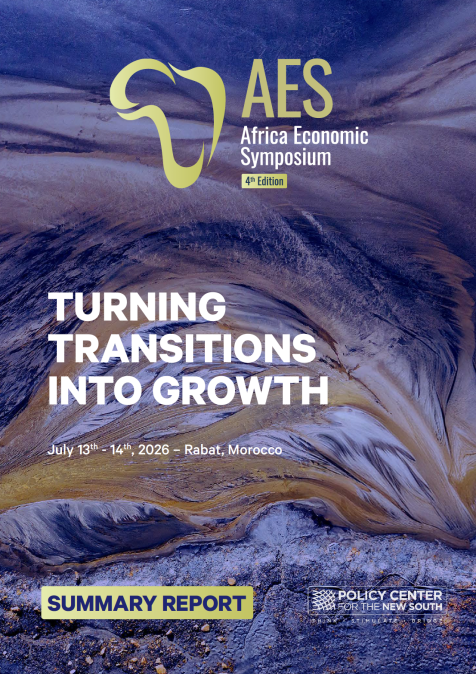
Africa Economic Symposium (AES) 4th edition - SUMMARY REPORT
Authors
Policy Center for the New South
September 23, 2026

The Africa Economic Symposium (AES) has firmly established itself as one of the flagship annual events of the Policy Center for the New South, alongside the Atlantic Dialogues and the African Peace and Security Annual Conference (APSACO). Now in its third edition, AES continues to provide a unique platform for economists, policymakers, and academics from across the continent and beyond to exchange perspectives on the pressing macroeconomic and structural challenges facing Africa. Its mission remains to foster rigorous, evidence-based debates that inform policymaking and support long-term strategies for Africa’s development in an era of uncertainty. 

The 2025 edition, convened under the theme “Bold Moves amid Global Shifts,” explored the difficult policy trade-offs confronting African governments as they navigate a volatile global environment. The continent’s recovery from COVID-19 has been uneven, while debt pressures, supply chain disruptions, and geopolitical tensions weigh heavily on fiscal and economic resilience. Structural challenges such as persistent unemployment, low productivity, and the exclusion of Africa’s youth continue to hinder inclusive growth, even as policymakers are called upon to adapt to deep systemic uncertainty. 

The symposium underscored that many African states are increasingly resorting to short-term stabilization measures—such as accumulating reserves and postponing reforms—that may provide immediate security but risk delaying the structural transformation urgently needed. Against this backdrop, AES 2025 called for a careful balance between fiscal prudence, social investment, and the pursuit of sustainable growth, placing emphasis on reforming governance, improving macroeconomic management, and accelerating structural change. 

The discussions highlighted the urgent need to rethink Africa’s economic strategies in a shifting global order. From debt sustainability and the role of central banks to the promise of financial innovation, digital inclusion, and new instruments such as central bank digital currencies, the symposium emphasized that policy choices must align with long-term transformation goals. The debates also explored the opportunities and challenges of regional integration, trade connectivity, and development finance, all of which are essential levers for Africa’s resilience and prosperity. 

As in previous editions, the Annual Report on African Economies was launched alongside the symposium, offering an in-depth analysis of the continent’s macroeconomic dynamics and structural transformation pathways. More than just a publication, the report reflects the collective intellectual effort of leading scholars and practitioners, providing evidence-based insights to guide decision- makers. Together, the symposium and the report reinforced the Policy Center for the New South’s commitment to fostering forward-looking economic thinking that moves beyond short-term headlines to tackle Africa’s enduring challenges.
RELATED CONTENT

  • From

    17
    9:00 am November 2026
    In person registrationOnline registrationIndustrialization in North Africa is entering a new phase shaped by global megatrends, the green and digital transitions, evolving value chains, and the growing need for resilient and competitive production systems.Against this backdrop, the Policy Center for the New South and the United Nations Industrial Development Organization (UNIDO) are convening The Future of Industrialization: Building Future-Ready Industries in North Africa on November 17, 2026, at the Policy Center for the New South in Rabat.The event will present key insights from the Industrial Development Report 2026 (IDR26) and bring together policymakers, industry leaders and experts to discuss the region’s industrial opportunities, constraints and policy priorities. The ...
  • Authors
    November 16, 2026
    How can international arbitration preserve its core principles of neutrality, party autonomy and enforceability while adapting to a world increasingly characterized by geopolitical fragmentation, technological disruption and competing regulatory interests? Meeting this challenge demands a collective effort, bringing together arbitral institutions, national courts, governments, international organizations, academics and practitioners. It requires openness to institutional innovation, ...
  • From

    11
    10:00 am November 2026
    Depuis 2021, le Policy Center for the New South, le Programme des Nations Unies pour le développement et le Groupe de la Banque mondiale portent conjointement l’initiative « Parlons Développement », une plateforme de réflexion collective sur les enjeux du développement durable au Maroc. Organisée avec différents partenaires, notamment du monde académique et de la société civile, cette plateforme destinée à la jeunesse vise à rapprocher les débats stratégiques de ses préoccupations et à favoriser le dialogue autour de réponses concrètes aux défis du développement.Dans cette continuité, la 25ᵉ édition de « Parlons Développement », organisée en partenariat avec la Faculté des Sciences Juridiques, Économiques et Sociales de l’Université Mohammed Premier d’Oujda, sera consacrée au ...
  • Authors
    November 11, 2026
    Suriname is at a crossroads. In 2020, the country discovered extensive oil and gas reserves, presenting the new Geerlings-Simons Government with a golden opportunity to use this windfall to chart a new path of high productivity and inclusive growth, fundamentally different from the low and volatile growth of previous decades. The key question is: will it successfully do so? Success will require the current government to overcome the main constraints of the business-as-usua ...
  • November 10, 2026
    يناقش هذا الحوار أبرز التوجهات الاقتصادية والاجتماعية لمشروع قانون المالية لسنة 2027 في المغرب، في ظل الحاجة إلى التوفيق بين دعم النمو والاستثمار وخلق فرص الشغل، وتعزيز الحماية الاجتماعية، والحفاظ على التوازنات المالية. كما يتناول شروط فعالية المجهود الاستثماري، وسبل تمويل الأولويات الا...
  • Authors
    Patrick Kabanda
    November 10, 2026
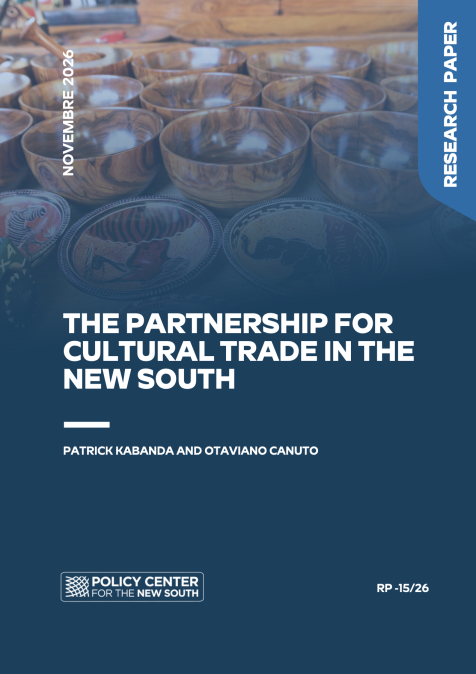
    Cultural trade is a dynamic engine for economic diversification in the New South. Despite decades of diversification rhetoric, however, this sector remains underrealized. Thus, many countries across Africa, Latin America and the Caribbean, Asia, and the Middle East are still commodity-dependent, even though the global creative economy has grown roughly eightfold since 2002, to surpass $2 trillion—that figure, moreover, does not even account for the nonmonetary benefits that merit co ...
  • November 9, 2026
    Cette interview examine les perspectives d’une éventuelle adhésion du Maroc à l’OCDE à l’horizon 2040, en revenant sur les conditions économiques, institutionnelles et réglementaires qu’un tel processus pourrait impliquer. Elle met en perspective les réformes engagées par le Royaume, le...
  • Authors
    Aziz Ajbilou
    Ouidade Sabri
    November 4, 2026
    School dropout remains a major challenge for education systems and public policy, with lasting consequences for human capital, labor market integration, social cohesion, and long-term economic growth. Despite sustained efforts to expand access to schooling, many countries continue to experience high dropout rates, particularly at key transition points in lower- and uppersecondary education. Policy responses have often relied on fragmented, sector-specific interventions—addressing ed ...