Publications /
Book / Report

Back
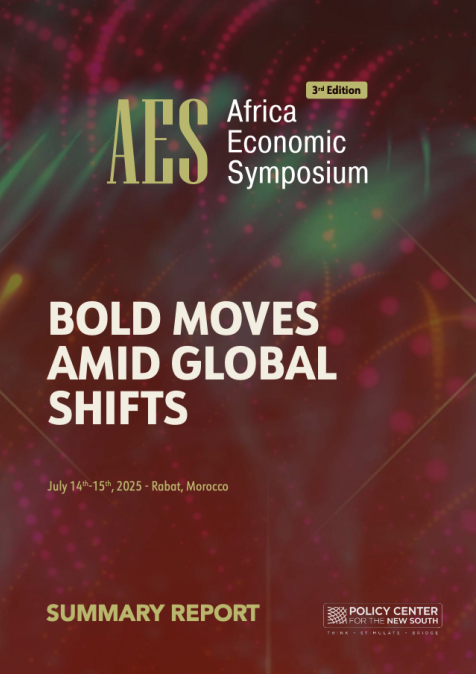
Africa Economic Symposium (AES) 3nd edition - SUMMARY REPORT
Authors
General rapporteur Mahmoud Arbouch
September 2, 2025

The Africa Economic Symposium (AES) has firmly established itself as one of the flagship annual events of the Policy Center for the New South, alongside the Atlantic Dialogues and the African Peace and Security Annual Conference (APSACO). Now in its third edition, AES continues to provide a unique platform for economists, policymakers, and academics from across the continent and beyond to exchange perspectives on the pressing macroeconomic and structural challenges facing Africa. Its mission remains to foster rigorous, evidence-based debates that inform policymaking and support long-term strategies for Africa’s development in an era of uncertainty. 

The 2025 edition, convened under the theme “Bold Moves amid Global Shifts,” explored the difficult policy trade-offs confronting African governments as they navigate a volatile global environment. The continent’s recovery from COVID-19 has been uneven, while debt pressures, supply chain disruptions, and geopolitical tensions weigh heavily on fiscal and economic resilience. Structural challenges such as persistent unemployment, low productivity, and the exclusion of Africa’s youth continue to hinder inclusive growth, even as policymakers are called upon to adapt to deep systemic uncertainty. 

The symposium underscored that many African states are increasingly resorting to short-term stabilization measures—such as accumulating reserves and postponing reforms—that may provide immediate security but risk delaying the structural transformation urgently needed. Against this backdrop, AES 2025 called for a careful balance between fiscal prudence, social investment, and the pursuit of sustainable growth, placing emphasis on reforming governance, improving macroeconomic management, and accelerating structural change. 

The discussions highlighted the urgent need to rethink Africa’s economic strategies in a shifting global order. From debt sustainability and the role of central banks to the promise of financial innovation, digital inclusion, and new instruments such as central bank digital currencies, the symposium emphasized that policy choices must align with long-term transformation goals. The debates also explored the opportunities and challenges of regional integration, trade connectivity, and development finance, all of which are essential levers for Africa’s resilience and prosperity. 

As in previous editions, the Annual Report on African Economies was launched alongside the symposium, offering an in-depth analysis of the continent’s macroeconomic dynamics and structural transformation pathways. More than just a publication, the report reflects the collective intellectual effort of leading scholars and practitioners, providing evidence-based insights to guide decision- makers. Together, the symposium and the report reinforced the Policy Center for the New South’s commitment to fostering forward-looking economic thinking that moves beyond short-term headlines to tackle Africa’s enduring challenges.


RELATED CONTENT

  • Authors
    Carlos R. Azzoni
    October 1, 2018
    This chapter analyzes the emergence of disparities in income and development levels between Brazil’s main regions, in particular the gap that exists between the comparatively rich South and Southeast and the poorer North and West regions. Economic activity and the population are concentrated in a small part of the territory. Even within this reduced area, the geographical distribution is highly uneven. Besides concentration, regional inequalities are marked in the country in terms o ...
  • September 24, 2018
    The Beijing Declaration “Toward and Even Stronger China-Africa Community with a Shared Future” - and the Forum on China-Africa Cooperation (FOCAC) Beijing Action Plan (2019-2021), resulting from the last FOCAC held on September the 3rd and 4th 2018, in Beijing, showed the China-Africa cooperation will increase deeper in the near future, clearly demonstrating a new era for both China and Africa. FOCAC currently comprises China and 53 African countries.  China, slowly but surely ...
  • Authors
    September 21, 2018
    This blog is based on remarks delivered at the Think-Tank Summit in Buenos Aires on 18 September 2018 held under the G-20’s Argentine Presidency.  Africa has an enormous infrastructure gap that impedes its development. The Compact with Africa (CwA) is an international policy initiative sponsored under the German presidency of the G-20 in 2017 designed to bridge that gap. Intended to draw in the private sector in developing Africa’s infrastructure through a combination of Priva ...
  • Authors
    Mouhamadou Moustapha Ly
    Tharcisse Guedegbe
    September 19, 2018
    La ville de Kigali, au Rwanda, a accueilli du 5 au 8 septembre 2018 le forum de l’AGRA, devenant ainsi la capitale de l’agriculture africaine pendant ces quatre journées. Délégations gouvernementales, partenaires techniques et financiers, chercheurs, universitaires, investisseurs, producteurs, club de réflexion, entre autres, étaient en conclave pour faire l’état des lieux du secteur et mesurer les progrès accomplis sur la route de la transformation de l’agriculture africaine.  ...
  • Authors
    September 18, 2018
    If I were to synthesize the current situation of the Brazilian economy in one sentence, I would say: “it is suffering from a combination of ‘productivity anemia’1 and ‘public sector obesity2’". On the one hand, the mediocre performance of productivity in Brazil in recent decades has limited its GDP growth potential. On the other, the gluttony for expanding public spending has become increasingly incompatible with such limits in the potential expansion of GDP, particularly since ...
  • Authors
    September 13, 2018
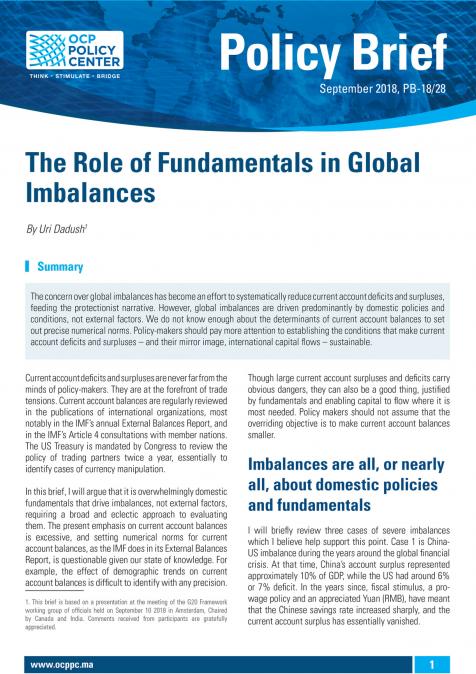
    The concern over global imbalances has become an effort to systematically reduce current account deficits and surpluses, feeding the protectionist narrative. However, global imbalances are driven predominantly by domestic policies and conditions, not external factors. We do not know enough about the determinants of current account balances to set out precise numerical norms. Policy-makers should pay more attention to establishing the conditions that make current account deficits and ...
  • Authors
    September 5, 2018
    As the world is shifting away from conventional fossil fuels towards renewable energy sources, the power industry is starting to invest more in sustainable clean energy installations rather than the traditional large-scale infrastructures, which rely mainly on oil and coal.  Besides its environmental benefits, this shift to renewables is very likely to benefit economic growth as well. A recent study of the International Renewable Energy Agency shows that, indeed, dou ...
  • Authors
    Nauro Campos
    Davide Furceri
    September 1, 2018
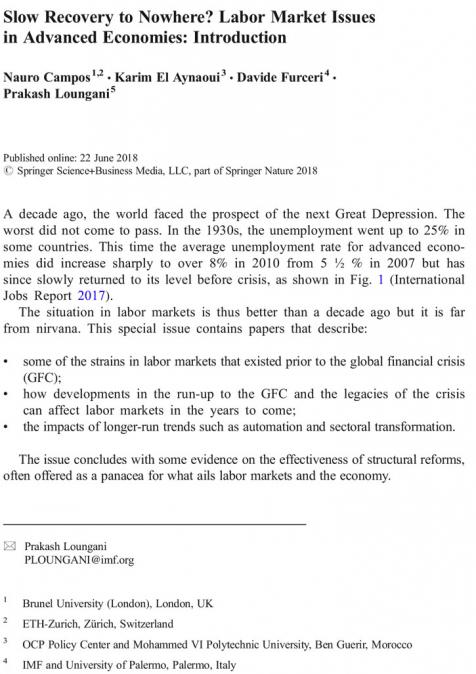
    A decade ago, the world faced the prospect of the next Great Depression. The worst did not come to pass. In the 1930s, the unemployment went up to 25% in some countries. This time the average unemployment rate for advanced economies did increase sharply to over 8% in 2010 from 5 ½ % in 2007 but has since slowly returned to its level before crisis, as shown in Fig. 1 (International Jobs Report 2017). ...
  • Authors
    Anabel Gonzalez
    August 30, 2018
    The agreement establishing the African Continental Free Trade Area (AfCFTA) is a framework to create a free trade area across the region, bringing together the 55 members of the African Union into a continental market with a cumulative Gross Domestic Product (GDP) exceeding US$2.2 trillion and a total population of over one billion people. When concluded and successfully implemented, it will become the largest free trade area in the world in terms of membership, opening up significa ...