Publications /
Book / Report

Back
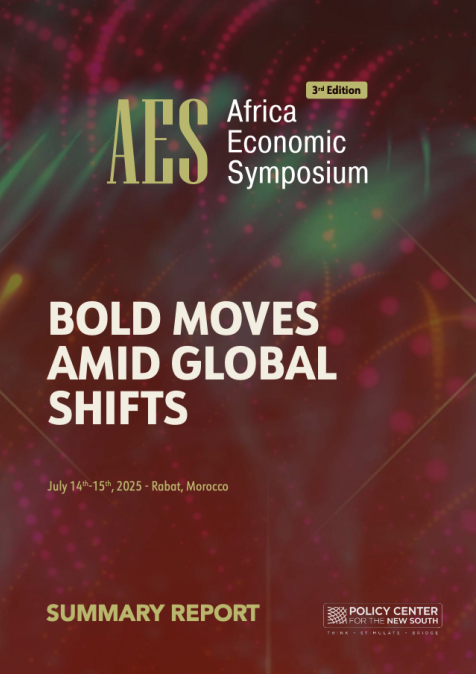
Africa Economic Symposium (AES) 3nd edition - SUMMARY REPORT
Authors
General rapporteur Mahmoud Arbouch
September 2, 2025

The Africa Economic Symposium (AES) has firmly established itself as one of the flagship annual events of the Policy Center for the New South, alongside the Atlantic Dialogues and the African Peace and Security Annual Conference (APSACO). Now in its third edition, AES continues to provide a unique platform for economists, policymakers, and academics from across the continent and beyond to exchange perspectives on the pressing macroeconomic and structural challenges facing Africa. Its mission remains to foster rigorous, evidence-based debates that inform policymaking and support long-term strategies for Africa’s development in an era of uncertainty. 

The 2025 edition, convened under the theme “Bold Moves amid Global Shifts,” explored the difficult policy trade-offs confronting African governments as they navigate a volatile global environment. The continent’s recovery from COVID-19 has been uneven, while debt pressures, supply chain disruptions, and geopolitical tensions weigh heavily on fiscal and economic resilience. Structural challenges such as persistent unemployment, low productivity, and the exclusion of Africa’s youth continue to hinder inclusive growth, even as policymakers are called upon to adapt to deep systemic uncertainty. 

The symposium underscored that many African states are increasingly resorting to short-term stabilization measures—such as accumulating reserves and postponing reforms—that may provide immediate security but risk delaying the structural transformation urgently needed. Against this backdrop, AES 2025 called for a careful balance between fiscal prudence, social investment, and the pursuit of sustainable growth, placing emphasis on reforming governance, improving macroeconomic management, and accelerating structural change. 

The discussions highlighted the urgent need to rethink Africa’s economic strategies in a shifting global order. From debt sustainability and the role of central banks to the promise of financial innovation, digital inclusion, and new instruments such as central bank digital currencies, the symposium emphasized that policy choices must align with long-term transformation goals. The debates also explored the opportunities and challenges of regional integration, trade connectivity, and development finance, all of which are essential levers for Africa’s resilience and prosperity. 

As in previous editions, the Annual Report on African Economies was launched alongside the symposium, offering an in-depth analysis of the continent’s macroeconomic dynamics and structural transformation pathways. More than just a publication, the report reflects the collective intellectual effort of leading scholars and practitioners, providing evidence-based insights to guide decision- makers. Together, the symposium and the report reinforced the Policy Center for the New South’s commitment to fostering forward-looking economic thinking that moves beyond short-term headlines to tackle Africa’s enduring challenges.


RELATED CONTENT

  • Authors
    Sabine Cessou
    April 26, 2021
    At 31, this Moroccan “impact tech” entrepreneur already has an impressive track record. She is not only the founder of Douar Tech, an inclusive tech hub that helps empowering young people and women with digital skills in rural and peri-urban areas in Morocco, but also spent 2020 in Kigali, working as a Project Manager on startups and ICT ecosystems for Smart Africa. This pan-African initiative of Paul Kagame, President of Rwanda, has 30 member countries working on a common digital ...
  • April 20, 2021
    Otaviano Canuto, Policy Center for the New South After peaking in 2007 at around 6% of world GDP, global current-account imbalances declined to 3% of world GDP in the last few years. But they have never left entirely the spotlight, albeit acquiring a different configuration from that wh...
  • April 14, 2021
    When the global financial crisis hit the international economy in 2008, central banks in major advanced economies widened their range of monetary policy instruments, increasingly resorting to unconventional tools. Initially to avoid a deepening of the financial destabilization and bankr...
  • April 13, 2021
    Technologies and Big Data in Shaping African Public Services: Towards Efficient Digital Solutions for Africa Social Good Can technology and digitalization improve and enhance the value we get from public services? Data can change the experience that individuals get from a public service...
  • April 6, 2021
    Les revenus sur la rive Sud de la Méditerranée sont de l'ordre d'un cinquième à un tiers de ceux de la rive Nord, des ratios qui n'ont pas beaucoup évolué au cours de la dernière génération. Ce n'était pas censé se produire. Le Processus de Barcelone, mis en place en 1995 en tant que partenariat entre l'Union européenne et les pays de l'est et du sud de la Méditerranée pour promouvoir la croissance et la stabilité dans la région, l'intégration économique grâce au commerce, à l' ...
  • April 6, 2021
    يخصص مركز السياسات من أجل الجنوب الجديد حلقته الاسبوعية لحديث الثلاثاء لمناقشة الانتعاش الاقتصادي وحملة التطعيم في المغرب، رفقة العربي الجعيدي، باحث بارز بمركز السياسات من أجل الجنوب الجديد. على الرغم أنه من المتوقع أن يؤدي الاختلاف في وتيرة برامج اللقاحات في جميع أنحاء العالم إلى تفاوت...
  • April 5, 2021
    Private balance sheets have risen relative to GDP in advanced economies in the last decades, in tandem with a trend of decline in long-term real interest rates. Asset-driven macroeconomic cycles, along with a structural trend of rising influence of finance on income growth and distribut...
  • April 5, 2021
    All economies affected by the pandemic have something in common. The rate of vaccination of the population—quite different in different countries—has been the main factor determining the prospects for the resumption of economic activity, as it is a race against local waves of transmission of the virus. Personal contact-intensive services have borne the economic brunt of the pandemic. To the extent that vaccination enables them to restart, one may even be able to witness some tempor ...