Publications /
Book / Report

Back
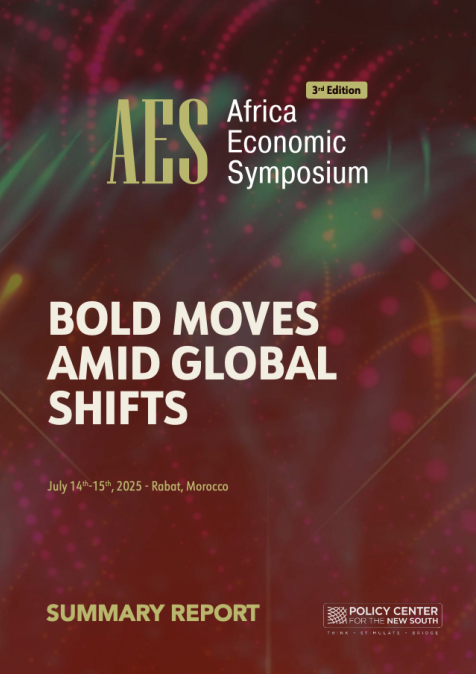
Africa Economic Symposium (AES) 3nd edition - SUMMARY REPORT
Authors
General rapporteur Mahmoud Arbouch
September 2, 2025

The Africa Economic Symposium (AES) has firmly established itself as one of the flagship annual events of the Policy Center for the New South, alongside the Atlantic Dialogues and the African Peace and Security Annual Conference (APSACO). Now in its third edition, AES continues to provide a unique platform for economists, policymakers, and academics from across the continent and beyond to exchange perspectives on the pressing macroeconomic and structural challenges facing Africa. Its mission remains to foster rigorous, evidence-based debates that inform policymaking and support long-term strategies for Africa’s development in an era of uncertainty. 

The 2025 edition, convened under the theme “Bold Moves amid Global Shifts,” explored the difficult policy trade-offs confronting African governments as they navigate a volatile global environment. The continent’s recovery from COVID-19 has been uneven, while debt pressures, supply chain disruptions, and geopolitical tensions weigh heavily on fiscal and economic resilience. Structural challenges such as persistent unemployment, low productivity, and the exclusion of Africa’s youth continue to hinder inclusive growth, even as policymakers are called upon to adapt to deep systemic uncertainty. 

The symposium underscored that many African states are increasingly resorting to short-term stabilization measures—such as accumulating reserves and postponing reforms—that may provide immediate security but risk delaying the structural transformation urgently needed. Against this backdrop, AES 2025 called for a careful balance between fiscal prudence, social investment, and the pursuit of sustainable growth, placing emphasis on reforming governance, improving macroeconomic management, and accelerating structural change. 

The discussions highlighted the urgent need to rethink Africa’s economic strategies in a shifting global order. From debt sustainability and the role of central banks to the promise of financial innovation, digital inclusion, and new instruments such as central bank digital currencies, the symposium emphasized that policy choices must align with long-term transformation goals. The debates also explored the opportunities and challenges of regional integration, trade connectivity, and development finance, all of which are essential levers for Africa’s resilience and prosperity. 

As in previous editions, the Annual Report on African Economies was launched alongside the symposium, offering an in-depth analysis of the continent’s macroeconomic dynamics and structural transformation pathways. More than just a publication, the report reflects the collective intellectual effort of leading scholars and practitioners, providing evidence-based insights to guide decision- makers. Together, the symposium and the report reinforced the Policy Center for the New South’s commitment to fostering forward-looking economic thinking that moves beyond short-term headlines to tackle Africa’s enduring challenges.
RELATED CONTENT

  • March 17, 2021
    Cette étude concerne la Communauté économique des Etats d'Afrique de l'Ouest (CEDEAO), rappelant, tout d'abord, leur diversité géographique, démographique et économique. Montrant ce que ces Etats ont en commun mais, aussi, ce qui les différencie. La CEDEAO, qui réunit quinze pays parmi les plus pauvres de la planète, si on se réfère à leur PIB par habitant, en dollar courant ou en parité de pouvoir d'achat/PPA/. Ce qui explique une démographie explosive, sans que l'on puisse dire si ...
  • Authors
    Fernando S. Perobelli
    Inácio F. Araújo
    Tomaz P. Dentinho
    March 16, 2021
    Angola’s prospects for reconstruction and development of its poor connectivity infrastructure are heavily dependent upon the export performance of its oil sector. Using an interregional inputoutput table for Angola, we estimate comprehensive measures of trade in value added revealing different hierarchies of interregional and international trade integration, with implications for regional inequality in the country. By encompassing the subnational perspective in the case study of an ...
  • March 15, 2021
    China’s growth trajectory in the second decade of the century has been one of a rebalancing toward a new growth pattern, one in which domestic consumption is to rise relative to investments and exports, while a drive toward consolidating local insertion up the ladder of value added in g...
  • Authors
    Bouchra Rahmouni
    March 12, 2021
    La crise sanitaire de la Covid-19 a mis en exergue les limites de la société-monde. En effet, sans la femme on ne peut faire face aux défis du millénaire et l’on ne peut surpasser les impacts de la pandémie et les bouleversements révolutionnaires qu’elle génère et qu’elle continuera à générer. Dans le contexte de la Journée des droits de la femme, on ne peut s’empêcher de s’arrêter devant le rôle central que joue la femme marocaine en tant qu’acteur moteur du développement économiqu ...
  • March 9, 2021
    In the 1990s and 2000s, the world manufacturing production partially moved from advanced countries to some developing countries, especially in Asia. This was the result of the combination of an increase of the labor supply in the global market economy, trade opening, and technological i...
  • March 5, 2021
    For the last 70 years, the social order in Europe has been based on the concept and practice of inter-generational solidarity. The welfare state granted every citizen, in addition to education and universal health services (and dependency care when needed in the most advanced welfare states), an old-age pension, which ensures that older generations do not suffer a huge income loss when retiring from work and are protected against insecurity. Population aging means that now, accordin ...
  • Authors
    Sabine Cessou
    March 4, 2021
    L’Afrique a perdu 70 % de ses arrivées touristiques en 2020, selon le dernier baromètre de l’Organisation mondiale du tourisme (OMT), soit un peu moins que la moyenne mondiale (74 %). Au début de la crise, l’Union africaine (UA) s’inquiétait surtout pour les petits pays insulaires fortement dépendants du tourisme. Les Seychelles ont perdu 71 % de leurs visiteurs en 2020, avec 114 850 arrivées contre 384 000 en 2019, et 61 % de leurs revenus touristiques. Lourde ...
  • Authors
    March 3, 2021
    Brazil, an oil-exporting nation, was still struggling to recover from the depression which started around 2014/15 when it was hit by a quick succession of shocks: the COVID-19 pandemic and the oil price collapse. The global pandemic triggered major economic dislocations and contractions in foreign and domestic markets, which further exacerbated the fall in demand for oil, sending world prices tumbling further. Poverty was already widespread in Brazil pre-pandemic. And despite recen ...
  • March 2, 2021
    خصص مركز السياسات من أجل الجنوب الجديد حلقته الاسبوعية لحديث الثلاثاء لمناقشة انعكاسات القطاع غير المهيكل على الاقتصاد المغربي رفقة نجيب صومعي، خبير اقتصادي وعضو ب The Economist Intelligence Unit البريطانية. بينما تم تطوير استراتيجيات متعددة لتحسين البيئة المؤسسية والاقتصادية والمالية ف...