Publications /
Policy Brief

Back
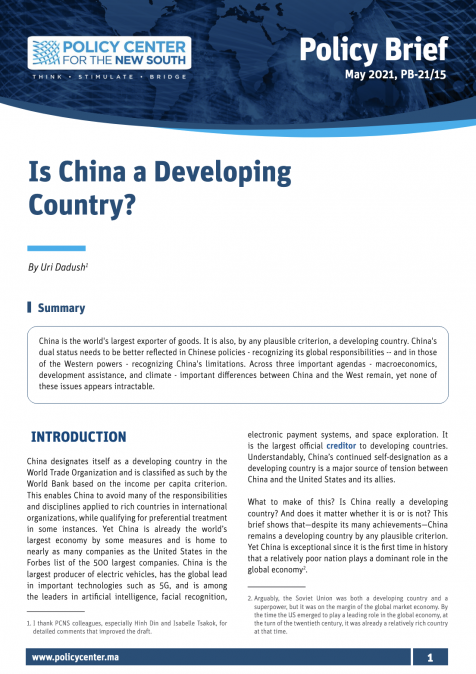
Is China a Developing Country?
Authors
May 31, 2021

China is the world's largest exporter of goods. It is also, by any plausible criterion, a developing country. China's dual status needs to be better reflected in Chinese policies - recognizing its global responsibilities -- and in those of the Western powers - recognizing China's limitations. Across three important agendas - macroeconomics, development assistance, and climate - important differences between China and the West remain, yet none of these issues appears intractable.

RELATED CONTENT

  • Authors
    Ahmed Ouhnini
    December 5, 2025
    L’« uberisation », terme né du nom de l’entreprise américaine Uber au début des années 2010, désigne initialement un modèle économique fondé sur la mise en relation directe entre offre et demande via des plateformes numériques. Rapidement popularisé, le concept s’est élargi, avec Airbnb dans l’hébergement, puis à une multitude d’autres secteurs : livraison de repas, services à domicile, commerce en ligne, voire des métiers traditionnellement régulés ou corporatistes. Ce néologisme t ...
  • Authors
    December 3, 2025
     Global GDP growth has proven resilient in 2025, despite the shocks caused by the trade policies implemented by United States President Donald Trump in the first year after his return to office. The gloomy projections offered by multilateral and private institutions in the first quarter of 2025 have given way to revised levels mostly in the 2.5% to 3% range for the year. ...
  • November 25, 2025
    This Policy Paper analyses the Fourth Industrial Revolution (4IR) through the critical lens of technological colonialism. It argues that the fusion of physical, digital, and biological technologies is not merely a technical phenomenon but a civilizational shift reshaping the foundations of global power. The article traces a historical continuum from previous industrial revolutions, demonstrating how patterns of inequality and extraction persist, now transposed into the digital realm ...
  • Authors
    January 12, 2024
    A 2023 United Nations progress report (UN, 2023) showed that, of the 169 targets that make up the Sustainable Development Goals (SDGs), only 15% are on track, and progress on many has either stalled or regressed. The Water-Energy-Food nexus approach has highlighted the utmost importance of understanding the interconnections between systems in order to accelerate the achievement of the SDGs. In this policy brief, we use the lessons learned from the water sector through a case study f ...
  • December 5, 2023
    في حلقة هذا الأسبوع سنحاول مناقشة موضوع القطاع غير المُهيكَل في المغرب، أبرز التحديات وأفاق المستقبل. حيث أن ظاهرة العمالة غير الرسمية أصبحت تأخذ حيزا كبيرا في مختلف النقاشات العالمية الدائرة حول مسألة التنمية، والمغرب يعد من بين الدول التي تبقى فيها الظاهرة عند مستويات مرتفعة كون منظو...
  • October 7, 2022
    “The debate on the viability of industrial policy design based on the fragmentation of global value chains, from a cost optimization perspective, did not arise first in the wake of the Covid-19 crisis but was present long before. This industrial policy design was justified by the great development of logistics and transport across the world’s industrial clusters, which allowed just-in-time manufacturing to become the main adopted production model. However, the disruption of logistic ...
  • Authors
    Sous la direction de Larabi Jaïdi
    September 29, 2022
    La succession des chocs pandémique, climatique et géopolitique a éprouvé les économies africaines. Les liens commerciaux et financiers avec le monde ne sont plus seulement considérés comme des moteurs de performance, mais aussi comme des sources potentielles de vulnérabilité. La défiance à l’égard de la mondialisation s’est accrue. Parce qu’elle est venue souligner la dépendance du continent, le dérèglement de ses rapports à la nature et sa vulnérabilité face aux tensions géopolitiq ...
  • June 10, 2022
    The latest IMF projections indicate that global growth will be 4.4% in 2022 after 5.9% in 2021. These projections make us very optimistic for the future, but they certainly cannot heal th ...
  • Authors
    February 3, 2022
    COVID-19 has ravaged nearly every country in the world, with the globalization of recent decades intensifying its spread. As of mid-2021, the world had spent $16.5 trillion—18% of global GDP—to fight the disease. And that amount does not even include the most important losses such as deaths, mental health effects, restrictions on human freedom, and other nonmonetary suffering. Nearly 90% of this spending was by developed economies, with the rest by emerging market and developing eco ...
  • Authors
    December 6, 2021
    Between January 2020 and June 2021, the world spent about US $16.5 trillion (18% of world GDP) to fight COVID-19, and this amount does not even include the most important losses such as deaths, mental health effects, restrictions on human freedom, and other nonmonetary suffering. Nearly 90% of this amount was spent by developed economies; the rest by emerging market and developing economies. Low-income countries spent just US $12.5 billion, or less than 0.0001% of the total. Moreove ...