Publications /
Book / Report

Back
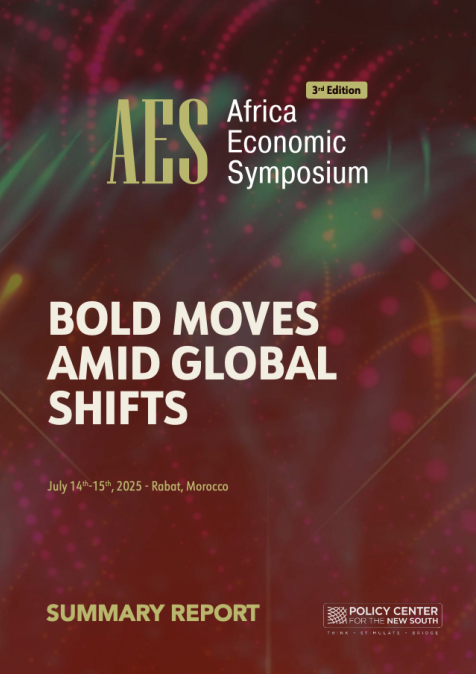
Africa Economic Symposium (AES) 3nd edition - SUMMARY REPORT
Authors
General rapporteur Mahmoud Arbouch
September 2, 2025

The Africa Economic Symposium (AES) has firmly established itself as one of the flagship annual events of the Policy Center for the New South, alongside the Atlantic Dialogues and the African Peace and Security Annual Conference (APSACO). Now in its third edition, AES continues to provide a unique platform for economists, policymakers, and academics from across the continent and beyond to exchange perspectives on the pressing macroeconomic and structural challenges facing Africa. Its mission remains to foster rigorous, evidence-based debates that inform policymaking and support long-term strategies for Africa’s development in an era of uncertainty. 

The 2025 edition, convened under the theme “Bold Moves amid Global Shifts,” explored the difficult policy trade-offs confronting African governments as they navigate a volatile global environment. The continent’s recovery from COVID-19 has been uneven, while debt pressures, supply chain disruptions, and geopolitical tensions weigh heavily on fiscal and economic resilience. Structural challenges such as persistent unemployment, low productivity, and the exclusion of Africa’s youth continue to hinder inclusive growth, even as policymakers are called upon to adapt to deep systemic uncertainty. 

The symposium underscored that many African states are increasingly resorting to short-term stabilization measures—such as accumulating reserves and postponing reforms—that may provide immediate security but risk delaying the structural transformation urgently needed. Against this backdrop, AES 2025 called for a careful balance between fiscal prudence, social investment, and the pursuit of sustainable growth, placing emphasis on reforming governance, improving macroeconomic management, and accelerating structural change. 

The discussions highlighted the urgent need to rethink Africa’s economic strategies in a shifting global order. From debt sustainability and the role of central banks to the promise of financial innovation, digital inclusion, and new instruments such as central bank digital currencies, the symposium emphasized that policy choices must align with long-term transformation goals. The debates also explored the opportunities and challenges of regional integration, trade connectivity, and development finance, all of which are essential levers for Africa’s resilience and prosperity. 

As in previous editions, the Annual Report on African Economies was launched alongside the symposium, offering an in-depth analysis of the continent’s macroeconomic dynamics and structural transformation pathways. More than just a publication, the report reflects the collective intellectual effort of leading scholars and practitioners, providing evidence-based insights to guide decision- makers. Together, the symposium and the report reinforced the Policy Center for the New South’s commitment to fostering forward-looking economic thinking that moves beyond short-term headlines to tackle Africa’s enduring challenges.


RELATED CONTENT

  • June 11, 2021
    Inequality is nowadays one of the most important issues facing many economies around the world, not only in developing countries but also in advanced and emerging ones. Today, there is a ...
  • June 11, 2021
    For science fiction writers, the universe has no limits. They imagine spacecraft conquering the unknown, the mining of asteroids, access to solar power and room for colonization by earthlings tempted by new frontiers billions of miles and dreams away. Or worlds to conquer barred by radioactive fields, devilish storms, metallic dust, unbearable darkness leading towards black holes and hell in space, and the sun, radiating up to 15 million degrees Celsius, which suggests nothing less ...
  • June 9, 2021
    The Policy Center for the New South (PCNS), in partnership with the Royal United Services Institute (RUSI), will hold a workshop at the occasion of the launch of the “Free Trade Zone Risk Assessment Tool”, scheduled to take place on Wednesday, June 9th 2021 at 3pm GMT. It has been demon...
  • June 9, 2021
    The middle-income trap may well characterize the experience of Brazil and most of Latin America since the 1980s. Conversely, South Korea maintained its pace of evolution, reaching a high-income status. Such divergence of economic growth can be related to their distinctive performances o...
  • June 9, 2021
    The Policy Center for the New South (PCNS), in partnership with the Royal United Services Institute (RUSI), will hold a workshop at the occasion of the launch of the “Free Trade Zone Risk Assessment Tool”, scheduled to take place on Wednesday, June 9th 2021 at 3pm GMT. It has been demon...
  • Authors
    June 7, 2021
    First appeared at AMERICAS QUARTERLY A growing global imbalance threatens to further weaken already vulnerable emerging markets. The massive vaccine disparities between advanced and developing economies may exacerbate what the IMF has dubbed “divergent recoveries”—with dire consequences for Latin America. Despite being home to only 8% of the world’s population, the region has already suffered nearly 30% of all global COVID-19 deaths. The pandemic has ...
  • June 4, 2021
    The Native Indians in Guyana are among the country’s poorest populations. The RE NEW TT project wished to address one of the major problems the country’s Native Indian community is dealing with: the lack of access to energy. RE NEW TT installed a PV solar system at the sole indigenous p...
  • Authors
    Nadia Makara
    June 3, 2021
    In an effort to spur economic growth, industrial parks were created to combine industrial activities with infrastructure, service, and commercial activities. These parks involve a collection of businesses, utilizing a combination of heavy and light manufacturing, that are located in a dedicated zone for industrial use to boost efficiency, minimize operational costs, and maximize output. Though industrial parks can contribute to economic growth and social development in a region, the ...
  • June 2, 2021
    Otaviano Canuto, Policy Center for the New South The conceptual framework of natural wealth that we approached in the previous video may be illustrated with cases drawn from Sub-Saharan Africa. With at least 250 million inhabitants in resource-rich African countries, natural assets are ...
  • May 31, 2021
    La Diaspora marocaine, qui compte aujourd’hui près de 5 millions de ressortissants à l’étranger, contribue de manière significative au développement économique du Maroc.  Leurs transferts de fonds jouent un rôle crucial dans la réduction de la pauvreté, surtout en milieu rural.  Ils permettent également d’améliorer l’accès à l'éducation et à la santé. Les transferts des Marocains du monde qui, généralement, occupaient le deuxième poste de recettes dans la balance des paiem ...